February’s ‘rare planetary alignment’ is coming — here’s what to expect from the planet parade

When you purchase through links on our articles, Future and its syndication partners may earn a commission.

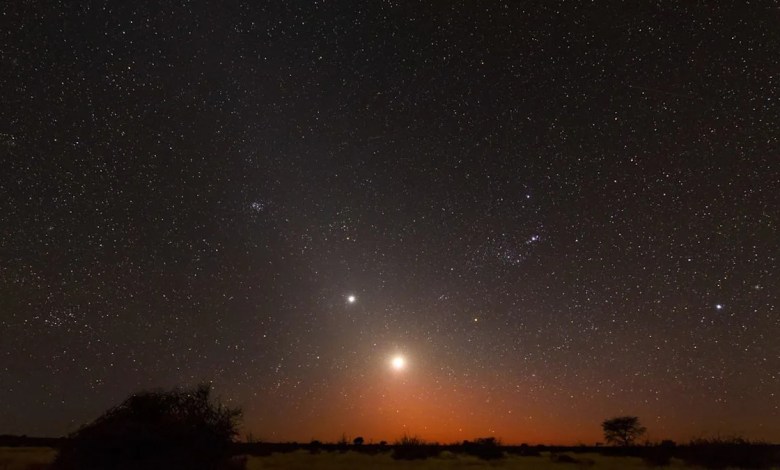
February’s “parade of the planets” won’t be easy to watch. In this photo taken in Namibia, the rising moon and Venus are visible, glowing in the zodiacal light. | Credit: Westend61 via Getty Images
Is the “planetary parade” the latest buzzword in sky observation? Supermoons, shooting stars “lighting up the night sky,” and “ring of fire” eclipses have been popular in recent years. Now bring forward the prospect of a planetary alignment, apparently more than enough to make the general public look up.
It was hard to escape the so-called “planetary parades” of early 2025, when Mars, Jupiter, Uranus, Neptune, Venus And Saturn were in the night sky simultaneously – although only four of them were visible.
Cue February 2026, which is expected to bring just as much hype about so-called rare planetary alignments. With March exchanged for Mercurythis time it’s even harder to see.
The “parade of the planets” of February 2026
Saturday, February 28 is the proposed date for seeing six planets in the evening sky. “On February 28, we will see not one, not two, but six planets in the evening sky,” writes Alyssa Lee on the space agency “Observe the sky” blog. ” Mercury, Venus, NeptuneSaturn, UranusAnd Jupiter will appear shortly after sunset.
Unfortunately, “see” does a lot of the heavy lifting here.
To stand a chance, you will need:
-
An unobstructed view due west
-
Approximately half an hour after sunset on Saturday, February 28
-
Binoculars, a telescope – and most likely a good dose of imagination.

February’s “parade of the planets” won’t be easy to watch. | Credit: Starry Night
Dissecting the “global parade”
The main problem with seeing all six planets is that four of them are already close to us. the sun and will only be visible for a short time – if at all – at dusk. Venus and Mercury will be closest to the horizon at dusk, followed by Saturn and Neptune, with Uranus and Jupiter much higher in the sky. In practice, seeing more than three planets will likely be a challenge.

Mercury, Venus, Neptune and Saturn during the February “parade of the planets”. | Credit: Starry Night
Venus and Mercury
The inner planets, which shine at magnitudes of -3.8 and 0.3 respectively, will likely require binoculars. Mercury will actually be easier to see earlier in the month; it is highest in the sky after sunset on February 19 and 20. However, at that time, Venus will be lower in the sky, therefore harder to see – which is why February 28 offers a sort of balance.
Saturn and Neptune
Moving slowly toward the glare of the sun (its solar conjunction occurs on March 25), Saturn is well past its peak and now shines at magnitude 1. It is visible to the naked eye; however, unlike nearby Neptune, which at magnitude 8 will require a small telescope to see.
Uranus
Halfway between the cluster of four planets to the southwest and Jupiter to the south, Uranus will hang just below the Pleiades (M45), cluster opened on February 28. Shining at magnitude 5.7, it should be possible to spot it with a pair of stargazing binoculars.
Jupiter
Today outdated, after having reached the opposition on January 10, the solar systemThe giant planet Venus now shines at magnitude -2.3, about four times less bright than the intrinsic brightness of Venus. However, Jupiter will be by far the easiest planet to observe.
Moon and M44
Although likely overlooked by most “planetary parade” observers, the 92% illuminated waxing gibbous moon will be high in the eastern sky, below Jupiter. Those with binoculars will be able to see the Beehive Cluster (M44), one of the brightest star clusters, just below.

Jupiter, the Moon and M44 during the February “parade of the planets”. | Credit: Starry Night
Watch the construction of the “planetary parade”
Instead of limiting yourself to one night, Saturday, February 28 – which is both limiting and, for slow planets, frankly rather meaningless – observe the planets throughout the month of February:
-
Sunday, February 8: Venus becomes visible for the first time after so long out of the evening sky – although finding it in the west just after sunset will be difficult.
-
Thursday, February 19: Observe a 7% illuminated waxing crescent Moon in the west-southwest near Saturn, just above Mercury at its greatest eastern elongation from the sun (about 10 degrees above the horizon 45 minutes after sunset from mid-northern latitudes). As a bonus, Saturn and the moon will be spaced approximately four degrees apart.
-
Friday, February 20: Mercury will be highest in the sky after sunset of its current appearance, with Saturn and a brightly lit waxing crescent moon 14% above.
-
Thursday, February 26: Jupiter and a 77% waxing gibbous moon will be about four degrees apart.
The “parade of the planets” that everyone missed

The rare superior triple conjunction of January 18 seen by the LASCO C3 coronagraph at the SOHO observatory. | Credit: ESA-NASA SOHO
In mid-January 2026, a rare superior triple conjunction of Venus, Mars and Mercury was observed, but no one saw it. Indeed, this happened not only on the opposite side of the solar system, but also very close to the sun, with only solar observatories being able to spot the three planets in the glow of our star.
Venus, Mars and Mercury were in superior solar conjunction (when a planet crosses the far side of the Sun to Earth) on January 6, 9 and 21 respectively. The images come from ESA-NASA coronagraphs Solar and heliospheric observatory (SOHO) and the GOES-19 weather satellite — the latter also presenting the new moon.
The planets in 2026
Although this “planetary parade” will fade quickly, the outlook for planetary observers in 2026 is excellent. Mars moves from the evening sky to the morning sky and will become visible again before sunrise in April. Even more impressive, Venus rises into the sky after sunset and will establish itself as a super bright planet by the end of March.Evening Star“, shining at magnitude -3.8 – the third brightest object after the sun and moon, and much brighter than Jupiter. Venus will be highest in the sky in August and brightest in late September, although the planetary high point of 2026 will undoubtedly occur on June 9, when Venus and Jupiter will be in close conjunction in the evening sky, with Mercury just below.


