Rare medieval seal discovered in UK is inscribed with ‘Richard’s secret’ and bears a Roman-period gemstone


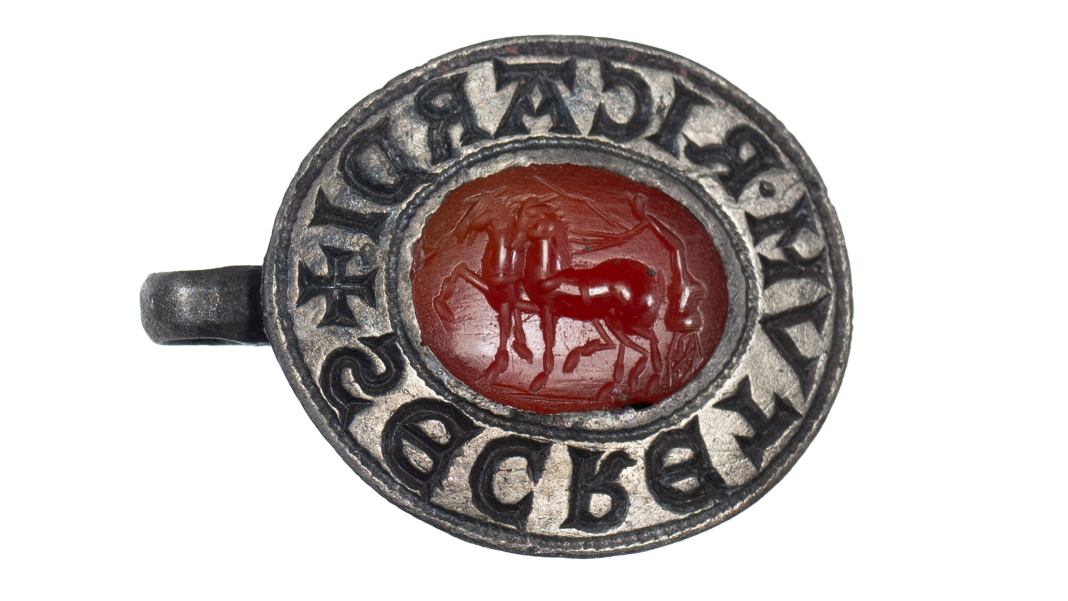
A medieval seal with a blood-red gemstone discovered in the UK hides an ancient secret, researchers have discovered.
A metal detector discovered the medieval seal in Gosfield, in the eastern county of Essex, in autumn 2024. But a recent analysis of the seal by experts from the UK’s Portable Antiquities Scheme revealed that the 800-year-old object had a 2,000-year-old Roman gemstone at its center.
The silver seal is only 27.5 millimeters long and the entire keepsake weighs 0.23 ounces (6.44 grams), according to the artifact’s entry in the Portable Antiques Program database. A loop attached to one end of the oval seal suggests that it was suspended, perhaps from a necklace, rather than a signet ring.
Around the bezel there is a mirrored inscription that says “SECRETUM.RICARDI”, meaning “Richard’s Secret” or the “Secret [seal] of Richard”, accompanied by a cross pattée, a shaped Christian symbol most commonly used in medieval times by Templars.
The center of the Gosfield seal features a piece of carnelian, a brownish-red semi-precious stone, engraved with the image of a two-horse chariot. A charioteer stands at the back of the cart, holding the reins and a whip, suggesting that he is participating in an ancient circus race. The carved gem dates from the late first century BC or early first century AD, making it at least 1,200 years older than the metal seal matrix.
The mirror image engraving and the intaglio drawing of the chariot would appear correctly when Richard pressed them into wax to make his seal.
Rogerson said Richard might have specifically chosen the Roman gemstone to show his knowledge of the classical world and his ability to procure something from a distant place and time.
“It certainly would have been an indicator of the social status of the owner,” Rogerson told the BBC, “and would have indicated that they were quite important – or considered themselves quite important.”
The Gosfield Seal has been submitted for examination as a treasure under the auspices of the United Kingdom. Treasury Act 1996since it is made of silver and over 300 years old. THE Braintree Museum in Essex hopes to acquire the item following a treasure investigation.
Gold and Gemstones Quiz: How much do you know about the sparkling treasures created by nature?