First Pig-to-Human Lung Transplant Marks Milestone in Xenotransplantation—But Surgeons Have Many More Questions


August 28, 2025
4 Min read
What does the first pulmonary pork pulmonary transplant with xenotransplantation mean?
Surgeons think that the first transplantation of a pork lung in a human is a step forward exciting for the field, but many questions remain open
Sebastian Kaulitzki / Science Science
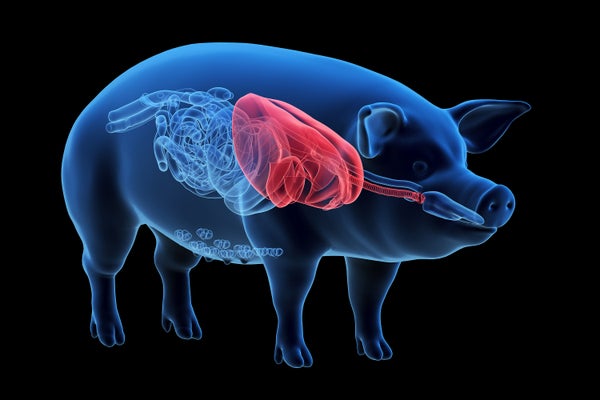
Scientists announced this week that they had managed to keep a genetically modified pork lung living in a human body – although briefly – for the first time. The lung has survived for nine days, marking what some researchers say they are an early step towards a major and long medical breakthrough. But others note that the coming road is still long.
The available human organs constantly fulfilling only a small fraction of the demand for transplantation, scientists have been trying for decades to transform pigs into vital donors. Many pig organs are close to the size and structure of those of man, and pigs are prolific breeders who are relatively easy to raise in an environment without pathogen. The researchers managed to transplant pork kidneys, livers and hearts into humans, but the lungs remained an intimidating challenge because of their complex physiology.
On the one hand, the lungs contain many blood vessels and white blood cells called macrophages, which surround and kill bacteria and viruses. These cells quickly produce immune responses, but they also tend to trigger rapid and potentially fatal inflammation when surgeons restore blood flow after having reduced it during transplantation surgery. Due to such complexity, “we knew that the lungs would be the last organ that would enter the clinic,” explains Muhammad Mohiuddin, surgeon and president of the International Xenotransplantation Association, which led the first cardiac transplant of the pig to human in 2022 but was not involved in the new experience. And although it is “a great success” for the field, “we must be carefully optimistic” because it is only an early foray to understand this extremely difficult procedure.
On the support of scientific journalism
If you appreciate this article, plan to support our award -winning journalism by subscription. By buying a subscription, you help to ensure the future of striking stories about discoveries and ideas that shape our world today.
A team of scientists from the Guangzhou University of Medicine in China transplanted the lung pouf into the body of a 39 -year -old beneficiary who had already been declared dead from the brain. The researchers used the editing technique of the CRISPR genes to modify three pork genes which are naturally targeted by human antibodies. They also added three human genes to help prevent rejection. From the resulting genetically modified pig, they transferred the left lung to the recipient, whose body was maintained on support for life, to observe the functioning of the organ and how the human immune system reacted. They also administered immunosuppressants to help prevent rejection.
The transplanted lung remained functional for nine days and was not immediately rejected by the human body. Scientists reported signs of pulmonary tissue lesions – produced by the lack of oxygen during transplantation – one day after surgery. And the immune system showed the first signs of rejection mediated by antibodies in days three and six. The experience ended on the new day at the request of the beneficiary’s family.
In the study, which was published in Nature Medicine this week, the authors declared that the process needs significant improvements, such as the optimization of genetic modifications of the pork and the immunosuppressive drugs used to avoid long -term rejection of the organ. None of the authors responded to the requests for interviewing Scientific American.
“I do not think that adding to the blind man more Knockouts and Transgenes is the solution,” explains the immunologist at Columbia University, Megan Sykes, referring to genetic changes to the donor pig. If scientists adopt this approach, she adds, each modification must be tested separately by transplanting the pork organs in a baboon-a primate which is often used as a prehuman test stop for transplants. Sykes was not involved in surgery and focused on pork-babon experiences to establish the tolerance of a transplanted lung recipient “I think tolerance, as well as better control of innate immunity, will be essential for success,” she said.
“It would have been pleasant to see if the lung could support life,” said surgeon Richard Pierson of the Harvard Medical School, who also transplanted pork lungs into non -human primates. To test this capacity, known as Pierson, surgeons can block the blood flow to the existing lung of a recipient, letting the transplanted lung operate alone.
The longest than a pork lung survived after being transplanted into a baboon is 31 days. Pierson, who has carried out this surgery, says the new one – as well as the pig kidney transplants which succeed clinically – “arouse enthusiasm” in the community of transplantation. “It reminds us that real progress is made,” he says.
The recent relaxations of regulatory executives in countries have expanded the opportunities of surgeons to experiment with human pork surgery, which makes it likely that more procedures will be tempted in the coming years, says Mohiuddin.
Pork kidney transplants in humans have shown successful results in recent years; These organs have worked relatively well. Two people are currently living with a pig kidney, one in China that has undergone the operation in March and another in the United States that has had the new body since January.
The last preliminary surgical intervention in a cerebral death receiver cannot reveal much about the long-term function of the lung, known as Mohiuddin. But he adds that it can help scientists test immunosuppressive drugs that do not work in the same way in Babound bodies.
According to Mohiuddin, some first difficult stages to advance the development of human pork transplant surgeries which could one day save thousands of lives, according to Mohiuddin. He said he believed in the possibility of making a pig’s heart transplant for decades before being able to perform surgery. “Progress will be slow,” he adds, “but each advance that occurs in this area is very critical.”
It’s time to defend science
If you enjoyed this article, I would like to ask for your support. American scientist has been a defender of science and industry for 180 years, and at the moment can be the most critical moment of this two -centuries story.
I was a American scientist The subscriber since the age of 12, and that helped shape my way of looking at the world. Sciam Educates me and always delights me, and inspires a feeling of fear for our vast and magnificent universe. I hope that does this for you too.
If you subscribe to American scientistYou help make sure that our cover is focused on significant research and discoveries; that we have the resources necessary to report the decisions that threaten laboratories in the United States; And that we support the budding scientists who work at a time when the value of science itself does not become often again.
In return, you get essential news, Captivating podcasts, brilliant infographics, Maybe not miss newsletters, videos to watch, Difficult games and the best writings and reports in the scientific world. You can even Give someone a subscription.
There has never been more time for us to get up and show why science counts. I hope you will support us in this mission.


