Five key takeaways from an annual briefing by China’s foreign minister : NPR

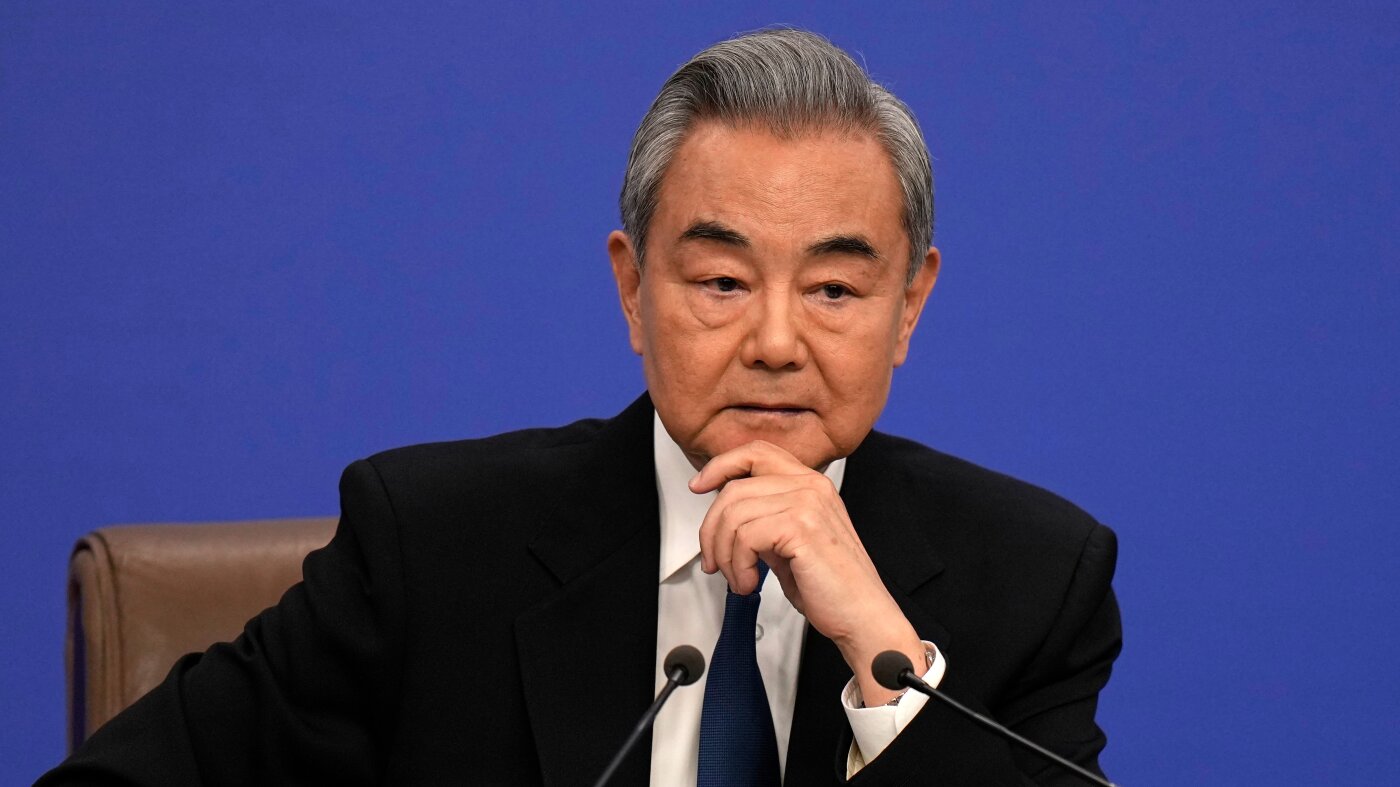

Chinese Foreign Minister Wang Yi listens during a press conference on the sidelines of the National People’s Congress (NPC) at the Beijing Media Center, Sunday, March 8, 2026.
Andy Wong/AP
hide caption
toggle caption
Andy Wong/AP
Chinese Foreign Minister Wang Yi said Sunday that the U.S.-Israeli war with Iran “should not have happened” and “does no good to anyone.”
But while Wang criticized the United States over the war in Iran, he also issued a positive signal that an expected meeting between President Donald Trump and Chinese leader Xi Jinping could take place at the end of the month.
Speaking to reporters on the sidelines of an annual policy meeting in Beijing, Wang did not confirm a meeting date but said China was open to dialogue with the United States.
He said the world could not afford for the two largest economies to engage in conflict.
Here is a summary of what Wang said on five key international issues.
1. Iranian War
China wants the fighting to stop and all parties involved in the Iran war to return to the negotiating table.
“Might does not make right, and the world cannot return to the law of the jungle,” Wang said. said.
He said the United States and Israel should respect the sovereignty, security and territorial integrity of Iran and other Middle Eastern countries.
China said it would send one sent to the region for mediation.
But the Chinese are not impartial.
China is strategically more aligned with Iran than with the United States and Israel. China buys large quantities of oil from Iran and elsewhere in the Middle East – which have been hit by Iran’s blockade of the Strait of Hormuz.
2. Relations with the United States – and Europe
China says it wanna “peaceful coexistence” and “win-win cooperation” with the United States.
“China and the United States are both great countries. Neither side can reshape the other, but we can choose how we want to engage,” he said.
Chinese diplomats often emphasize that there should be mutual respect because there is a deep feeling that the United States wants repress and contain the inevitable rise of China.
At the same time, Wang tried to allay fears in Europe that China’s rise would come at the expense of its key industries.
Wang said Europe had a misperception of China as a competitor and should instead view it as a “global partner.”
.
“We are happy to see our European friends come out of the ‘small attic’ of protectionism and enter the ‘fitness club’ of the Chinese market to strengthen their strength and competitiveness,” he said.
3. Prices
Wang implicitly criticized President Trump’s global tariffs, saying that pursuing trade protectionism is like “locking yourself in a dark room.”
“It can keep wind and rain out, but it also blocks light and air,” he said.
Unlike the United States, China has said it is opening its own markets to global players.
From May 1, China said it will completely lift tariffs on all imports from most African countries so it can “help Africa access the huge opportunities in the Chinese market,” according to Wang.

However, he did not address the weakness in domestic demand, which became apparent earlier this week when China together its lowest economic growth target since the 1990s, with a target of between 4.5% and 5% this year.
4. Japan and Taiwan
Relations between China and Japan are currently particularly tense, with Japanese Prime Minister Sanae Takaichi suggesting last year that Japan could become involved if China invaded Taiwan, which Beijing claims as its own territory.
Wang said it was in Tokyo to decide what the future holds for Sino-Japanese relations.
“Taiwan never was, is not and never will be a country,” Wang said. said. “Taiwan’s affairs are purely China’s internal affairs.”
He said Japan had no right to interfere in the Taiwan issue.
5. Gaza
Wang said China supports a two-state solution for Palestine.
“Any other arrangements or new mechanisms must strengthen – rather than undermine – the two-state solution,” Wang said. said.
He welcomed international efforts to bring about a ceasefire, but said much work remained to be done.
China was guest to join Trump’s Peace Council, but he did not participate.