
For generations, a misidentified medieval manuscript was hidden in a 474-year-old English boarding school’s library. After a careful new analysis, a medieval literature researcher can confirm the manuscript is actually the oldest and only known edition of Richard Rolle’s The Emending of Life (Emendatio vitae) written in its original Latin.
Who is Richard Rolle?
Most people today may not be familiar with Richard Rolle, but he was almost certainly the Late Medieval Era’s most widely read author. One of a handful of writers known as the Middle English Mystics, Rolle was born sometime around 1300 CE in Yorkshire, England, and spent the majority of his adult life as a hermit until his death in 1349, possibly due to the Black Death.
To give a sense of Rolle’s popularity: over 650 surviving manuscripts contain his writings today. Compare that to around 144 similar archival pieces from Chaucer. His last work in English, The Form of Living, was his most popular at the time, but The Emending of Life would eventually become far more influential. Written in Latin, it was his most circulated book and detailed 12 stages of spiritual life. Think of it as a self-help book for the medieval reader.
“Medieval people struggled with distractions as we do today. They were trying to still their wandering minds,” Timothy Glover, a historian at the University of Bergen in Norway said in a recent profile. “Rolle offered practical strategies to help, and some people treated him like a saint for it.”
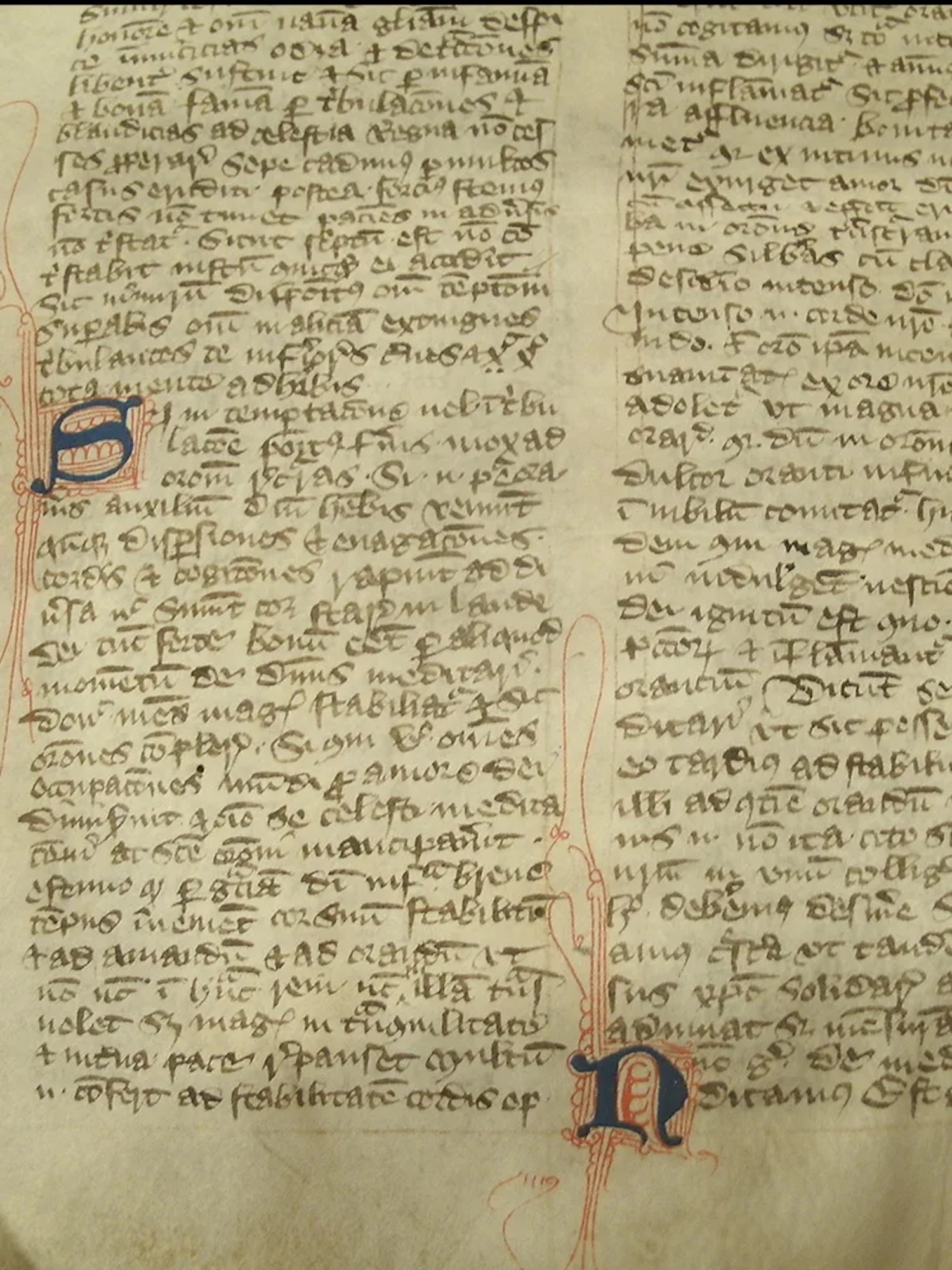
The misidentification of ‘MS 25’
Knowing there was likely more to learn about “Richard the hermit” (as he was known), Glover traveled to Shropshire, England, to visit the medieval archives at Shrewsbury School, a private educational institution founded in 1552.
“As a hermit, Rolle probably didn’t have a regular access to an institutional library and he rarely tells us what he’s been reading. To try to find out, I went looking for early copies of his work,” he explained.
After later reviewing his photographs of a manuscript catalogued as “MS 25,” Glover noticed a passage at the end explaining “six different kinds of dreams.”
“I’d seen something similar in one of Rolle’s English texts, The Form of Living, so I compared them and realised they were identical. That was my Eureka moment,” he said.
Scholars first formally described MS 25 during the 1920s, but the work had actually resided in Shrewsbury since its donation to the library in 1607. In 2009, a study of all known remaining copies of The Emending of Life concluded MS 25’s extra passages were added later by an unknown person. According to Glover, the forensic reanalysis detailed in his recent work published in the journal Mediaeval Studies proves otherwise.
Rolle definitely did not handwrite this edition of The Emending of Life himself. Instead, it was produced the same way as almost every other book of the era—by painstakingly copying the text onto new parchment. However, unlike every other remaining version, MS 25 features Rolle’s full, unaltered original draft. But how could experts like Glover be so sure?
Code word: melliphono
According to the historian, the “smoking gun” is a single word: melliphono. Or, more accurately, a single, completely made-up word. It’s also one that appeared in multiple of Rolle’s works and nowhere else at the time.
“Melliphono is a very Rolle word,” said Glover. “He’s all about this idea of spiritual song and experience of angelic heavenly music being the highest experience of God. He had an enormous Latin vocabulary and creatively deployed a huge range of very specific terms for music to explain his ultimate experience of God.”
While more people will likely soon race to examine the major historical discovery, for now the unique copy has only been reread by a single individual.
“I’m the only person since the Middle Ages to have read this knowing that it’s Rolle’s original,” said Glover. “It’s such an important manuscript and it offers a direct connection with an author who deserves far greater recognition.”

2025 PopSci Best of What’s New


