Fragment of lost tectonic plate discovered where San Andreas and Cascadia faults meet


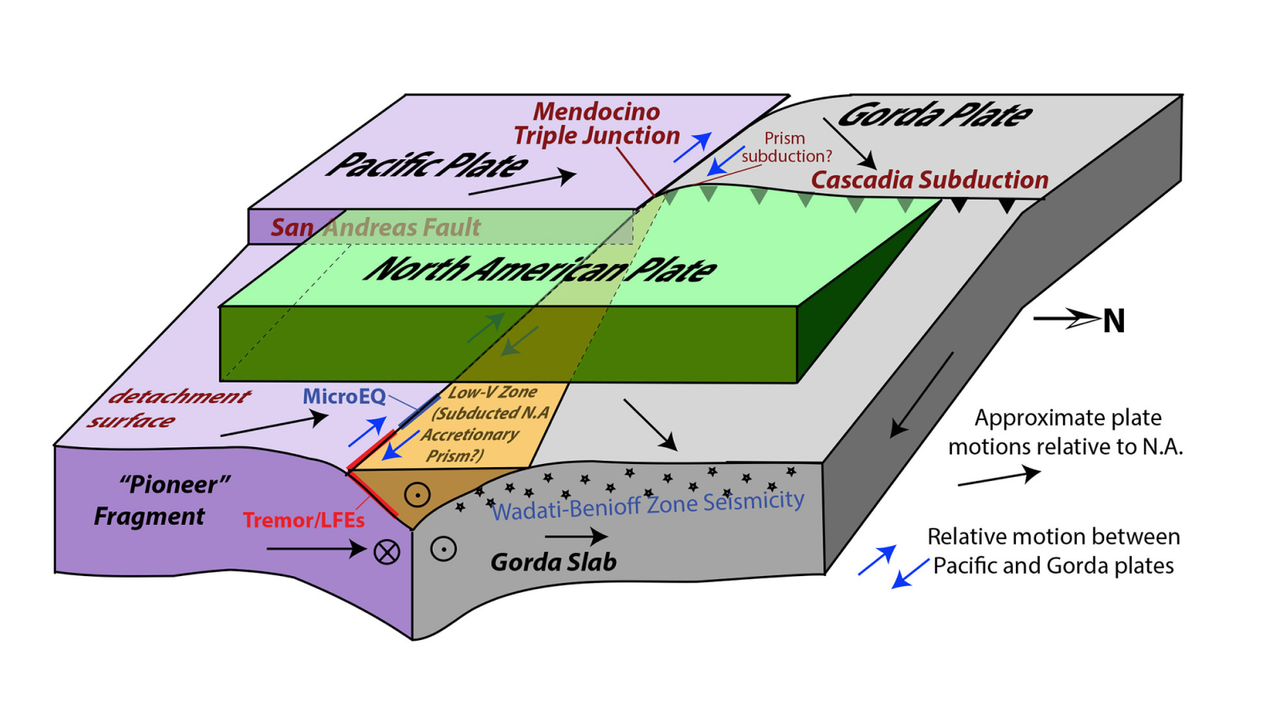
A fragment of a long-lost tectonic plate is sliding beneath the North American continent in the southern part of the Cascadia subduction zone, scientists have discovered. This remaining plate fragment could present a new seismic risk for the region.
New research, published Thursday January 15 in the journal Sciencerevealed that the Pioneer Fragment – a remnant of an oceanic plate that disappeared beneath the North American Plate about 30 million years ago – is now stuck to the bottom of the Pacific Ocean and moving northwest with that plate.
Some evidence suggests that earthquakes in the Cascadia subduction zone could trigger earthquakes along the San Andreas Rivera possibility that would widen the danger of the Cascadia Fault.
Although the new findings do not specify the risk, the study’s first author said David Shelleygeophysicist at the U.S. Geological Survey in Golden, Colorado, they are a step toward understanding this relationship.
The pioneer fragment “increases the contact zone between what is effectively the Pacific plate and the subduction zone,” Shelly told Live Science.
Shelly and her colleagues probed the Mendocino Triple Junction using tiny, low-frequency earthquakes and tremors—a kind of seismic shudder that originates deep in the crust and cannot be felt without sensitive seismometers. “These are tiny events, but they often happen on larger faults,” Shelly said.
By analyzing these events, the researchers determined the direction of the plates’ subtle movements. At Mendocino, the Pacific Plate slides northwest against the North American Plate, colliding with the Gorda Plate as it advances beneath North America. It’s a complex situation, and there are competing explanations for exactly where all the pieces are and where the fault lines lie.
Shelly and her colleagues discovered that the situation is even more complex, because a surprise piece of the long-vanished Farallon plate still has influence on the triple junction. This ancient tectonic plate began subducting beneath North America 200 million years ago, during the breakup of the supercontinent. Pangea. The Juan de Fuca is a remnant of Farallon. But the researchers discovered that another remnant had remained stuck to the Pacific plate. This remnant, the Pioneer Fragment, does not submit but rather moves laterally against the continent.
Meanwhile, pieces of the Gorda plate that were scraped off the North American plate as the two crashed together were apparently sent back to the Gorda like a “tectonic hot potato” and could dive back under North America, Shelly said.
This geological disorder may explain why one of the largest triple junction earthquakes, the 1992 Cape Mendocino earthquake, had a shallower origin than scientists predicted. Because of the extra pieces, “the fault may not follow the oceanic crust itself. It may be shallower than that,” Shelly said.
Beyond the increase in the surface area of the Pacific plate that interacts with Cascadia, the pioneer fragment could itself cause earthquakes. Between the fragment and the North American plate is a nearly horizontal fault, like icing on a layer cake.
“We don’t know if this fault can generate large earthquakes, but it’s a fault that is not currently included in risk models,” Shelly said. “So that’s something we need to consider going forward.”


