France’s AFP calls on Israel to let hungry journalists out of Gaza : NPR


AFP journalist Khader Zaanoun poses for a photo in Gaza City on Tuesday. AFP journalists in the Gaza Strip say that chronic food shortages affect their ability to cover the conflict of Israel with Hamas activists.
AFP / Getty images
hide
tilting legend
AFP / Getty images
The French press agency Agency France-Presse calls on the Israeli government to allow its independent journalists to leave the Gaza Strip due to a worsening of the hunger crisis.
“They spend so much time and energy trying to get food from food and also they feel so weak,” said Phil Chetwynd, AFP World Director at NPR Morning edition On Tuesday, on the situation of journalists and photographers with whom the agency works in Gaza. “They speak of constant headaches, constant dizziness. So, just the capacity physically to, you know, a story is reduced.”
Chetwynd spoke a day after the AFP journalists’ union published a dramatic advocacy on Monday to get help.
“Since AFP was founded in 1944,” said the agency’s journalists’ society on X “, we have lost journalists in conflicts, some were injured, others have taken prisoner. But none of us never remembers seeing colleagues starving.”
The union described the situation of local AFP freelancers working in Gaza. Israel has not allowed independent access to international journalists to enter the enclave since the attack on October 7, 2023 of Hamas against Israel. The union cited an article on Facebook by a photographer: “I no longer have the strength to work for the media. My body is thin and I can no longer work.”

AFP journalist, Bashar Taleb, poses for a photo in the Gaza Strip on Tuesday. Journalists from the agency’s text, photos and Palestinian videos say that the shortages of food and water make them sick and exhausted.
AFP / Getty images
hide
tilting legend
AFP / Getty images
Lack of access to food for the 2 million Palestinians estimated in Gaza alarmed the world leaders. Severe food shortages and generalized hunger continue, and the Gaza health authorities say that 25 children died of “famine and malnutrition” last week.
On Tuesday, UN Secretary General António Guterres warned that “malnutrition arrows. Famine strikes each door.”
He told the Security Council that Gaza was a “horror show with a level of death and destruction without parallel in recent times”.
The Gaza report was fatal during the more than 21 months of conflict, with at least 186 journalists killed in the besieged enclave, the vast Palestinian majority, and most often because of the Israeli air strikes, according to research from the committee to protect journalists, or CPJ.

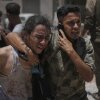
Palestinian journalists, children and families meet to demand the end of Israeli attacks and the entry of humanitarian aid on July 19 in Gaza City. Stressing the growing food shortage, the demonstrators held banners reading “Gaza is hungry”, “Stop the Attacks” and “We appeal to the conscience of the world”.
Saeed Mmt Jaras / Anadolu via Getty Images
hide
tilting legend
Saeed Mmt Jaras / Anadolu via Getty Images
But hunger has become a deepening challenge, as explained by the producer based in NPR Gaza, Anas Baba, in a story earlier this month, describing his experience in search of food from a site supported by the United States and Israel called Gaza Humanitarian Foundation. He faced Israeli military fires, threats from private American entrepreneurs, to crowds that fight for masked rations and thieves.

The committee to protect journalists said it threatens not only the lives of media workers in Gaza – this also leaves an extended impact on the information that the world can obtain from the territory.
“While these journalists are confronted with famine, the constant movement and threat of attack, the international community risks losing its last independent source of reporting from the interior of Gaza,” said regional director of the CPJ, Sara Qudah, in an email at NPR. “It is not only a loss of information – it is a collapse of transparency, a defense to advocate it for civilians and a dangerous opening for impunity. Backing journalists in these conditions is not simply a problem of media freedom – it is a global liability crisis.”
The United Nations spokesperson Stéphane Dujarric, told journalists on Tuesday: “I read the [AFP union] declaration and it is heartbreaking. … It is a reminder of the work that journalists who stayed in Gaza, the Palestinians who stayed in Gaza, bring their lives into play to point out, in front of the fights and in the face of hunger. “”

The Israeli government has not responded to a request for comments on AFP’s request to allow its journalists to leave Gaza.
AFP’s push received the support of the French Minister of Foreign Affairs, Jean-No-Noël Barrot on Tuesday, who said that he hoped that journalists could be evacuated “in the coming weeks”. Barrot also called on the Israeli government to allow international press to Gaza.
Israeli authorities have previously brought groups of international journalists during visits led by soldiers in Gaza and said they should not go to unaccompanied territory for security reasons.
“I ask that the free and independent press will be authorized to access Gaza to show what is going on there and to testify,” he told the France Inter radio station.


