From a new flagship space telescope to lunar exploration, global cooperation – and competition – will make 2026 an exciting year for space

When you purchase through links on our articles, Future and its syndication partners may earn a commission.

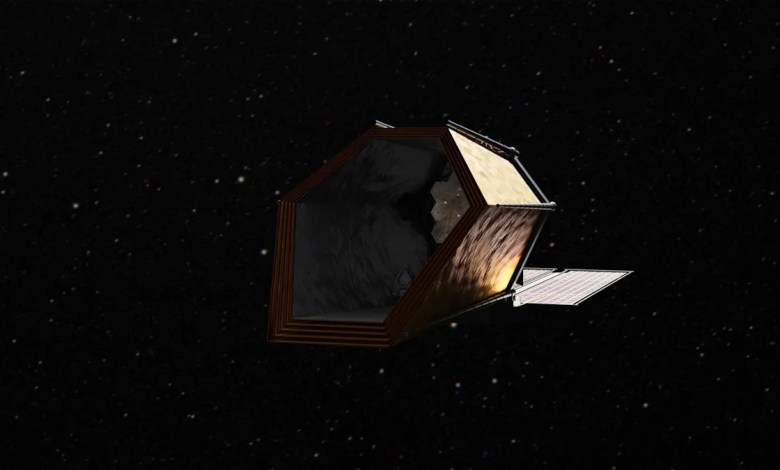
Artist’s impression of NASA’s Habitable Worlds Observatory in space. | Credit: NASA Goddard Space Flight Center Conceptual Image Lab
This article was originally published on The conversation. The publication contributed the article to Space.com Expert voices: opinion pieces and perspectives.
In 2026, astronauts will circle the Moon for the first time since the Apollo era, new powerful space telescopes will prepare to study billions of galaxies, and several countries will launch missions aimed at finding habitable worldswater on the Moon and clues to the formation of our solar system.
Together, these launches will mark a turning point in how humanity studies the universe – and how nations cooperate and compete beyond Earth. Coming from one of the largest astrophysical research institutes in the worldI can tell you, the anticipation within the global space science community is electric.
Mapping the cosmos at unprecedented scales
Several of the most ambitious missions scheduled to launch in 2026 share a common goal: to map the universe on the largest possible scale and reveal how planets, galaxies and the largest cosmic structures have evolved over billions of years.
The centerpiece of this effort is NASA Nancy Grace Roman Space Telescope. Completed construction of the Roman telescope in December at NASA Goddard Space Flight Centerand if all goes well, it could be launched as early as fall 2026.
What makes Roman more special than NASA’s other flagship space telescopes is not only what it will see, but also how much of the sky it can see at once. Its 300-megapixel camera can capture sky regions of approximately 100 times bigger that the The Hubble Space Telescope field of view while maintaining comparable sharpness – as if you were going from studying individual tiles to studying the entire mosaic at once.
During his five-year primary mission, Roman is expected to discover more than 100,000 distant planets. exoplanetsmap billions of galaxies scattered across cosmic time and help scientists probe dark matter And dark energy – the invisible scaffolding and mysterious forces that together explain 95% of the cosmos.
Roman also carries a coronagraph, a scouting instrument capable of blocking the blinding light of a star to directly photograph the planets orbiting it. This technology could pave the way for future missions, like the one planned by NASA. Habitable Worlds Observatorycapable of searching for signs of life on Earth-like worlds.

The Nancy Grace Roman Space Telescope exposes part of its sunshade. | Credit: NASA/Sophia Roberts
In Europe, the European Space Agency Mission PLATONshort for PLAnetary Transits and Oscillations of stars, scheduled to launch in December 2026 aboard the new European ship Ariane 6 rocket. PLATO will monitor around 200,000 stars using an array of 26 cameras, looking for small, rocky planets in their habitable zones of starswhile also determining the ages of stars.
For China, 2026 should mark a milestone of another kind: the launch of its first large flagship space telescope dedicated to astrophysics. THE Xuntien Space Telescopealso known as the China Space Station Telescope, is currently scheduled to launch in late 2026. Xuntian will study huge regions of the sky with image quality comparable to Hubble, but with a field of view greater than Hubble. 300 times bigger.
Like NASA’s Roman Space Telescope, Xuntian is designed to answer some of the biggest questions in modern cosmology. It will search for dark matter and dark energy, study billions of galaxies, and trace the evolution of cosmic structure over time. Uniquely, Xuntian will co-orbit with the Chinese satellite Tiangong Space Station, allowing astronauts to maintain and upgrade it and, potentially, extend its lifespan for decades.
With the new Vera C. Rubin Observatory on the ground, which will repeatedly scan the entire southern sky to capture the evolution of the universe over time, the Roman, PLATO and Xuntian space telescopes will study the cosmos not only as it is but as it evolves.

Artist’s rendering of the Chinese Space Station telescope, also known as Xuntian. | Credit: NAOC
Global Human Spaceflight Milestones
As robotic observatories quietly expand our view of the cosmos, 2026 will also mark a major breakthrough for human spaceflight.
NASA’s Artemis II missionnow ready to be launched from April 2026, send four astronauts on a 10-day trip around the moon and back. This will be the first time humans have traveled beyond low Earth orbit. since Apollo 17 in December 1972.
Across the world, India is preparing to achieve an equally important historic milestone. Thanks to his Gaganyaan ProgramTHE Indian Space Research Organization plans a series of uncrewed test flights in 2026 as part of its efforts to send astronauts into space. If this happens, India will become only the fourth country to achieve human spaceflight on its own – a significant achievement. technological and symbolic achievement.
Meanwhile, China will continue regular crewed flights to its Tiangong space station in 2026, part of a broader effort to develop the experience, infrastructure and technologies needed for its planned human missions to the Moon later in the decade.
At the same time, NASA is relying more and more on a commercial spaceship to transport astronauts to and from the International Space Stationallowing the agency to focus its own human spaceflight efforts on deep space missions beyond Earth.
Together, Artemis II, Gaganyaan and China’s ongoing crewed space station missions reflect a renewed global push toward human exploration beyond Earth’s orbit – a world in which governments and commercial partners lay the foundations for longer missions and a sustainable human presence in space.
The origin and geology of the Moon and Mars
Another set of 2026 missions focuses on a more fundamental question: how rocky worlds – and the resources they contain – came to be.
from Japan Mission to explore the Martian moonsscheduled for launch in late 2026, will travel to Mars and spend three years studying its two small, potato-shaped moons – Phobos And Deimos – and take a surface sample of Phobos to bring it back to Earth by 2031.
Scientists still wonder if these moons originated like captured asteroids or debris from an ancient giant impact with Mars. The return of pristine material from Phobos could finally resolve this question and reshape our understanding of the evolution of the inner solar system.
China Mission Chang’e 7scheduled for launch in mid-2026, will head towards the south pole of the Moon, a region of intense scientific and strategic interest. The mission includes an orbiter, a lander, a rover and a small flying “hopper” designed to jump into constantly shadowed craters, where sunlight never reaches. It is believed that these craters harbor water icea resource that could one day support astronauts or be converted into rocket fuel for missions into deeper space.
Both the Chinese and Japanese missions highlight how planetary science and exploration are increasingly intertwined, as understanding the geology of nearby worlds also informs future human activity.
It’s the sun’s solar system, we just live there
In 2025, powerful solar storms forces airlines to reroute and ground their flightsdisrupted radio communications and pushed the bright auroras far beyond their usual polar haunts – lighting up the sky as far south as Florida. These events remind us that space is not a distant abstraction: activity on the sun can have immediate consequences here on Earth.
Not all of the major missions of 2026 are focused on deep space. Some aim to understand the dynamic space environment that surrounds our own planet.
In a notable example of international cooperation, the link explorer ionosphere magnetosphere solar windSMILE – a joint mission between the European Space Agency and the Chinese Academy of Sciences – is expected to launch in spring 2026.
SMILE will provide the first global pictures of how Earth’s magnetic field responds to the constant flow of charged particles coming from the sun. This interaction leads space weather, including solar storms which can disrupt satellites, navigation systems, power grids and communications.
Understanding these interactions is essential not only for protect modern infrastructure on Earth but also for protect astronauts and spacecraft operating beyond the planet’s protective magnetic shield.
At a time of growing geopolitical tension in spacethe mission also stands out as a rare and significant example of sustained scientific cooperation between Europe and China.
Global issues
These missions take place against a complex geopolitical context. The United States and China are both in the race to bring humans back to the moon by the end of the decade.
Yet despite all the competition, space science remains deeply collaborative. The Japanese mission to explore the Martian Moons carries instruments from NASA, ESA and France. International teams share data, expertise and the wonders of discovery. The universe, after all, does not belong to any nation.
Having spent my career studying the universe, I see 2026 as a year that reflects both the rivalries and shared ambitions of space exploration today. Competition is real, but so is cooperation on a scale that would have been difficult to imagine a generation ago. From the search for habitable worlds around distant stars to projects to return humans to the Moon, the work is global – and the skies are shared by all.


