From tattoos to plastic bottles, here’s how society assigns moral values to everyday things


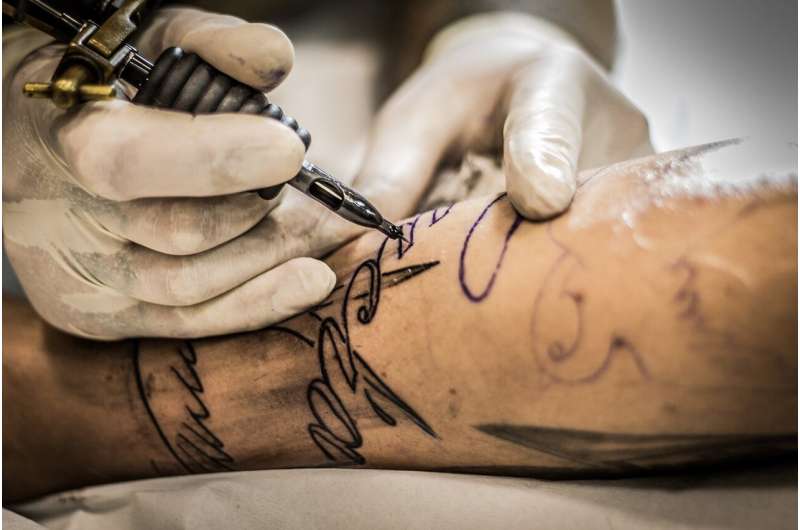
Credit: Public Pixabay / CC0 domain
When we think of morality, we generally focus on actions: is this act morally good or bad? But more and more, these types of debate involve the morality of everyday objects, such as plastic bottles, smartphones or even foods on our plates.
Our research shows that the objects themselves can not only have a moral weight, but that these judgments can change over time. Take tattoos, for example. Have you ever considered if having tattoos is considered moral, immoral or simply amoral?
In our recent research, we demonstrate how traditional societal feelings for tattoos have changed through history. We have conducted a metalsis of existing studies to develop a framework to understand how moral attributions on the markets are shaped.
Our results show that moral feelings shared towards objects, products or services are neither fixed nor universally shared. By “objects”, we mean products and services that people can use, consume or embody due to moral associations, such as plastic bags, tattoos, fur clothes or diamond jewelry.
The changing moral landscape of tattoos
In the first societies, tattoos were not stigmatized, but they were used to mark identity, social belonging or spiritual protection. It is always a continuous feeling in certain cultures, including Kurds, Inuit and certain Aboriginal groups in the Philippines.
In the 19th century, tattoos began to have divergent moral meanings, especially negative meanings, depending on the context. For sailors, they were a brand of their adventures at sea or the land they conquered. For people on the outskirts of the Northern worldwide, they were symbols of non-compliance.
Since then, the moral judgments of the tattoos have fluctuated between being seen moral or immoral through time and the place. Tattoos were considered signs of bravery and memory for soldiers of the Second World War, but in other contexts, they were associated with crime or gang affiliation.
These changes occur through complex social processes which involve social entities with different capacities: individuals, groups (such as unions or consumption collectives) and organizations (such as churches or governments). We call this process a “moralization of the market”, which produces what we call “the moral feelings of the market”.
Not always in black and white
The moral feelings of the market are not always in black and white, but can also be intermediate, debated and negotiated, as in the case of meat consumption. While vegans consider it immoral to consume meat, other groups could consider it morally neutral or even necessary for cultural or health reasons.
To understand how these moral debates take place, we used the theory of actors – which involves the translation stages of the problematization, registration, interries and mobilization – to map the stages of market moralization. In clear terms, these stages include the increase in a problem, the persuasion of others and the organization of support.
In case of success, a new collective moral feeling is formed. For example, a new consensus on the need to eat animal proteins can move nutritional directives to plead for more plant protein.
If it is unsuccessful, however, the old feeling remains dominant. This means that the moral status of the object remains disputed and subject to additional negotiation.
Market moralization results
Our research has revealed that market moralization can produce one of the four results. Sometimes an object can reach a “harmonized moral feeling”, where almost everyone agrees that it is moral or immoral. Donation to a charitable work, for example, is widely recognized as morally good. It is supported by your social network and rewarded by government policies such as tax deductions.
Other times, an object can have a “divided moral feeling”, with different groups holding opposite views. Some hummer owners, for example, moralize the purchase of their vehicles by arguing that it is an expression of individual freedom and rights or that it is a necessity for safer trips, while others condemn them as a waste or an ecological damage.
In some cases, moral feelings are dispersed: some people can dispute a widely widespread opinion but lack a large support. The first detractors of bullfighting in Spain, for example, spoke against a deeply darling cultural practice.
Finally, organizations can impose moral opinions on people through regulations or policies. In this case, individuals and groups are forced to comply even if they disagree in private, such as mask and vaccine mandates during the COVVI-19.
Why is it important?
The markets are not only economic exchange establishments; They also concern moralized values and emotions. Large -scale problems such as climate change, racism, animal rights or gender equality show how morality and markets are linked.
Brands often exploit existing moral feelings by supporting social movements or promoting ecological products. In doing so, they are also inserted in moralized debates and negotiations.
For example, the cosmetics retailer Lush closed his stores in the United Kingdom on September 3 and stores in the Republic of Ireland on September 4, as a gesture of solidarity with Palestine. The company also sells watermelon soap to collect funds for medical services in Gaza as part of its collection of Giving products.
More recently, concerns about environmental, cognitive and other ethical problems surrounding generative artificial intelligence have aroused criticism of companies seeking to integrate AI into their products or processes.
These examples illustrate why it is crucial to understand the fluidity of moral judgments on objects, rather than assuming that objects have an inherent or immutable moral value.
For individuals, this understanding can help to contextualize moral disputes and allow them to see that disagreements on objects are not always rooted in absolute moral truths, but often from different cultural, social and historical perspectives.
For managers and business leaders, it allows a more deliberate application of moral complaints – as sustainable, green or without cruelty – to their products or services while contextualizing them.
And finally, for decision -makers, this allows them to create better policies by monitoring public feelings on complex issues such as possession of firearms, food policy and technology.
More information:
Aya Aboelenien et al, the formatting of moral feelings on the market, Journal of Business Research (2024). DOI: 10.1016 / J.Jbusres. 2014.114810
Supplied by the conversation
This article is republished from the conversation under a Creative Commons license. Read the original article.
Quote: Tattoos with plastic bottles, here is how the company attributes moral values to everyday things (2025, September 21)
This document is subject to copyright. In addition to any fair program for private or research purposes, no part can be reproduced without written authorization. The content is provided only for information purposes.


