President Trump signs executive order aimed at regulating college sports


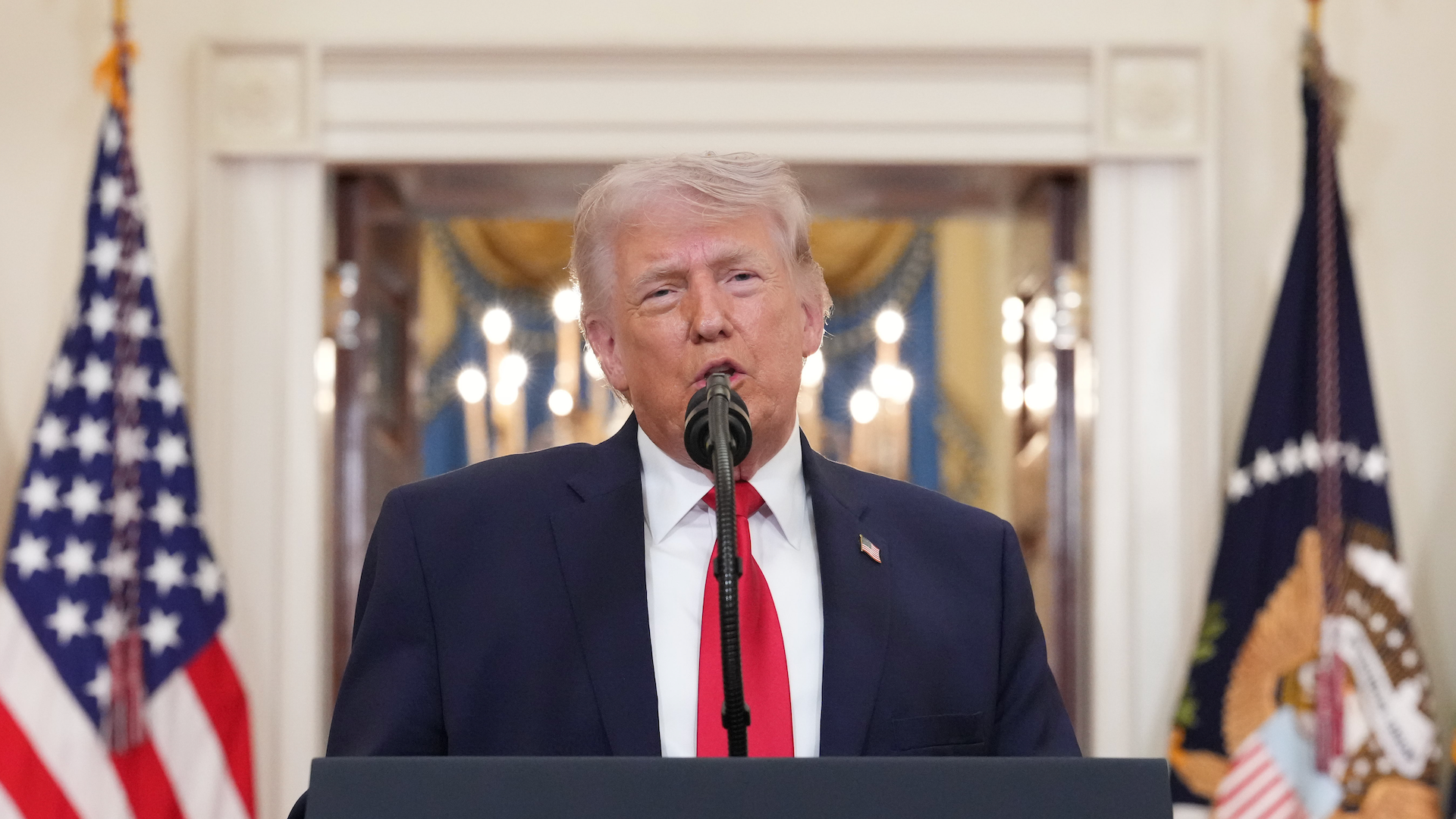
President Donald Trump signed an executive order for “Urgent National Action to Save College Sports,” a high-level action to federally regulate NIL collectives, limit transfer moves, cap player eligibility and enact funding requirements for the Olympics and women’s sports, the White House announced Friday.
Trump’s recommendation includes strict guardrails on player transfers and even mentions bringing back the NCAA’s “one-size-fits-all” transfer rule, a source with direct knowledge of the order told CBS Sports’ Brandon Marcello. This rule had already been found illegal in court. Under the revised transfer rules, athletes would be allowed to transfer once without penalty, but a second transfer would automatically trigger a redshirt season. The order also redefines eligibility with a 5-for-5 model where athletes have five years to play five seasons, the source said.
Trump’s order includes a provision to review federal government grants and contracts for schools and potentially cut funding if they fail to comply with NCAA rules, according to the fact sheet released by the White House.
NCAA President Charlie Baker released a statement regarding the order Friday evening:
“The NCAA has modernized college sports to provide more benefits to student-athletes, and the Executive Order strengthens many of our mandated protections, including guaranteed health care coverage, mental health services and scholarship protections.
“This action is a significant step forward, and we appreciate the administration’s interest and attention to these issues. Stabilizing college sports for student-athletes still requires a permanent, bipartisan federal legislative solution, so we look forward to continuing to work alongside the administration and Congress to enact targeted legislation with the support of student-athlete leaders from all three divisions.”
Trump said last month that he was fast-tracking a “comprehensive” executive order to put Congress in charge of initiating NIL changes to improve the current landscape of college athletics.
“The entire education system is going to go bankrupt because of this,” Trump said.
Trump first considered an executive order aimed at NIL reform after meeting last May with former Alabama coach Nick Saban, who was highly critical of NIL’s impact on college athletics. THE the couple reunited on March 6 with more than two dozen others during a meeting at the White House to give his thoughts on the future of college athletics.
NCAA President Charlie Baker, SEC Commissioner Greg Sankey, NBA Commissioner Adam Silver, Texas Tech billionaire Cody Campbell and Sarah Hirshland, the CEO of the United States Olympic and Paralympic Committee, were among the attendees.
Following this “Saving College Sports” symposium, Trump formed five commissions on college sports covering legislation, rules, NCAA reform, media and player issues. The President’s Oversight Committee is responsible for collecting recommendations from the groups before making final decisions.
The University of Louisville athletic department is one of dozens experiencing a recurring deficit nationwide and wrote last month in a statement titled “College Athletics is Running Out of Time” that “the math no longer works” in college sports.
Louisville revealed it took out a $25 million “line of credit” before this season to help pay athletes and called on Congress to act to fix a broken system. The statement, issued on behalf of Louisville President Gerry Bradley, AD Josh Heird and Board of Trustees Chair Laurence Benz, was broad in scope and gave numbers to what most already knew was happening in the era of NIL and revenue sharing in college sports.
Proposed Eligibility, Transfer Changes
Thanks to the recent influx of student-athletes challenging NCAA eligibility standards in court, since the current requirements are unclear, Trump’s order includes the five-year plan. Virginia quarterback Chandler Morris was denied his seventh year of eligibility Thursday by a Virginia judge who ruled his injunction was based on insufficient information.
Morris is the third Power Four quarterback to seek an injunction this offseason, joining Ole Miss’ Trinidad Chambliss and Tennessee’s Joey Aguilar. A Mississippi judge granted Chambliss a temporary injunction that will allow him to spend another season with the Rebels, while Aguilar was denied an injunction in a ruling that was a major victory for the NCAA and was similar to former Vanderbilt quarterback Diego Pavia’s JUCO-motivated pleas ahead of the 2025 season.
In college football in particular, the the transfer portal has gotten out of hand in recent yearsleading to involuntary free agency across the sport. Immediate eligibility led to approximately 25% of FBS players entering the portal during the 2026 cycle, highlighted by a one-time window from Jan. 2-16 before the spring semester.
What happens next?
Trump’s order is considered “comprehensive and direct” compared to his last attempt, which targeted cabinet members, according to Yahoo Sports. Courts have struck down many of Trump’s other orders regarding college sports, finding them unenforceable.
The executive orders are subject to intense legal scrutiny and lawsuits against Trump’s calls for reform are expected.
Many of those at Trump’s rally last month were supportive the SCORE Act, first introduced in July 2025 by members of the United States House of Representatives. Supported by the NCAA and the U.S. Olympic and Paralympic Committee, the SCORE Act aims to regulate payments to college athletes, but has not been passed.
Chairman Mike Johnson (R-La.) believes passage of the SCORE Act is a necessity in combating current NIL issues and would help establish federal standards for player payments and regulations for agents representing college athletes, according to The Hill.
The bill aims to “protect the name, image, and likeness rights of student-athletes to promote fair compensation with respect to intercollegiate athletics and for other purposes.”
“If we don’t act, we’re going to very quickly find ourselves in a world of 30 to 50 college football teams that are essentially a mini NFL. And the rest of the schools are going to be left behind,” Sen. Ted Cruz (R-Texas) said last month. “For some time now, to use a football analogy, we’ve been at the 2-yard line and we’ve been unable to push. And there are interest groups, particularly trial lawyers and labor unions, that are leading Democratic senators to actively lobby against the SCORE Act and not want to see the law passed.”
Cruz said 60 votes in the Senate — including seven Democrats — are needed for the SCORE Act to pass. Democrats Janelle Bynum (Ore.) and Shomari Figures (Ala.) introduced the legislation with Republicans last summer to try to restrict big business in college sports, but the Democratic Party largely opposed the SCORE Act.
Former Ohio State coach Urban Meyer previously vouched for an end to pay-for-play, while Saban stressed the importance of academic support and athletes’ progression beyond an athletic career.
“How much is anyone talking about education anymore? Nobody’s talking about it at all, which is the most important thing that each of these student-athletes can do to make the future better,” Saban said during Trump’s college sports panel.
Expensive listings the norm for contenders
Even though some coaches have dissed ‘irresponsible reporting’ on $40 million lists in college football, others recognized their authenticity after the House vs. NCAA Rules last summer paved the way for revenue sharing.
Before winning a national championship to close out the 2024 season, athletic director Ross Bjork said the football program spent $20 million on its elite-level roster, which included a few expensive transfers and No. 1 recruit Jeremiah Smith. CBS Sports previously reported the highest-spending programs in the same season paid more than $30 million for talent, a record that was immediately broken in the next roster cycle.
A report released earlier this week through LSU donors indicated the Tigers invested $40 million in Lane Kiffin’s first-year team through NIL and revenue sharing, an amount initially allocated between $25 million and $30 million. That’s a different approximation than most other SEC programs outside of Texas and Texas A&M.
An SEC head coach recently told The Athletic that he expects the baseline for 2027 to be around $45 million for those expecting to compete in the conference championship and College Football Playoff discussions.
Without federal NIL regulation, the gap between the haves and have-nots in the Power Conference ranks will widen, not to mention the low success rate of programs outside of that range when it comes to winning.
Based on data from the 2026 transfer portal cycleonly 29.5% of Group of Six players who earned first or second team all-conference honors last season remain with the team they played for in 2025. By comparison, 74.6% of Power Four all-conference players who returned in 2026 chose to stay with their previous team.
There is even a significant retention gap In the Power Four. Thanks to the SEC and Big Ten’s monstrous TV contracts, those two conferences have retained 97.4% of their eligible players, compared to just 56.8% in the ACC and Big 12.
With the revenue sharing “cap” for the 2025-26 academic year hovering around $20.5 million per school according to the College Athletic Commission, most athletic departments have allocated at least 75% of that total to its largest revenue driver — football — which has left the majority of other sports struggling to keep up. This cap is expected to increase by at least 4% per year over the next few seasons.


