Geoscientists Pinpoint Ancient Forces behind Antarctica’s Gravity Hole


New research by geoscientists at the University of Florida and the Institut de Physique du Globe in Paris traces the origins of the Antarctic gravity hole (or Antarctic geoid depression) – the most extreme gravitational anomaly on the planet – to slow underground rock flows over tens of millions of years.
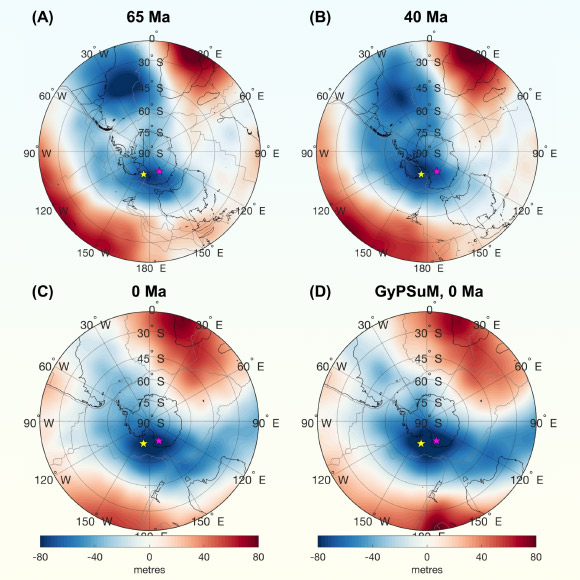
Evolution of the Antarctic geoid depression. Image credit: P. Glišović & AM Forte, doi: 10.1038/s41598-025-28606-1.
“If we can better understand how the Earth’s interior shapes gravity and sea level, we will gain insight into the factors that may play a role in the growth and stability of large ice sheets,” said Professor Alessandro Forte of the University of Florida.
“Caused by different densities of rocks far beneath the Earth’s surface, these gravity variations are small in absolute terms. But they can have particularly large effects on the oceans.”
“Where gravity is lower, the ocean surface may be slightly lower relative to the center of the Earth because water flows toward areas of stronger gravity.”
“Because of its gravity hole, the sea surface height around Antarctica is significantly lower than it would otherwise be.”
In the new study, Professor Forte and Dr Petar Glišović from the Paris Institute of Earth Physics mapped the Antarctic geoid depression and revealed how it developed during the Cenozoic era, the period from 66 million years ago to today.
The researchers relied on an Earth-scale science project combining global earthquake records with physics-based modeling to reconstruct the 3D structure inside the Earth.
“Imagine doing a scan of the entire Earth, but we don’t have X-rays like we have in a doctor’s office,” Professor Forte said.
“We have earthquakes. Seismic waves provide the ‘light’ that illuminates the interior of the planet.”
Taking into account all the rocks their seismic waves could illuminate within Earth and physics-based modeling to predict the gravity pattern, scientists reconstructed the gravitational map of the entire planet.
The reconstructed map closely matched the reference gravity data captured by the satellites, confirming the realism of their underlying models.
Then came the hard part: going back in time to see how the Antarctic geoid depression developed over the eons.
Using sophisticated computer models, they used physics-based reconstructions to rewind the flow of rocks inside and track changes going back 70 million years.
These past snapshots revealed that the Antarctic geoid depression started out weaker.
Then, about 50 to 30 million years ago, the gravity hole began to strengthen.
This period coincides with major changes in the Antarctic climate system, including the onset of widespread glaciation.
“We hope to test a causal link between this strengthening gravity hole and the ice sheets, using new modeling that links changes in gravity, sea level and continental rise,” Professor Forte said.
“The objective is to answer a big question: what is the link between our climate and what is happening inside our planet?
The study was published in December 2025 in the journal Scientific reports.
_____
P. Glišović and AM Forte. 2025. Cenozoic evolution of Earth’s strongest geoid depression sheds light on mantle dynamics beneath Antarctica. Scientific representative 15, 45749; doi: 10.1038/s41598-025-28606-1


