Giant cosmic arachnid spotted by James Webb telescope could resemble the future of our own solar system


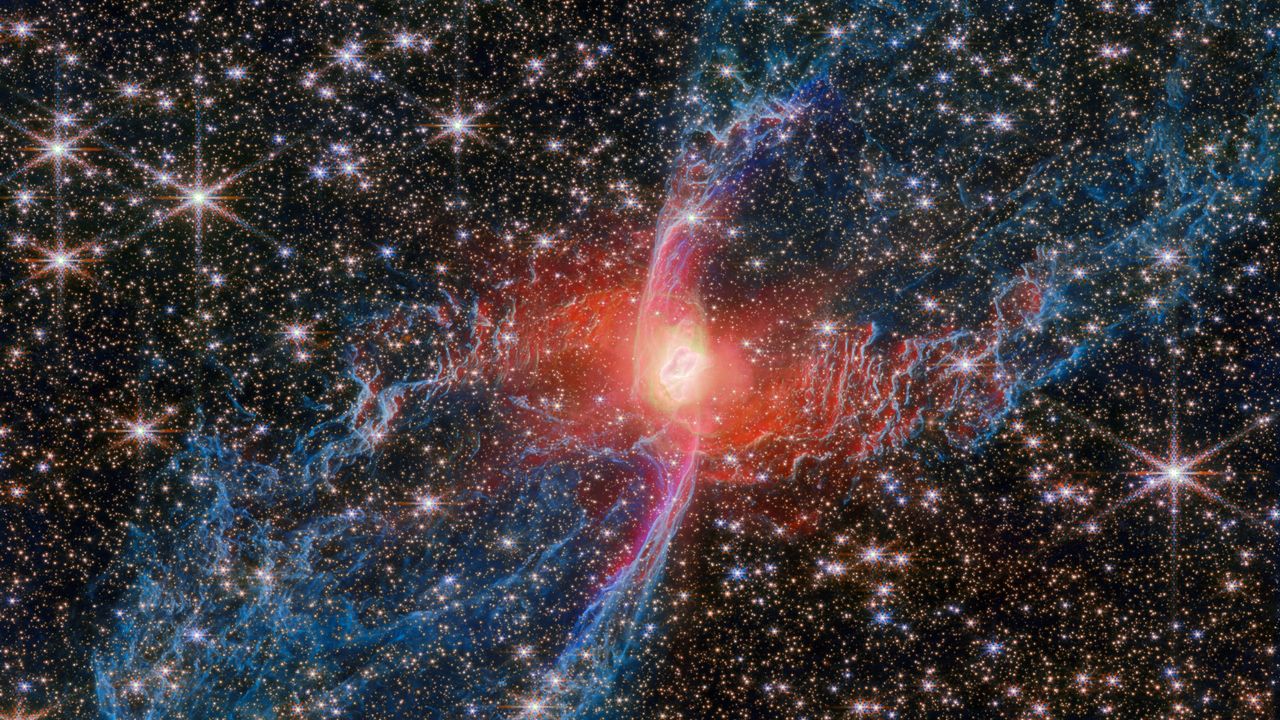
THE James Webb Space Telescope (JWST) celebrates Halloween with a stunning image showing never-before-seen details of the Red Spider Nebula.
The image, taken by JWST’s Near Infrared Camera (NIRCam), shows dust and gas being released from a dying star to form a planetary nebulaits filaments twisting and stretching like the limbs of a cosmic arachnid.
“The legs are hairy and shiny thanks to the emissions of molecular hydrogen that escaped from the torus”, Mikako Matsuuraastrophysicist at Cardiff University and co-investigator of the program that took the image, said in an emailed statement. “It is still unclear why the outflows appear ‘hairy’. One possibility is that the outflow from the primary star was not continuous, perhaps because mass transfer from the companion star affected the timing of the outflow.”
For most of their lives, stars burn by fusing hydrogen into helium. But once they run out of hydrogen fuel, they begin fusing helium into even heavier elements, leading to a massive increase in energy production that causes them to transform into red giants hundreds, if not thousands, of times their original size.
The star in the Red Spider Nebula (NGC 6537) has already transformed into a red giant and is currently shedding its outer matter to expose its white-hot core. Ultraviolet light from the star’s ember core ionizes this gas and dust, making it glow.
Stunning images like this give scientists a rare glimpse into our possible future. solar systemafter our sun turns into a red giant in 5 billion years. After running out of fuel, our star will also accelerate outward as a red giant, consuming Mercury, Venus, and perhaps even Earth and Mars in the process.
But if our planet is spared the sun’s transformation, it could find itself in a scene like this, drifting along the pinkish branches of a vanishing cosmic spider.


