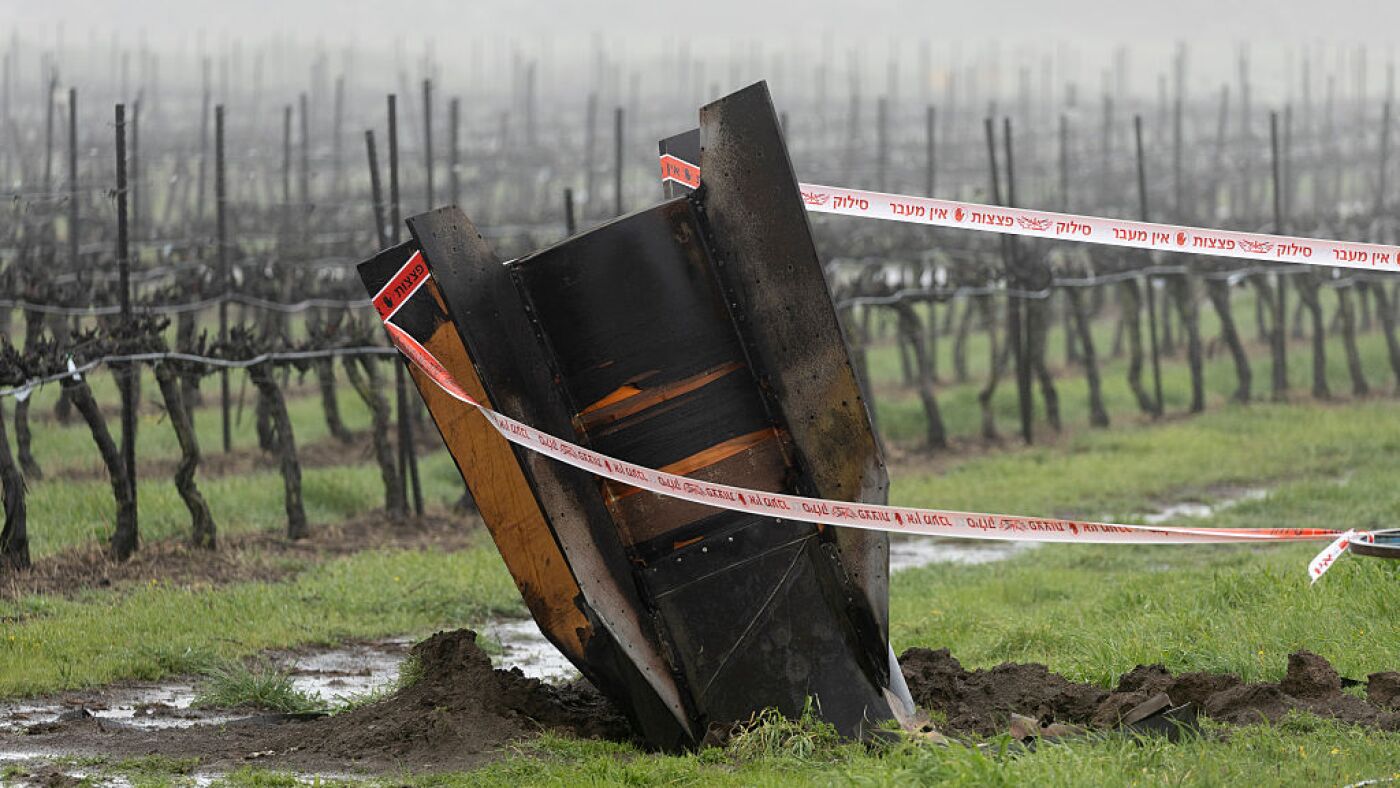

The tail section of a ballistic missile fired from Iran sticks out of the ground at a vineyard in the Israeli-controlled Golan Heights on March 20.
Amir Levy/Getty Images Europe
hide caption
toggle caption
Amir Levy/Getty Images Europe
As the war in the Middle East enters its fourth week, President Trump said on Friday the administration is considering “winding down” military efforts in the region.

The Israeli military said early Saturday it was once again striking targets in Tehran, as the United States and Israel claim to dominate the skies over Iran, with Iranian missile and drone attacks down 90% from the early days of the war, according to the U.S. Department of Defense.
Meanwhile, the Trump administration announced on Friday it is temporarily lifting sanctions on some oil from Iran, in an attempt to ease one of the worst disruptions to the world oil market ever experienced.
With over 3,000 vessels stranded in the Middle East, according to the International Maritime Organization, then Persian Gulf has become a massive parking lot for ships waiting for a resolution to the near-total halt of traffic through the Strait of Hormuz.

An Israeli fighter jet flies over the skies of Nablus in the occupied West Bank on March 20.
Zain Jaafar/AFP via Getty Images
hide caption
toggle caption
Zain Jaafar/AFP via Getty Images
The U.S. is now using Apache helicopters and A-10 Warthog planes to carry out attacks, a clear sign that the military believes the threat from Iranian forces has been drastically reduced. The Pentagon also says it is targeting the small, fast boats that Iran uses in the Persian Gulf.
Here are further updates from the conflict.
To jump to a specific coverage topic, click on the links below:
Iranian oil | Marines to Mideast | Syria strikes
Trump administration to lift sanctions on Iranian oil stranded at sea
The U.S. is temporarily lifting sanctions on some oil from Iran. This marks a major reversal for the Trump administration as oil prices climb. Treasury Secretary Scott Bessent says the decision is expected to quickly add about 140 million barrels to the global oil market, which uses about 100 million barrels each day.

This new lifting of sanctions applies to Iranian oil and oil products that are currently loaded on ships. It will last until April 19, 2026. The Trump administration has already lifted some U.S. sanctions on Russian crude to make it easier for those barrels to make it to market.
As the U.S.-Israeli war on Iran enters its fourth week, the near-total halt of traffic through the Strait of Hormuz, the key waterway through which about a fifth of the world’s oil and liquefied natural gas typically passes, has created a catastrophic disruption in oil markets.
While the world had been oversupplied with oil in February, the amount of oil stored at sea is quickly falling, and oil prices have risen around 45% since the war began. Crude oil prices have now topped $110 per barrel, and could climb more. Those higher prices have rippled through to U.S. gasoline prices.
More Marines are headed to the Middle East
NPR has confirmed that another group of U.S. Marines is headed to the Persian Gulf.
The USS Boxer group of three ships, carrying thousands of Marines from the 11the Marine Expeditionary Unit, has left California and will take about three weeks to reach the gulf, according two U.S. officials who spoke on condition of anonymity because they were not authorized to speak publicly.

That’s in addition to the USS Tripoli group, with more than 2,000 Marines, expected to arrive soon from Japan.
The military’s Central Command, which oversees Middle East operations, would not comment on the deployment or its mission.

US Secretary of Defense Pete Hegseth takes questions during a news conference at the Pentagon in Washington, DC, on March 19, 2026.
Mandel Ngan/AFP via Getty Images
hide caption
toggle caption
Mandel Ngan/AFP via Getty Images
When President Trump was asked by a reporter Thursday if U.S. troops would be sent to the region, he responded, “No. I’m not putting troops anywhere. If I were, I certainly wouldn’t tell you, but I’m not putting troops. And we will do whatever is necessary to keep the peace.”
Then on Friday, Trump suggested he could be looking for an off-ramp in the war.
“We are getting very close to meeting our objectives as we consider winding down our great Military efforts in the Middle East with respect to the Terrorist Regime of Iran,” Trump wrote on Truth Social.
He then went on to list progress he said the efforts had made, including degrading Iran’s missile capabilities, destroying its defenses, navy, air force, anti-aircraft weaponry and nuclear capability, as well as protecting Israel and Gulf Arab countries.
Trump also reiterated that he wants other nations to police the Strait of Hormuz.
Turkey calls recent Israeli strikes on Syria a “dangerous escalation”
Israel’s military said on Friday it had struck a Syrian command center and weapons depots. Deadly fighting broke out once again this week in southern Syria between fighters from Syria’s government and the Druze, a minority religious group.
Israel says it is acting to protect the Druze minority from the Syrian government. The Israeli military said in a statement it struck government sites in Syria’s southern Sweida province, where many Druze live. The strikes add to an Israeli military campaign in Syria that dates back to the fall of the Assad regime in December 2024.
Turkey said the attacks this week on Syria, its neighbor, were illegal. The country has funded militia groups in Syria in the past, including one run by now-President Ahmed al-Sharaa.

Iranians gather for a rally on March 20 in Tehran. The United States and Israel continued their joint attack on Iran that began on Feb. 28. Iran retaliated by firing waves of missiles and drones at Israel, and targeting U.S. allies in the region.
Getty Images//Getty Images Europe
hide caption
toggle caption
Getty Images//Getty Images Europe
Greg Myre, Quil Lawrence and Alex Leff contributed to this report from Washington, Julia Simon from Los Angeles, Emily Feng from Turkey, and Miguel Macias from Spain.


