Glowing bridge links dwarf galaxies in stunning new image from the James Webb Space Telescope

When you purchase through links on our articles, Future and its syndication partners may earn a commission.

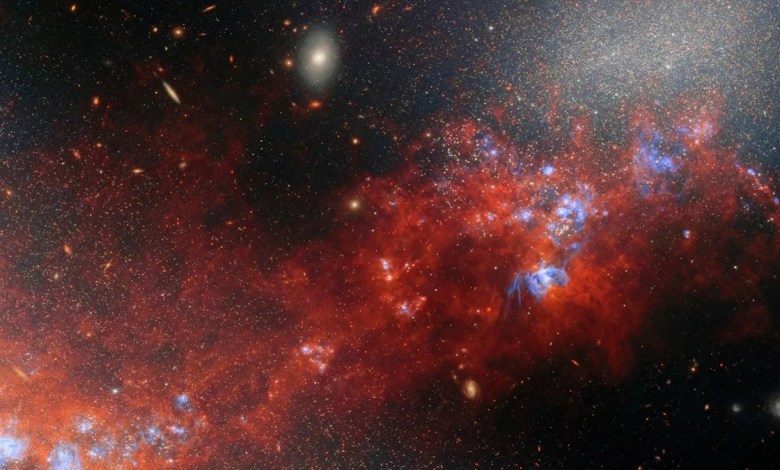
A new image from the James Webb Space Telescope captures the dwarf galaxies NGC 4490 at left and bright NGC 4485 at upper right, connected by a bright bridge of gas and dust dotted with bright blue star-forming regions. . | Credit: ESA/Webb, NASA & CSA, A. Adamo (Stockholm University), G. Bortolini and the FEAST JWST team
A spectacular new view of two dwarf galaxies caught in the middle of a cosmic collision reveals a bridge of glowing gas, streams of newborn stars and the ongoing gravitational tug of war reshaping the two galaxies.
Taken by the James Webb Space Telescope (JWST), new image captures dwarf galaxies NGC 4490 and NGC 4485 stretching, pulling and warping in a dramatic gravitational dance taking place 24 million light years away. Because dwarf galaxies are very similar to the low-mass, gas-rich, metal-poor systems that populated the world. primitive universeTheir collisions and gas exchanges provide a valuable window into how early galaxies formed and evolved, according to a declaration of the European Space Agency.
The biggest galaxyNGC 4490, stretches across the frame in a tangle of dust and newborn stars, dominating the left side of the image. Its smaller companion, NGC 4485, shines in the upper right. Connecting them is a bright bridge of gas and dust encrusted with clusters of hatchlings starsglowing blue against the reddish glow of hot interstellar dust. It was the interaction between the two galaxies that caused the appearance of new stars, according to the press release.
“Aside from the dwarf companions of the Milky Way, the Large and Small Magellanic Clouds “This is the closest interacting dwarf-dwarf system in which astronomers have directly observed both a gas bridge and resolved stellar populations,” ESA officials said in the release.
While the galactic couple, collectively called Arp 269has already been studied based on observations from Hubble Space TelescopeWebb’s infrared vision revealed the system in unprecedented detail. Using Webb’s Near Infrared Camera (NIRCam) and Mid-Infrared Instrument (MIRI), scientists now have a close-up view of individual stars and the fine structure of gas flowing between galaxies.
![This Webb image shows two interacting galaxies. NGC 4490 occupies the left side of the image, while NGC 4485 appears as a bright white hue in the upper right of the field. The two galaxies are connected by a bright red stream extending from the upper left corner of the image, to the lower center and ending on the right below the galaxy NGC 4485. Regions of bright blue ionized gas are visible in the concentrated areas of the red stream. The background is black with several galaxies of various shapes.]](https://s.yimg.com/ny/api/res/1.2/44.pugHd.t_ZAR9lOW0s0w--/YXBwaWQ9aGlnaGxhbmRlcjt3PTk2MDtoPTM2NDtjZj13ZWJw/https://media.zenfs.com/en/space_311/e8d2ad628c7e5a5d5fe978b24aaceae9)
The new image from the Webb telescope shows the dwarf galaxies NGC 4490 on the left and NGC 4485 bright on the upper right. | Credit: ESA/Webb, NASA & CSA, A. Adamo (Stockholm University), G. Bortolini and the FEAST JWST team
“By dissecting these galaxies star by star, researchers were able to determine where young, middle-aged and old stars reside, and trace the timeline of how the galaxies interact,” ESA officials said.
Their analysis suggests the dwarf galaxies crossed paths about 200 million years ago. During this encounter, NGC 4490 siphoned gas from its smaller partner, creating the visible bridge of exchanged material we see today and fueling waves of star formation, some of which began as recently as 30 million years ago.
“By capturing the story of the galactic dancers NGC 4490 and NGC 4485, Webb has revealed new details about how dwarf galaxies interact, giving us insight into how small galaxies near and far grow and evolve“ESA officials said in the statement.


