Gravitational Wave Science Faces Budget Cuts Despite A First Decade of Breakthroughs


We have just discovered the sounds of space-time. Let us continue to listen
Less than a decade for the first detection of gravitational waves – strikes in space -time itself – the proposed budget cuts threaten to silence this revolutionary science
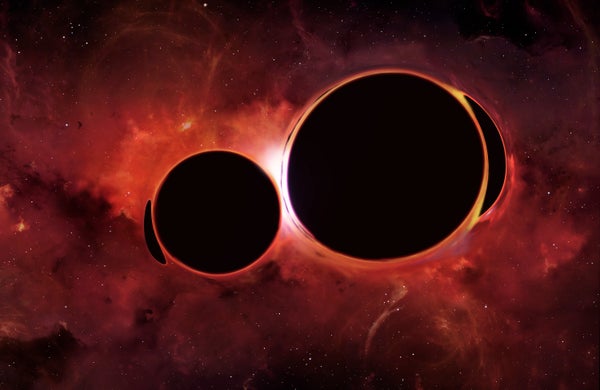
Illustration of two black holes in orbit.
Mark Garlick / Science Photo Library / Getty Images
A long time ago, in a galaxy far, two black holes danced one around the other, approaching more and more until they end in a cosmic collision which sent undulations through the fabric of space-time. These gravitational waves have traveled for more than a billion years before reaching the earth. On September 14, 2015, the Observatory of the Laser Interferometer Gravitational Onde (LIGO) heard their chirping signal, marking the very first detection of such a cosmic collision.
Initially, scientists expected Ligo detecting only some of these collisions. But now, approaching the 10th anniversary of the first detection, we have already observed more than 300 events with gravitational waves, discovering fully unexpected black holes. Recently, on July 14, Ligo scientists announced the discovery of the most massive merger of two black holes never seen.
Astronomy with gravitational waves has become a global company. Meronné by the two advanced Ligo detectors in the United States and reinforced by collaboration with detectors in Italy (Virgo) and Japan (Kagra), the field has become one of the boundaries richest in data and exciting in astrophysics. It tests fundamental aspects of general relativity, measures the expansion of the universe and questions our models of the way the stars live and die.
On the support of scientific journalism
If you appreciate this article, plan to support our award -winning journalism by subscription. By buying a subscription, you help to ensure the future of striking stories about discoveries and ideas that shape our world today.
Ligo has also stimulated the design and development of technologies beyond astronomy. For example, the progress of quantum technologies, which reduce noise and thus improve sensitivity to Ligo detector, have promising applications for microelectronics and quantum computer science.
Given all of this, it is not surprising that the Nobel Prize in physics was awarded to the founders of Ligo in 2017.
However, despite this extraordinary success, the estate is now faced with an existential threat. The Trump administration proposed to reduce the total budget of the National Science Foundation (NSF) by more than half: a decision so serious that one of the two Ligo detectors would be forced to close. The construction and upgrading of the two Ligo detectors required a public investment of around 1.4 billion dollars in 2022, so the abandonment of half of this project would now be a gigantic waste. A Committee of the US Senate in mid-July rejected against Ligo Colling, but the congress recently fell against requests to reduce the administration budget, always leaving it on the table.
The reduction of $ 19 million proposed to the LIGO operations budget (a reduction compared to 2024 out of approximately 40%) would be an act of myopia. With a single LIGO detector running, we will detect only 10 to 20% of the events we have seen with the two operating detectors. As a result, the United States will quickly lose its leadership position in one of the most revolutionary fields of modern science. Astronomy with gravitational waves, in addition to being a technical success, is a fundamental change in the way we observe the universe. Getting away now would be like inventing the microscope, then throwing it aside before we have a good chance of looking through the lens.
Here is why losing a detector has such a devastating impact: the number of events with gravitational waves that we plan to detect depends on the distance that our detectors can “see”. Currently, they can identify a merger of binary black hole (like that detected in 2015) at a distance of seven billion Light years! With only one of the two Ligo detectors operating, the volume that we can probe is reduced to only 35% of its original size, reducing the detection rate expected by the same fraction.
In addition, distinguishing the signals from real gravitational waves from noise is extremely difficult. It is only when the same signal is observed in several detectors that we can identify it with confidence as a real gravitational wave event, rather than, for example, the vibrations of a passing truck. Consequently, with a single functioning detector, we can only confirm the most vanilla and unambiguous signals. This means that we will miss extraordinary events like the one announced in mid-July.
Taking into account both the reduced detection volume and the fact that we cannot confirm that vanilla events, we arrive at the expected gravitational wave detections.
Finally, we will also lose the ability to follow events with gravitational waves with traditional telescopes. Several detectors are necessary to triangulate the position of an event in the sky. This triangulation was essential for monitoring the first detection of a fusion of binary neutron stars. By identifying the location of the fusion in the sky, telescopes around the world could be called to action to capture an image of the explosion that accompanied gravitational waves. This led to a cascade of new discoveries, in particular the realization in 2017 that these mergers constitute one of the main gold sources in the universe.
Beyond Ligo, the proposed budget also ends support in the United States for the gravitational waves mission based on the space led by Europe Lisa and almost guarantees the cancellation of the gravitational waves of new generation Cosmic Explorer. The United States is thus ready to lose its position as world leadership. While Europe and China advance with ambitious projects such as the Einstein, Lisa and Tianqin telescope, it could not only miss the next wave of breakthroughs but also in a significant brain leak.
We cannot predict what discoveries still await us. After all, when Heinrich Hertz confirmed for the first time the existence of radio waves in 1887, no one could have imagined that they would one day wear the internet signal that you used to load this article. This underlines a vital point: although science cuts seem to have only minor effects in the short term, the systematic funding of fundamental sciences undermines the foundation of innovation and discovery which has long motivated progress in the modern world and fed our economies.
The detection of gravitational waves is a breakthrough with tie with the first detections of X -ray or radio waves, but even deeper. Unlike these forms of light, which are part of the electromagnetic spectrum, the gravitational waves come from an entirely different force. In a way, we have released a new meaning to observe the cosmos. It’s like before, we could only see the universe. With gravitational waves, we can hear all the sounds that accompany it.
Choosing to stop listening now would be stupid.
It is an article of opinion and analysis, and the opinions expressed by the author or the authors are only theirs and not those of an organization with which they are affiliated or necessarily those of American scientist.


