‘Gringo go home.’ Mexico City protests target Americans, gentrification

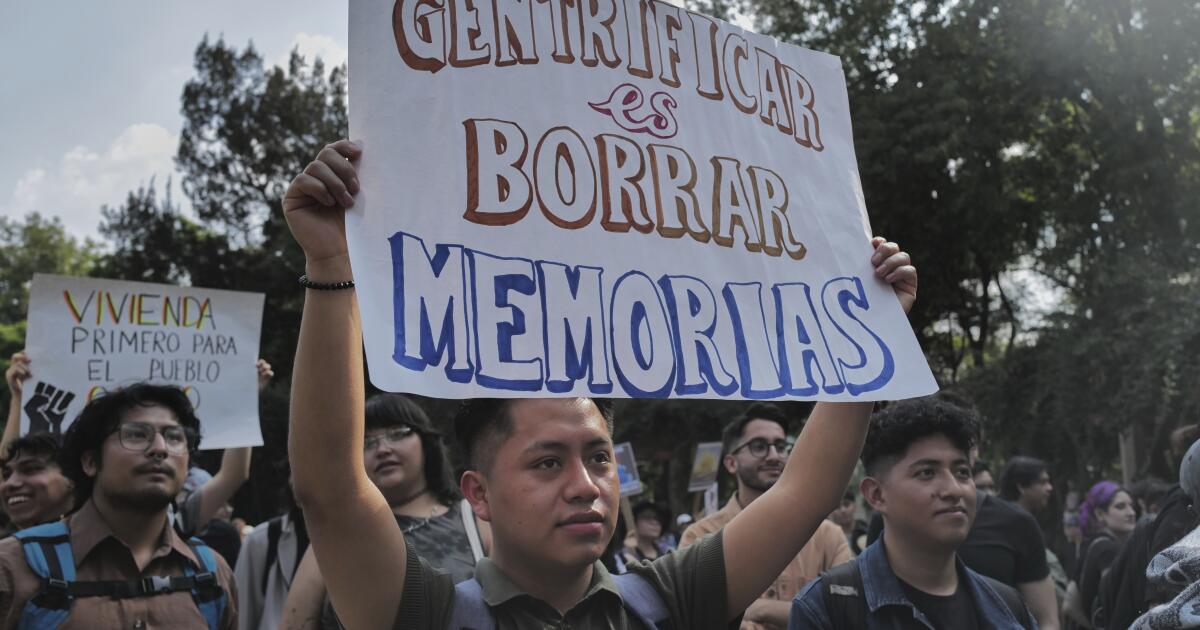
Mexico – Since the first days of the pandemic, foreigners have flooded Mexico City, in particular Americans and Europeans driven by the cost of living and the possibilities of remote work.
Meanwhile, several districts of the city center have been transformed, with wracks, corner stores and hairdressing salons replaced by wine bars, cafes and Pilates studios, many of which make English advertising. The rents have skyrocketed and some residents were prices of their houses.
Some blame the tightening of the city’s housing and the increase in the costs of newcomers – and more than 35,000 Airbnbs operating here.
In recent days, this anger has overturned in the streets.

A protester burns a effigy of the American president Trump at the Mexico prosecutor in Mexico City on Friday, during a protest against gentrification, because the increase in workers at a distance increased prices and increased the demand for housing in neighborhoods like Condesa and Roma.
(Jon Orbach / Associated Press)
A march against gentrification has attracted hundreds of people, demonstrators holding signs that said “Gringo returns home” and demanding that Mexican leaders slow down short -term and tax foreigners.
It took place on July 4 – the day of independence of the United States – and was announced as a protest against “American imperialism”.
The march, which passed the United States Embassy, was mostly peaceful. But later, some walkers turned to vandalism, breaking windows of more than a dozen storefronts, including a bank, a popular tacos and a Starbucks.
The videos have shown that demonstrators harass tourists sitting in a high -end taquer until they get up and left. Some customers sitting in cafes on the street targeted by the demonstrators protested that they were Mexicans, and not foreigners, in some cases, indicating their identification cards.
In some parts of the city, the walls remain scribbled with graffiti: “My culture is not your trend” and “kill a gringo”.
The demonstrations, which have echoed the demonstrations against mass tourism and the high accommodation costs in other places, notably Barcelona and Berlin, have challenged the longtime concept of Mexico as a place that welcomes foreigners.
And they add fuel to increase bi-national tensions because President Trump threatens the prices on Mexican imports and seeks to expel immigrants living without authorization in the United States. Trump’s attacks on Mexico have sparked a wave of nationalism, some people pushing a boycott of American products and companies embracing the red, green and white of the Mexican flag in advertising campaigns.
On social networks, where commentators have both applauded and assaulted the demonstrations, the American department of internal security joined the fray, publishing an article on X Sunday by encouraging unauthorized immigrants to self-partner via a future request for customs protection: “If you are in the United States illegally and wish to join the next demonstration in Mexico, use the CBP Home App facilitate your departure. ”
Mexican leaders condemned vandalism and the nativist tone adopted by many demonstrators.

A demonstrator throws a restaurant chair at the end of a peaceful demonstration which became violent against gentrification in Mexico City on Friday.
(Aurea del Rosario / Associated Press)
“Xenophobic exhibitions of this type must be sentenced,” President Claudia Sheinbaum said on Monday at her daily press conference. “Mexico is a country open to the world.”
But she pointed out that the demonstrators had legitimate complaints and that “gentrification is a phenomenon that must be addressed”.
The mayor of Mexico City, Clara Brugada, who, like Sheinbaum, belongs to the left political party which controls a large part of the country, said that the city must focus on the construction of more affordable housing.
“We must continue to implement public measures and policies to fight against these phenomena,” she said on Monday. “The demand for housing and rent increases overnight, and residents are expelled because they no longer have the economic means to live there.”
Sheinbaum, who was mayor of Mexico City before being elected president, was criticized during her mandate for not having taken stronger measures against the dispossession of long -standing residents while the owners rented properties to digital nomads, tourists and other foreigners. The demonstrators say that the government is still not enough.
“We are not against migration, which is a human right,” wrote one of the collectives that organized walking in a press release. “But we must recognize that the state, institutions and local and foreign companies offer different treatment to those who have greater purchasing power.”
Analysts have rejected the allegations that an influx of foreigners is largely responsible for increasing costs in Mexico City.
“The reality is that, with or without Gringos, the accommodation in Mexico has become extremely more expensive,” wrote Viri Ríos, political scientist, in the newspaper of El País. From 2005 to 21, house prices across Mexico increased by 247%, she said. This includes low tourist flow states, such as Morelos, where prices increased by 193%. She said increases from Mexico City has actually decelerated from the pandemic.
“The rise in Mexico City precedes the Gringos, occurs throughout the country and has causes that go beyond the arrival of tourists or digital nomads,” she wrote. More to blame, she said: high construction costs and public policies that mean construction do not meet demand. She said that Mexico officials have adopted Airbnb in large part because it is much easier to collect the company’s taxes compared to long -term rentals, many of which are paid in cash.
Some of the districts currently at the debate center were first wrapped by the Mexicans.
Mexico has long been the best foreign travel destination for the Americans, its beaches and its stubbornness attracting tens of millions of American visitors per year. But the Americans began to seriously flood Mexico around 2016, when the New York Times appointed him the best travel destination in the world, and magazine writers wondered if it was “New Berlin”.
Artists, chefs and international designers have arrived, by collecting cheap studio spaces, opening restaurants and integrating into the city’s nocturnal life.
The pandemic pushed her to overdrive. While a large part of Europe and Asia closed their doors to the Americans in 2020, Mexico, which adopted few covid-19 restrictions, was one of the few places where the Gringos were welcome.
Make things easier: Americans have long been able to stay here up to six months without a visa.
For remote workers who gain dollars, the call is clear: for the cost of $ 2,500 to a room in Los Angeles or New York, a person can rent a penthouse here.
The phenomenon transforms some of the most beloved districts of the city into expatriate enclaves.
English rings everywhere in the green and accessible districts on foot from the Roma, Condesa, Centro and Juárez.
For years, most people in this metropolis were unwavering and patient with international visitors.
But some chilangosAs the inhabitants are known, are fed up.

A protest panel is displayed on a makeshift clothes rope during a demonstration against gentrification in Mexico City on Friday.
(Fernando Llano / AP)
A few years ago, posters with explanatory laces appeared in town. “New in the city? Work from a distance? ” They read in English. “You are AF – Plague and the residents F you hate. Go. “
This feeling echoed the hundreds of answers that flocked after a young American published an apparently harmless tweet: “Do a favor and distant work in Mexico – it’s really magical.”
“Please don’t do it,” read one of the most beautiful answers. “This city is becoming more and more expensive every day because of people like you, and you don’t even come from it or you care.”
Genoveva Ramírez, 35, who works in marketing and advertising, makes two hours a day in the Juárez district because rent in the city is “impossible for me”. The same goes to take the tab in restaurants, where the price of a sandwich could be quadruple what it was. “When you see these places,” she said, “they are full of foreigners.”


