Utilities are doing even worse on climate than they were 5 years ago


Since 2021, the Sierra Club has classified American public services on their commitment to a clean energy transition. While most public services have not obtained high notes on the group’s annual dashboards, as a whole, they had shown progress.
It’s over now. The latest edition of the Sierra Club “The Dirty Truth” report reveals that the country’s greatest public electrical services collectively worse on climatic objectives when the organization began to follow its progress five years ago. This year, they obtained an overall note of “F” for the first time.
With only a handful of rare exceptions, American public services lost the gains they made during the Biden administration. Almost none is on the right track to pass fossil fuels with carbon -free energy at the speed and scale necessary to combat the worst climate change damage.
“It is very disappointing to note that we are at a score lower than that of the first year,” said Cara Fogler, principal analyst of the Sierra Club, who co-written the report. But it is not entirely unexpected.
How low oil prices have transformed Trump’s call to “break through, baby, unravel” in a pipe dream
Public services had already started to slip their carbon commitments last year in the face of the outbreak of electricity demand, according to the “Dirty Truth” report of 2024, largely in response to the boom of the data centers used to supply the objectives of the AI. But the anti-renewal agenda of pro-fossil foods from the Trump administration and the Republicans in the Congress pushed this overth in overdrive.
“We have a new federal administration that does everything in their power to send public services in the direction of cleaner power,” said Fogler. “They delete everything in the law on the reduction of inflation which supported clean energy. They are direct in difficulty clean energy, as we have seen with Revolution Wind”, the offshore wind farm of New England which is now under a work order. “And they do everything in their power to maintain online fossil fuels” – for example, through the actions of the Ministry of Energy which force coal, oil and gas factories to continue running even after their owners and regulators were satisfied with retirement dates.
But public services are also responsible for not doing more to adopt technologies that offer cleaner and cheaper power, said Fogler. “From the point of view of costs, from the point of view of health, from the point of view of pollution, there are so many reasons to build a cleaner energy and less fossil fuels. Unfortunately, we note that public services are much less concerned with doing the right thing for the climate and their customers. ”
What’s the score?
For its new report “The Dirty Truth”, the Sierra Club has analyzed 75 of the country’s greatest public services, which together have more than half of the country’s generation of coal and fossil gas. The report measures the plans of public services against three references: if they intend to close all the power plants with coal remaining by 2030, that they intend to build new gas power plants and the capacity of clean energy that they intend to build by 2035.
In mid-2025, public services intended to build only enough solar and wind capacity to cover 32% of what should be necessary by 2035 to replace the production of fossil fuels and meet new demand. While 65% of public services have increased their clean energy deployment plans since 2021, 31% reduced them.
Meanwhile, commitments to reduce dependence on fossil fuels have taken a big step back because the public services turned to the old coal centers and plan to build more petrol plants to meet growing demand. In mid-2025, public services intended to close only 29% of coal production capacity by 2030, against 30% last year and 35% in 2023.
With the kind permission of the Sierra Club
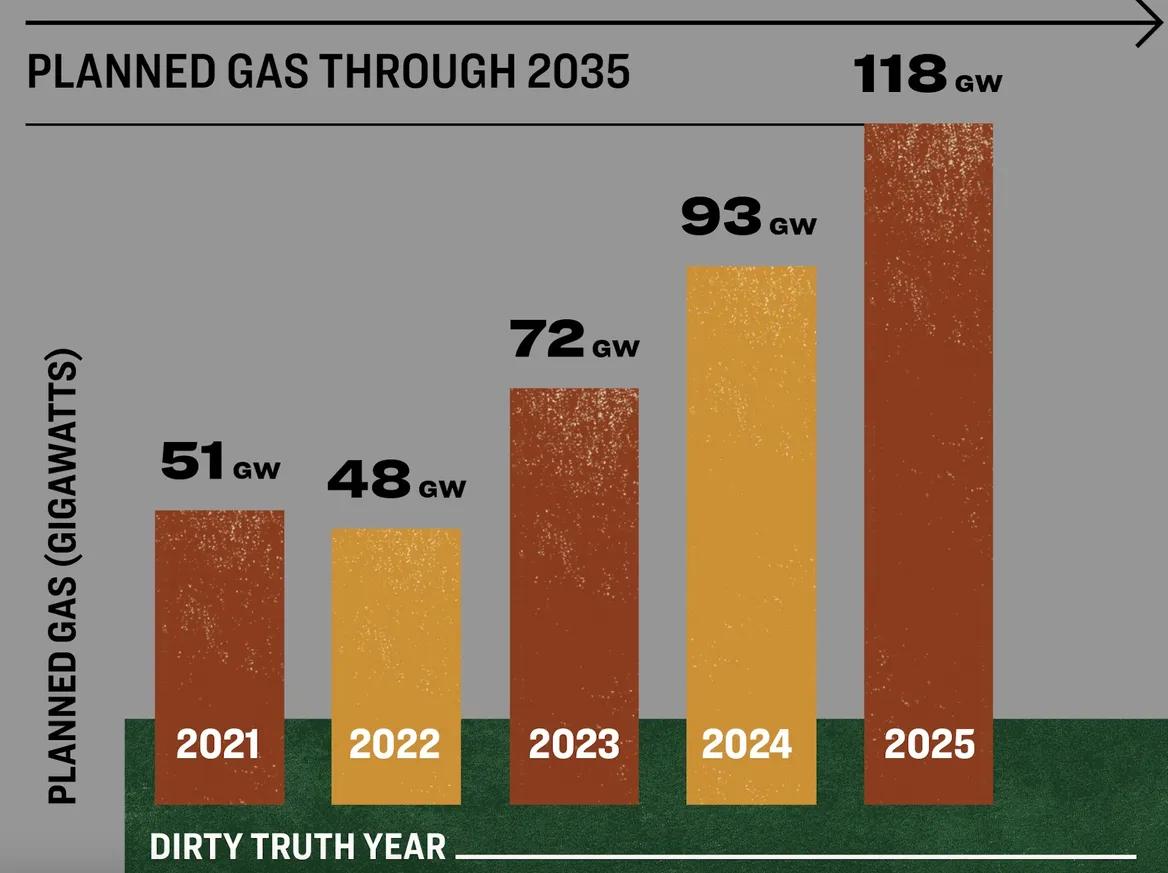
And the quantity of gas production capacity that the public services plan provides by 2035 increased to 118 gigawatts in mid-2010. It was up 93 gigawatts in 2024, and more than double the 51 gigawatts scheduled for 2021.
This growing appetite for a new gas supply has been supervised by the sharp increase in the demand for electricity provided in a large part of the country – data centers are the main engine of this growth. But a large part of the expected demand from the data center is speculative. And the part of the lion is based on the idea that the hundreds of billions of dollars in investment in AI of technology giants like Amazon, Google, Meta and Microsoft as well as the managers of AI like Openai and Anthropic will eventually earn enough money to repay their costs – a risky bet.
The Sierra Club is part of an increasing number of groups requiring public services and regulators to be cautious in the construction of power plants to serve the data centers that may never materialize. The energy demand for the planned data center already increases public services prices for everyday customers in certain parts of the country, and the new gas power plants now in public service plans are not even built.
“There is a charge that we will naturally see – there is a population growth, a lot of beneficial electrification that we want to see occur,” said Noah Ver Beek, senior analyst of energy campaigns at the Sierra Club and another co -author of the report. “But we also want public services to be realistic on load growth projections.”
Why is your energy bill suddenly much more expensive
Unfortunately, the growth in booming demand gives public services “more coverage” to invest in polluting assets, said Fogler. Public services make guaranteed benefits on the money that they spend by building power plants and network infrastructure, which gives them an incentive to avoid questioning high -growth forecasts or looking for alternatives at a lower cost or less polluting.
Some of the most aggressive fossil fuels extensions are planned for the Midwest and the Southeast, including by Dominion Energy in Virginia, Duke Energy in North Carolina and Georgia Power.
Even the handful of public services which previously obtained high notes for clean energy commitments and coal fence in previous “Sluthring Truth” reports have slipped. Fogler highlighted the example of Indiana Utility Nipsco, which obtained an “A” in the last four reports, but only a “B” in the last one, largely because of its plan to rely on gas power plants to meet the expected demand for the data center.
Nipsco has “no intention of continuing the high-charge growth scenario until they see the contracts signed and the progress made,” said Fogler-a prudent approach that avoids charging customers with the costs of new power plants designed for data centers that may never be put online, she said. “The problem? Their high -load growth scenario requires all new gases. There should be cleaner options. ”
Most public services do not capitalize on solar and wind tax credits that should disappear in mid-2016 under the Mégalaw adopted by the Republicans at the Congress this summer, she said. Only a handful of public services, such as Xcel Energy in Colorado and Minnesota, accelerate their clean energy deployments to take advantage of these tax credits. “We want more public services to take this period of certainty and accelerate what they have already planned.”
Going large on clean energy is also the only way to quickly add a sufficient production capacity to meet the growing forecasts of demand and contain increased public services costs, noted Green Beek. Public services and large technological companies pinpoint their short -term expansion plans on new gas power plants, despite one -year manufacturing history for turbines that feed these factories and the rapid increase in turbine costs.
“From the point of view of costs, from the point of view of the climate, we want to see the public services plead to obtain as much online energy as possible,” he said.


