Has Trump kept his promise to tackle rising prices?


Tom EdgingtonBBC Check, Washington DC

 Getty Images
President Donald Trump was swept to power for a second time on a central campaign promise to fight inflation.
The sharp rise in the cost of living was a top concern among voters, and Trump blamed President Joe Biden.
He also made sweeping promises to lower prices for Americans “from day one.”
A year after his victory, BBC Verify returns to certain of the president’s assertions.
Grocery stores
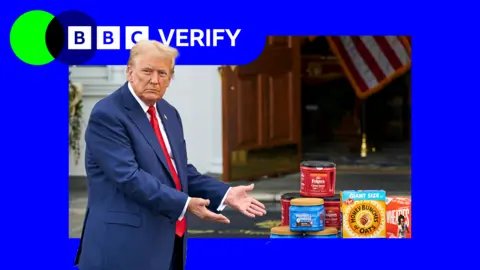
“When I win, I will immediately lower prices, from day one,” Trump said at a press conference in August 2024, surrounded by packaged foods, milk, meats and eggs.
Official data – which includes a four-month period when Biden was still president – shows that food prices rose 2.7% in the 12 months to September 2025, with some items seeing significantly larger increases:
- Coffee: 18.9%
- Ground beef (ground beef): 12.9%
- Bananas: 6.9%
Since Trump took office in January, the data also shows that aside from a drop in April, food prices have increased every month.
“The president of the United States has very little control over the price of food, especially in the short term,” Professor David Ortega, a food economics expert, told BBC Verify.
Trump’s tariffs are driving up the prices of some foods, he said: A third of the coffee consumed in the United States comes from Brazil and is therefore subject to 50% tariffs.
Trump’s crackdown on illegal immigration may also have had an impact, Ortega adds, particularly in the agricultural sector, where up to 40% of workers are estimated to be undocumented, or nearly a million people.
“As you know, farmers and businesses need to raise wages to attract more workers. But trying to quantify these impacts in terms of price increases is almost impossible at the moment.”
Diane Swonk, chief economist at KPMG, says changes in tariffs and immigration policy have contributed to rising costs.
“There is no doubt that these changes are now starting to translate into inflationary pressures,” she said.
But she adds that other factors, including weather events, have contributed to this situation.
“When it comes to coffee, you had climate problems due to a very poor growing season and that was exacerbated by tariffs imposed on Brazil and Colombia,” she said.
 Getty Images
A White House official told BBC Verify that President Trump has no control over the weather in South America and that rising coffee prices are a global phenomenon.
Data tracking the cost of coffee shows that prices rose globally, peaking in February, but are now falling.
The same official said the president was trying to address rising beef prices by temporarily increasing imports.
Although food prices have increased overall, not all items have become more expensive.
When Trump took over from Biden in January, the price of a dozen large eggs was $4.93 (£3.79), reaching a record high of $6.23 (£4.78) in March following outbreaks of bird flu.
Prices have since fallen to $3.49 (£2.68) a dozen.
“President Trump’s supply-side policies are taming Joe Biden’s inflation crisis,” White House spokesman Kush Desai said.
Other items that have fallen in price over the past 12 months include: butter and margarine (-2%), ice cream (-0.7%) and frozen vegetables (-0.7%).
Electricity
During his campaign, Trump pledged to slash his electric bills.
“Under my administration, we will cut energy and electricity prices in half within 12 months, with a maximum of 18 months,” he said at an August 2024 rally.
Since he has been president, prices have increased.
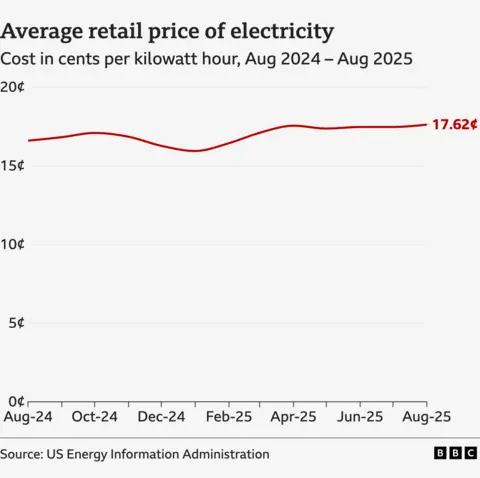
The latest figures show average residential electricity rates rose to 17.62 cents per kWh (kilowatt hour) in August 2025, up from 15.94 cents per kWh in January 2025, according to the U.S. Energy Information Administration.
“It was technically impossible [to halve prices] at the time, he made the promise,” according to Professor James Sweeney of the Stanford Precourt Institute for Energy.
Electricity prices reflect not only the cost of production, but also the expense of getting it through “the cables and the transformers and everything else,” he said.
Professor Sweeney attributes the increase to demand and supply issues.
“We are seeing an increase in demand, mainly driven by data centers. People creating images using artificial intelligence consume significant amounts of electricity.”
 Getty Images
He added that cuts to renewable energy subsidies and tariffs on imported steel – which increase the cost of building new electricity generators – have also pushed up prices.
Swonk acknowledges that the AI boom is driving up prices, especially for low-income people.
“This exacerbates inequality because consumers who have more access to solar panels and renewable energy are generally wealthier households,” she said.
In response, a White House official said Trump was expanding coal, natural gas and nuclear power, which was “the only viable way to meet growing energy demands and drive down energy prices.”
Cars
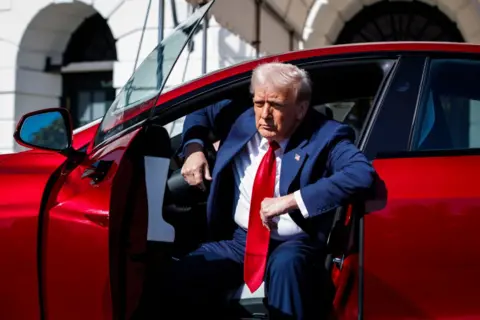
At a September 2024 campaign rally, Trump extended his commitment from groceries to cars, telling supporters, “We’re going to bring prices down…on groceries, on cars, on everything.”
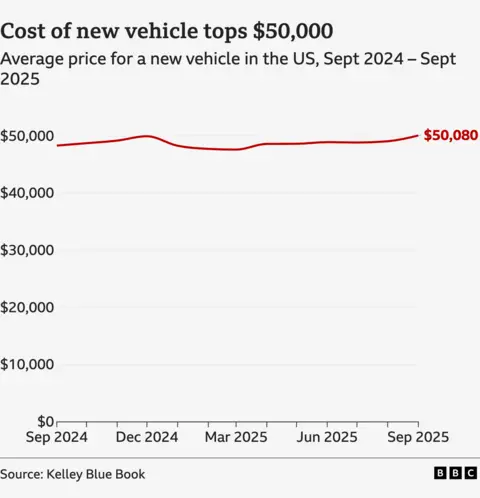
However, the average price of a new car exceeded $50,000 (£38,411) for the first time in September, up from $48,283 (£37,092) in January, according to Kelley Blue Book, a US vehicle valuation research company.
Car prices typically rise 2 to 3 percent a year, said Erin Keating of Cox Automotive.
“Tariffs, which have been the most significant factor in the auto industry over the past 12 months, have been nothing but inflationary.”
She said new car prices are rising about 4% a year, with tariffs contributing at least one percentage point.
“We definitely think in 2026 it’s going to increase because most manufacturers are holding back on raising prices directly due to tariffs, but they’re going to have to step in at some point.”
Keating pointed to the personal tax breaks in Trump’s spending bill, which she said could incentivize people to buy new cars.
Asked about rising car prices, a White House official told BBC Verify that the administration had taken historic regulatory actions to “reverse the left’s radical energy scam and save billions every year.”
 Getty Images
Essence



