He witnessed the sun’s power ‘like nobody else before or since.’ Now his first portrait has been found

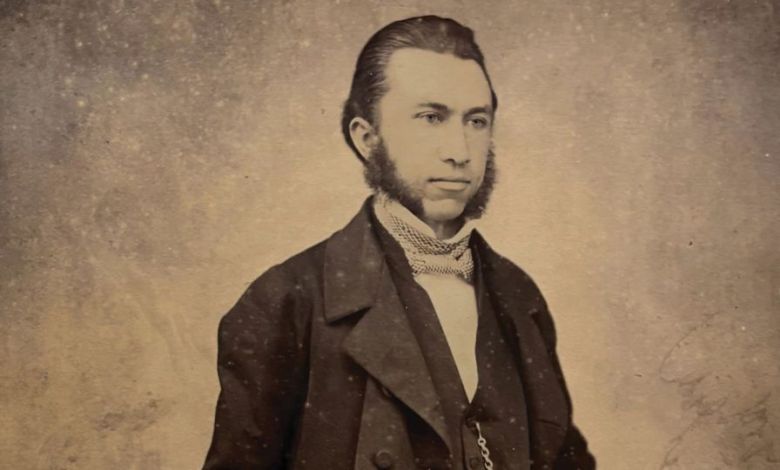
When solar storms erupt from the sun and reach Earth, their intensity is measured against a historical benchmark: the Carrington Event. Now a portrait of 19th-century British solar astronomer Richard Carrington has been discovered, finally providing a picture of the man after whom the event is named.
On September 1, 1859, powerful electrical surges delivered electric shocks to telegraph station operators and even started fires in their offices. According to the National Oceanic and Atmospheric Administration, some telegraph devices received messages that made no sense, while others sent messages even though they were not plugged in.
Incredibly bright auroras, typically seen in northern climates like Norway and Alaska, danced across the sky as far south as Panama.
This event remains the most intense geomagnetic storm on record – a major disruption of Earth’s magnetic field due to solar activity.
At the time, the effects of solar activity on Earth, called space weather, were not known.
Carrington had observed a large solar flare from the sun the day before – the first solar flare ever observed and recorded. He spotted the bright flare by using a telescope to project the image of the sun onto a screen.
Although his colleague Richard Hodgson also observed the eruption, Carrington established what is considered the first direct link between solar and geomagnetic activity: the eruption and the ensuing storm that arrived at Earth 17 hours later, said Mark Miesch, a research scientist at NOAA’s Space Weather Prediction Center.
“This connection then gave rise to the science of space weather,” Miesch said. “Richard Carrington witnessed the incredible power of the sun like no one else before or since.”
Despite his major contributions to solar physics, Carrington is not well known, and researchers suspect that this is partly because there is no face to bear his name.
Now the detective work of Kate Bond, assistant archivist at the Royal Astronomical Society in London, has uncovered the first and perhaps only known photograph of Carrington 150 years after his death.
A missing portrait
The archives of the Royal Astronomical Society contain Carrington’s original sunspot observations from 1853 to 1861, which are among the most requested because they contain his drawing of the 1859 solar flare.

Carrington’s illustration of sunspots was published in a November 1859 issue of the Monthly Notices of the Royal Astronomical Society. – Courtesy of NOAA
But searchers who wanted to see a photo of Carrington were out of luck because none were recorded, Bond said.
Bond became interested in Carrington after reading “The Sun Kings” by Stuart Clark. In the book, Clark mentions that he wished he could have seen a portrait of Carrington. A 2021 research paper by members of the Royal Astronomical Society also mentioned the search for the astronomer’s photo.
Even online searches revealed no resemblance, except for a mistaken photo belonging to British mathematician Lord Kelvin, taken around 1900, more than two decades after Carrington’s death.
Bond and Hisashi Hayakawa, an assistant professor at the Space-Earth Environmental Research Institute at Nagoya University in Japan, discussed what a lost Carrington portrait might look like during Hayakawa’s visit to the society’s library for separate research in June.
Like other scientists at the time, Carrington was a member of the Literary and Scientific Portrait Club, Bond said. And all members had to have their portraits taken at the Maull & Polyblank studio in London. The club operated between 1854 and 1865, when photography was in its infancy.
The National Portrait Gallery has a list of club members, which includes Carrington’s name as well as his title from 1857 to 1862 – secretary of the Royal Astronomical Society, Bond said.
The 2021 research paper also referenced an invitation letter sent to George Airy, the Astronomer Royal, to join the portrait club. Ten members of the club who had previously been photographed signed the letter, including Carrington.
However, exhaustive searches of museums and archives, including the UK’s National Portrait Gallery and the Royal Society, as well as the Getty Museum in Los Angeles and an impressive collection of Maull & Polyblank photos at the Harry Ransom Center in Austin, Texas, turned up nothing.
During his conversation with Hayakawa, Bond decided to research the frequency of sales of Maull & Polyblank photos or albums on auction sites. As a joke, she turned to eBay.
“A photography store opened in the United States selling a group of these photographs and one of them had ‘the late Carrington’ written in pencil on the backing,” Bond said in a statement. “The seller simply listed it as ‘Photo of Mr. Carrington,’ but without any biographical details. I couldn’t believe it.”
Illuminating clues
Staring back at her was a photo of a young man of around 30 – the age Carrington would have been in 1856 when the portrait was taken. Next to the mention of Carrington in the photo were the letters FRS, short for Fellow of the Royal Society.
The photo also matched the dimensions of all other photos associated with the portrait club.
After thinking all afternoon, Bond bought the picture that evening, fearing the opportunity would pass him by.
The seller, Bruce Klein, had purchased a Maull & Polyblank photo album at an auction in the early 2000s when he was looking for a specific photograph for his collection and decided to put the rest up for sale.
But further detective work was needed to confirm that it was indeed Carrington in the photo. The inscription of “the late Carrington” was concerning because it was written after his death in 1875, meaning anyone could have added it, even if they did not know what the astronomer looked like.
When the photo arrived, Bond spotted what she calls the smoking gun, something that wasn’t visible online.
“When I had the photo in my hands, I could see very light writing on the image itself,” she said in a statement. “I couldn’t read it: it was completely unintelligible. When we put it on a light box, it became clearer, but it was upside down.”
Bond took the photo to the photographic department of the John Rylands Library in Manchester, England, to ask whether the writing was an inscription on the back of the print, or whether it was smudged writing from a letter printed on the photo.

Placed face down on a light box, the photo reveals an inscription. – Royal Astronomical Society
Library experts concluded that it was an inscription on the back of the print that had been made before it was mounted.
“It’s important because it says, ‘RC Carrington, Esquire for CV Walker, Esquire,'” Bond said.
Charles Vincent Walker made Carrington a Fellow of the Royal Society, and the two were friends who attended Royal Astronomical Society Dining Club events together. Walker was also a member of the Photographic Club, and the inscription suggests that he owned the photo at one time.
“The photographer’s assistant’s error in writing on the back of the print – damaging what would have been an expensive photograph – made the identification possible,” Bond said.
Now Walker’s remembrance of his friend has been added to the archives of the Royal Astronomical Society. And Carrington’s photo already appears on his Wikipedia entry.
“It’s fitting that his photo also belongs to the company – it feels like he’s coming home,” Bond said. “I can’t say how likely this is. I don’t know how many copies of this print exist. This could be the only one, but it’s possible there are others.”
A new vision of the sun
Over a nine-year period, Carrington made major discoveries about the sun — but the case of his missing image was unique among the most prominent solar scientists of the past 400 years, said Dr. Ed Cliver, lead author of the 2021 paper and astronomer emeritus at the National Solar Observatory in Boulder, Colorado.
Carrington received a gold medal from the Royal Astronomical Society in 1859 for his catalog of circumpolar stars, or stars that never appear to dip below the horizon from certain vantage points on Earth.
In 1857, Carrington presented Heinrich Schwabe with a gold medal for his discovery of the Schwabe sunspot cycle, otherwise known as the solar cycle. The sun goes through an 11-year period of waxing and waning activity, which corresponds to sunspots and solar flares that occur on the sun’s surface.
But Carrington noticed that sunspots near the solar equator rotate faster than those at higher latitudes, Miesch said. His observations were the first to suggest that the sun is more fluid than solid – particularly plasma – with global currents carrying sunspots at different speeds depending on latitude.

Auroras dance in the sky above Jericho Beach in Vancouver, British Columbia, in May 2024, after a powerful solar storm hits Earth. -Chris Helgren/Reuters
“Carrington not only witnessed the incredible power of the sun; he saw deeply into its very nature,” Miesch wrote in an email. “This image of Carrington, so delightfully acquired, shows the intensity of a scientist but there is also a childlike wonder there. It reminds us that science is, and always has been, an intimately human endeavor.”
And then there is the event that bears his name. According to NOAA, solar storms such as the Carrington event occur approximately every 500 years, while those of half the intensity occur approximately every 50 years.
Lyndsay Fletcher, one of the authors of the 2021 paper and a professor of astrophysics at the University of Glasgow in Scotland, called Bond’s discovery of the portrait a stroke of luck and detective work.
For years, Fletcher studied the solar flares of white light discovered by Carrington.
“I imagine Carrington would be surprised to learn that 167 years later we still don’t fully understand their cause,” Fletcher said. “His article on the observation is wonderfully written, with much of his personality shining through, and so it is something to now see the face of the dedicated and competent scientist responsible.”
Sign up for CNN’s Wonder Theory science newsletter. Explore the universe with information on fascinating discoveries, scientific advances and much more.
For more CNN news and newsletters, create an account at CNN.com