U.S.-Iran peace talks in Islamabad collapse : NPR

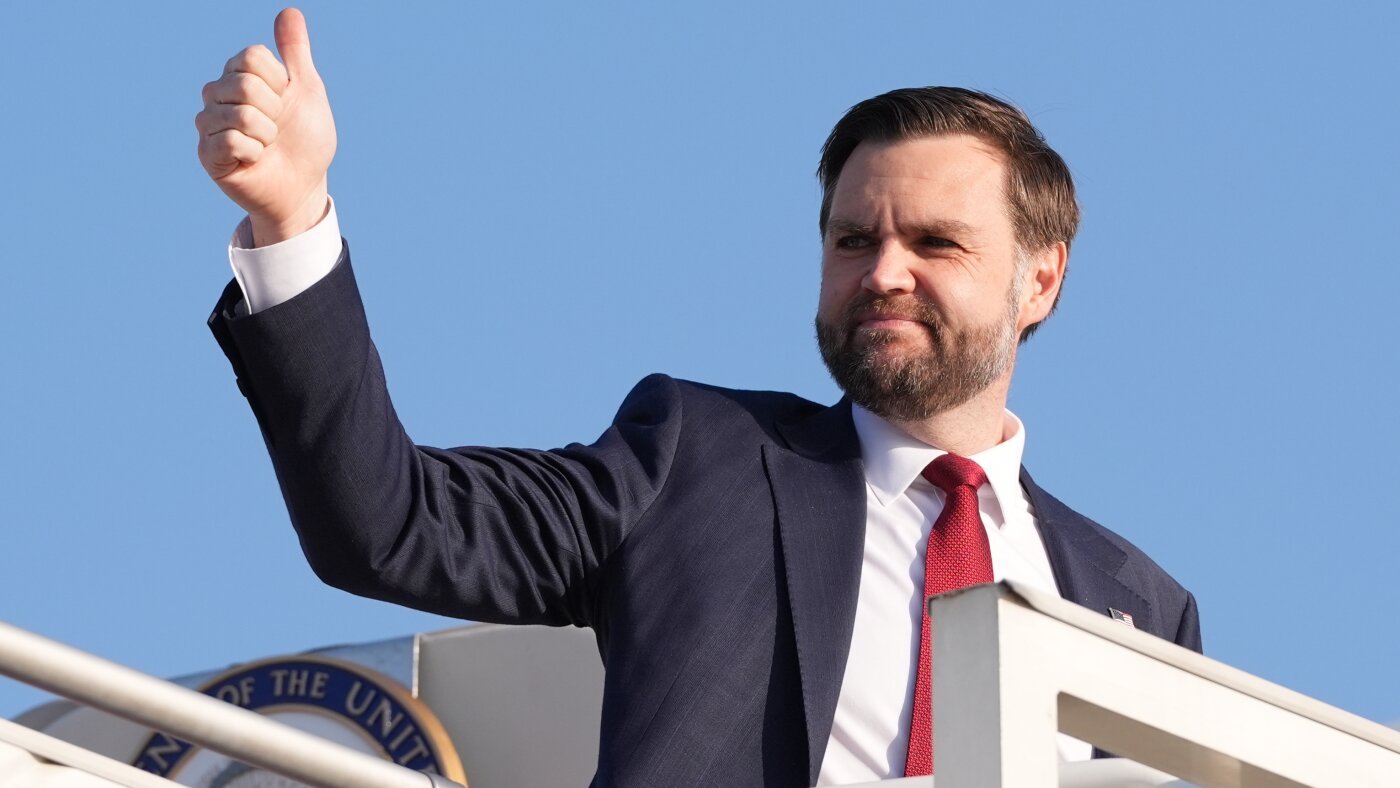

Vice President JD Vance gives a thumbs up as he boards Air Force Two after attending talks on Iran in Islamabad, Pakistan, Sunday, April 12, 2026.
Jacquelyn Martin/AP
hide caption
toggle caption
Jacquelyn Martin/AP
ISLAMABAD – The United States and Iran have failed to reach an agreement after a day of highly anticipated face-to-face peace talks, Washington’s chief negotiator, Vice President JD Vance, said Sunday.
“The bad news is we haven’t reached an agreement. And I think that’s bad news for Iran more than it is for the United States… they chose not to accept our terms,” Vance said at a news conference. press conference in Islamabad, before boarding Airforce Two to leave the country.
Asked about the main sticking point that led to the breakdown of the negotiations, Vance said: “The simple fact is that we need an affirmative commitment that they will not seek to obtain a nuclear weapon, and they will not seek the tools that would allow them to quickly obtain a nuclear weapon.”
For its part, Iran said the two sides had “reached agreement on a number of issues, but the discussions ultimately did not result in an agreement.”
Tehran has repeatedly declared that its nuclear program is civilian and that it has the right to continue enriching uranium for this purpose.
The status of the two-week ceasefire is now uncertain, but Vance left open the possibility that an agreement could still be reached, saying: “We leave here with a very simple proposal: a method of understanding that is our final and best offer.” He added: “We will see if the Iranians accept it.”
After the negotiations failed, Pakistan, which became a key mediator in the war and hosted the talks, said on Sunday it would continue to play a role in peace efforts. Foreign Minister Ishaq Dar urged both sides to continue to respect the ceasefire.
The talks – which lasted 21 hours – began on Saturday in Islamabad as the two sides sought to reach an agreement to end the war that has rocked the Middle East for six weeks.
This is the first face-to-face meeting between the United States and Iran since 2015, when the Obama administration negotiated a nuclear deal with Iran, which was later abandoned by Trump. It was also the highest-level talks since the 1979 Islamic Revolution.
Silence from Trump
So far, President Trump has not commented on the failure of the negotiations, despite postings in recent hours on his Truth Social platform on other issues. He spent Saturday night with Secretary of State Marco Rubio at a UFC fight in Miami.
However, earlier on Saturday, Trump said “We win, regardless” of the outcome of the negotiations, adding: “We have totally defeated this country.”
Vance said during his press conference that he had been in “constant” contact with the president during his stay in Islamabad.
Iran speaks of “excessive demands”
Iranian Foreign Ministry spokesperson Esmaeil Baqaei said in a statement post on and in a statement to Iranian state media, according to which the main topics of the negotiations were the Strait of Hormuz, nuclear issues, sanctions, reparations and ending the war against Iran and the region.
He added that issues, such as Iran’s demand to continue to control the Strait of Hormuz, added to the complexity of the negotiations and that “we should not have expected to reach an agreement in a single meeting from the start.”

A U.S.-Iran talks billboard is seen near the Serena Hotel, the venue for the U.S. officials’ meeting on Iran, in Islamabad, Pakistan, Sunday, April 12, 2026.
Anjum Naveed/AP
hide caption
toggle caption
Anjum Naveed/AP
However, he also criticized the United States, saying that “the success of this diplomatic process depends on the seriousness and good faith of the opposing party, which refrains from any excessive demands.”
As part of its multi-point negotiation plan, Tehran had demanded an end to Israeli attacks on Hezbollah as part of any permanent agreement. Other demands from the Iranian delegation include the release of $6 billion in frozen assets, safeguards around its nuclear program and the right to charge ships transiting the Strait of Hormuz.
Despite the breakdown in negotiations, some analysts noted that the optics of the meeting between the Iranians and Americans were still striking, just weeks after the United States and Israel launched the attack that killed Iran’s supreme leader.
The Iranian delegation had published photographs of a row of empty seats on the plane en route to Islamabad, on which were placed photos and bloodied belongings of schoolchildren killed in a US missile strike.
Fighting between Israel and Hezbollah continues
Israel’s refusal to stop fighting in Lebanon and respect the ceasefire with Iran threatens the truce. Iran threatened to cite “strong responses” and President Trump said Israel would reduce its attacks in Lebanon. But the attacks continue.
The Israeli military said over the weekend it had struck more than 200 Hezbollah targets, and Hezbollah said it was continuing its rocket, drone and artillery attacks against Israel and Israeli troops in Lebanon.
Lebanon says the Israeli and Lebanese ambassadors in Washington will hold their first direct meeting Tuesday at the State Department to discuss a ceasefire and a start date for negotiations.
In a speech, Prime Minister Benjamin Netanyahu claimed historic achievements in Iran and Lebanon and that his goal in the negotiations was to disarm Hezbollah and reach a peace agreement with Lebanon.

A woman mourns at her husband’s grave during the funeral of 13 state security agents killed the day before in an Israeli strike in the Lebanese coastal town of Sidon, Saturday, April 11, 2026.
Emilio Morenatti/AP
hide caption
toggle caption
Emilio Morenatti/AP
In an article for Orthodox Easter On Sunday, Lebanon’s prime minister said he hoped the country would “overcome the dangers we face together, and that stability, peace and prosperity can prevail throughout Lebanon.”
US warships pass through the Strait of Hormuz
The talks took place as two U.S. Navy guided-missile destroyers passed through the Strait of Hormuz on Saturday, a U.S. official told NPR, marking the first transit of U.S. warships since the war in Iran began six weeks ago.
U.S. Central Command (CENTCOM) said it had begun putting in place conditions to clear Iranian sea mines planted along the waterway to “encourage the free flow of commerce.”
Betsy Joles in Islamabad, D Parvaz in Van, Turkey, Daniel Estrin in Tel Aviv and Kate Bartlett in Johannesburg contributed to this report.


