
NEWYou can now listen to Fox News articles!
It was always going to be a tough act to follow.
San Jose State University’s volleyball team was eliminated from making the Mountain West Tournament with a loss Saturday to University of Nevada, Las Vegas, and finished the season under .500 with a 13-16 overall record and 8-10 in conference play.
SJSU outperformed expectations, finishing seventh in the Mountain West after being expected to finish 11th in the conference’s preseason coaches poll after a controversy involving trans athlete Blaire Fleming in 2024.
Head coach Todd Kress led last year’s team to the conference final but had eight wins, including the conference semifinal, awarded via forfeit. SJSU previously made the conference final with Fleming in 2022, the trans athlete’s first year with the Spartans under former head coach Trent Kersten.
CLICK HERE FOR MORE SPORTS COVERAGE ON FOXNEWS.COM
The controversy involving Fleming resulted in two lawsuits during the 2024 season, a federal investigation by the U.S. Department of Education and a mass exodus of players. At least seven of the team’s returning players from 2024 entered the transfer portal in December after the season ended.
The controversial 2024 season included eight forfeited matches, regular police protection, national scrutiny and internal turmoil between players and coaches.
Kress previously said the 2024 season was one of the “most difficult” of his life. Kress is 21st in NCAA women’s volleyball history in wins as a head coach.
“This has been one of the most difficult seasons I’ve ever experienced, and I know this is true as well for many of our players and the staff who have been supporting us all along. Maintaining our focus on the court and ensuring the overall safety and well-being of my players amid the external noise have been my priorities,” Kress said.
EX-SJSU STAR BROOKE SLUSSER MAKES NEW ALLEGATIONS ABOUT PROBE INTO TRANS TEAMMATE’S ALLEGED PLOT TO HARM HER
Kersten was the coach who recruited Fleming to SJSU as a transfer out of Coastal Carolina. Kersten then stepped down after the 2022 season and was replaced by Kress.
Former SJSU co-captain Brooke Slusser transferred to SJSU from Alabama in 2023
Then, in September 2024, Slusser joined a lawsuit against the NCAA alleging SJSU officials withheld knowledge about Fleming’s birth gender from her and other players on the team. Slusser alleged she was made to share changing and sleeping spaces with Fleming without knowing that Fleming was a biological male.
Slusser, along with several other players in the Mountain West, filed a separate lawsuit against the conference and San Jose State in November 2024 over Fleming’s presence. That lawsuit included testimony from former San Jose State volleyball players Alyssa Sugai and Elle Patterson alleging they were passed over for scholarships in favor of Fleming.
Assistant coach Melissa Batie-Smoose was suspended by the program in early November after she filed a Title IX complaint against the university for showing favoritism toward Fleming over the other players, especially Slusser. Batie-Smoose’s complaint also included allegations of Fleming’s plot to have Slusser spiked in the face.
CLICK HERE TO DOWNLOAD THE FOX NEWS APP
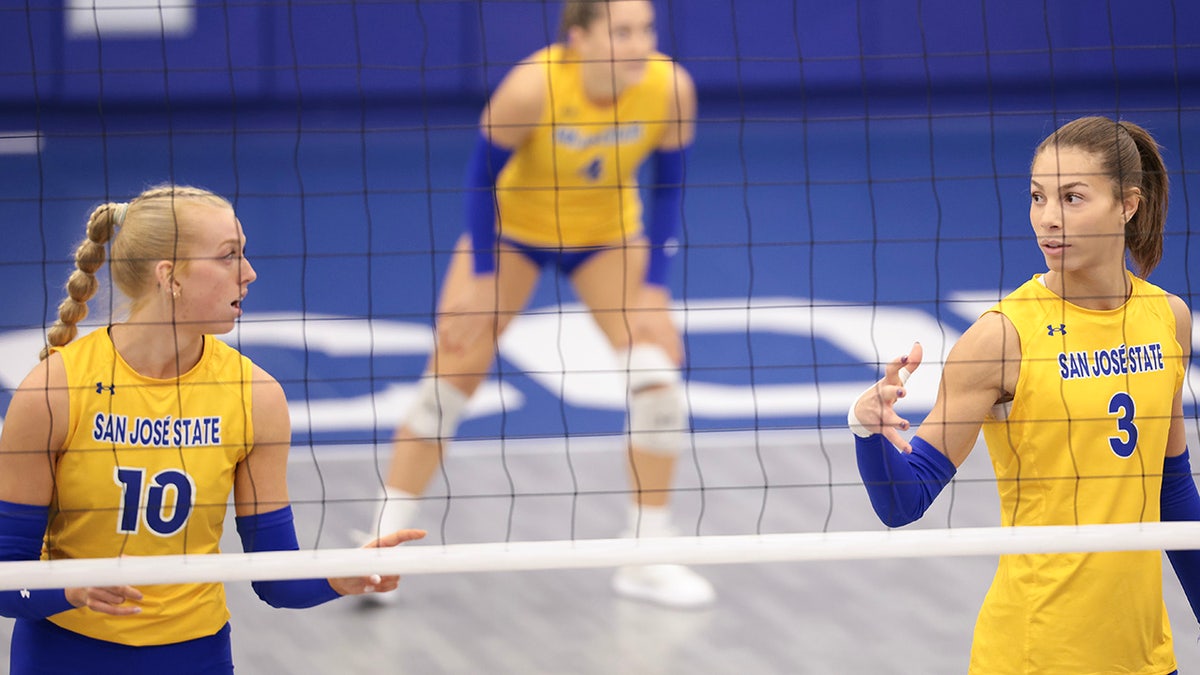
Brooke Slusser (10) and Blaire Fleming (3) of the San Jose State Spartans call a play during the first set against the Air Force Falcons at Falcon Court at East Gym Oct. 19, 2024, in Colorado Springs, Colo. (Andrew Wevers/Getty Images)
Batie-Smoose’s contract was not renewed by the school at the end of January. The coach then filed her own lawsuit against the Board of Trustees of the California State University (CSU) system. SJSU is one of 23 California-based schools that are part of the system.
Batie-Smoose told Fox News Digital that SJSU accommodated Fleming with special exceptions that were not granted to female athletes.
“Not showing up to practice with no excuses, sitting in the stands eating while practice was going on, those kind of things,” Batie-Smoose said of the special exceptions reserved exclusively for Fleming.
Fleming previously responded to Batie-Smoose’s claim and addressed Slusser in a social media exchange with Fox News Digital.
“The only times I showed up to practice with ‘no excuse’ and sat in the stands was when I was injured and couldn’t play. Brooke Slusser and Melissa need to get a life,” Fleming said.
After the 2024 volleyball season, Slusser fled SJSU after frequent alleged harassment and threats by other students in response to her speaking out against Fleming and the program the previous fall. She returned to her parents’ home in Texas to finish the school year remotely and is now working as a youth volleyball coach in North Carolina.
Fleming celebrated graduation from SJSU in a social media post in May.
The University of Nevada, Reno, which was involved in the 2024 controversy for trying to have its players compete against SJSU and Fleming despite preferring to forfeit, finished the 2025 season in 11th place with an 8-20 record, 4-14 in conference play.
Follow Fox News Digital’s sports coverage on X, and subscribe to the Fox News Sports Huddle newsletter.


