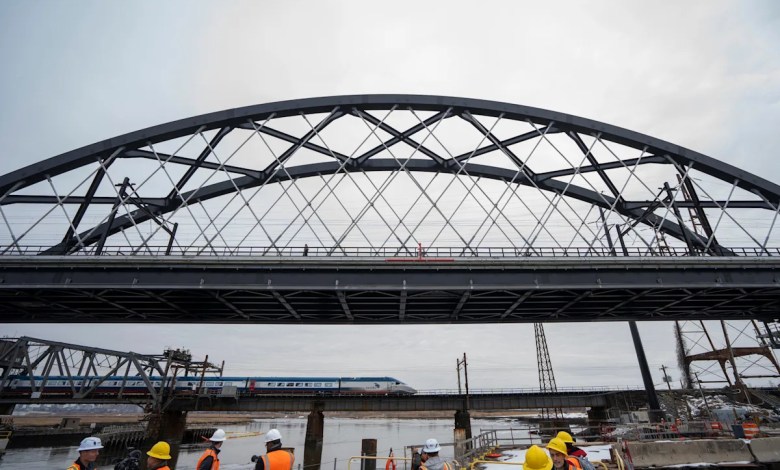
There is good news for grumbling and frustrated NJ Transit and Amtrak commuters dealing with four weeks of service reductions while crews switch to the track on the new Portal North Bridge: the work is on time, so far.
The meticulously planned work on this final stage of the project — which one Amtrak official described as the biggest infrastructure activation ever on the Northeast Corridor — is planned out down to the hour, with about 150 people working in two 12-hour shifts, 24 hours a day.
Work on this four-week “cutover” process is 25% complete.
“We’re on track and on schedule,” said Jason Hoover, assistant vice president of the major bridge program at Amtrak, on Feb. 19 during a media tour of the construction site in Kearny.
Story continues below photo gallery
Even with possible snow and inclement weather expected this weekend, Hoover is optimistic they’ll be able to push through, especially since they managed to work through the major snowstorm that hit a few weeks ago.
“Our crews have been working in the cold for the last few weeks, so I think we’re going to be OK,” Hoover said. “Our teams all meet in the morning before the day shift and in the evening before the evening shift to coordinate on what’s occurred, what’s gone to plan, what hasn’t gone to plan so we can react.
I don’t want to jinx us, but things are going to plan right now.”
The old Portal Bridge is 116 years old and around 450 trains use it to cross the Hackensack River on any given weekday. The four weeks of service reductions were required because one track on the old Portal Bridge has remained active while crews are working on the shoulders of the bridge to switch to the new track and bridge.
The second track will be switched over in the fall.
“We have a four-week, high-intensity operation going on, operations around the clock,” said Chrissa Roessner, acting chief of construction and project management at NJ Transit.
Adjusting wires, light signals
Crews could be seen on trucks with cherry pickers making adjustments to the overhead gantries that will hold wires, adjusting light signals and working in container boxes on the edge of the bridge where the communication and signal systems are housed.
In the first week of work, the crews have:
-
laid 2,600 feet of new track
-
delivered 2,500 tons of stones under the track bed
-
demolished and removed old overhead wires, as well as the structures that hold them up and old tracks
-
by the evening of Thursday, Feb. 19, new track on both ends of the bridge will be fully merged with the Northeast Corridor.
Week three work will be most critical, but least visible
Week two will be focused on electrical traction work, which includes installing the new overhead wires.
Tim Snow, a project manager for AECOM, one of the consultants on the project, said the third week is “probably the most critical” and the least visible.
It involves testing the system on site and from other locations, like Newark Penn and New York Penn Station, to ensure the signals and track surfaces are working as designed.
The fourth week is when the trains will run on the tracks for the final phase of testing before it can be commissioned for use by the riding public.
Once the new $2.3 billion bridge fully opens, trains will be able to travel up to 90 miles per hour, up from current speeds restricted at 60 miles per hour on the old bridge.
They should also have a significantly smoother ride because of the new wiring, infrastructure and track.
Work is scheduled to be completed — and full service restored — on the evening of March 15.
This article originally appeared on NorthJersey.com: When NJ Transit riders can expect service disruptions ending


