Here’s why people say they’re using ‘Are You Dead?’ and apps like it : NPR

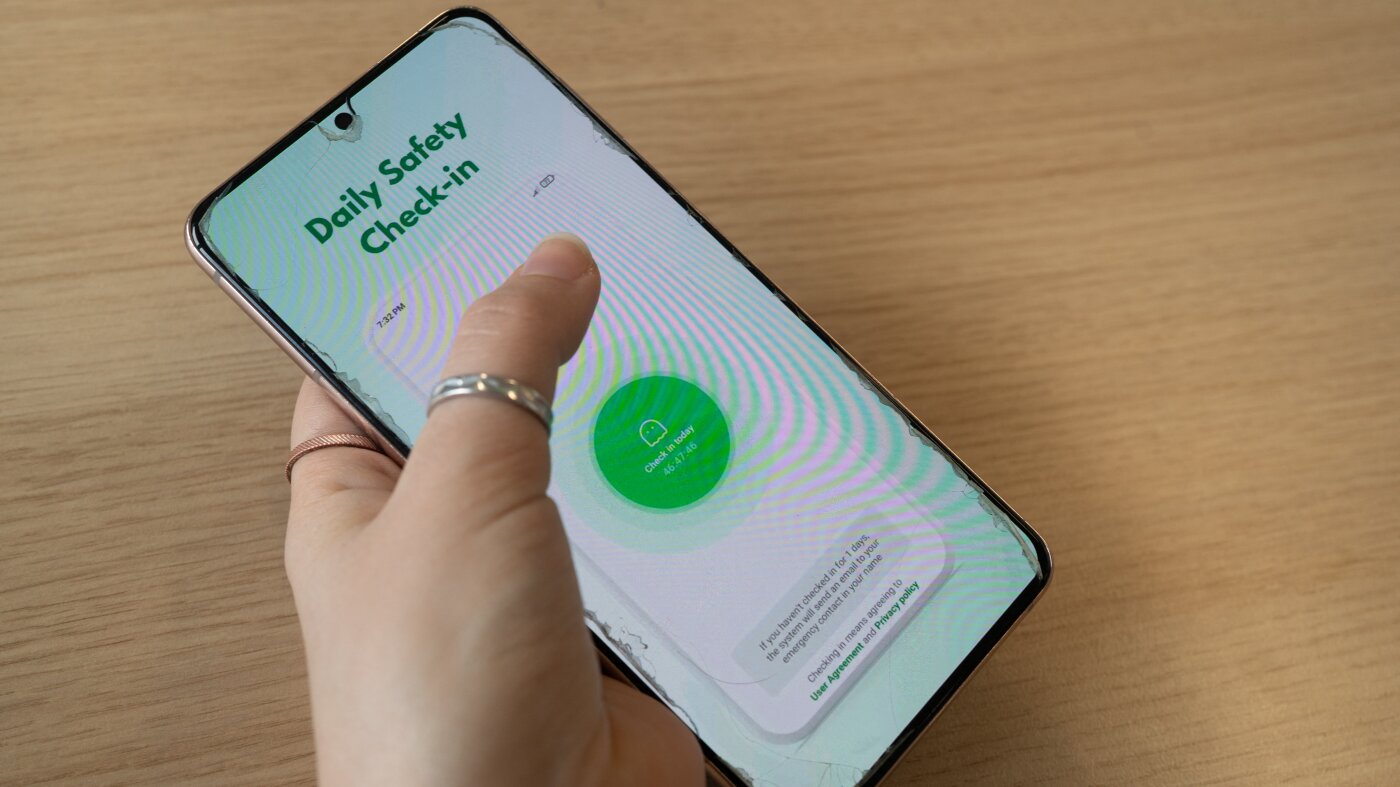

A person holds a phone that displays the message “Are You Dead?” » app in Paris on January 22.
Felice Rosa/Hans Lucas/AFP via Getty Images
hide caption
toggle caption
Felice Rosa/Hans Lucas/AFP via Getty Images
Every day, after feeding his cat and tidying up his house, Johnny Miller has one more task on his to-do list: confirming on his phone that he is indeed still alive.
He does this through a Chinese app called Sileme, which in Mandarin means “Are You Dead?” » Its function lives up to its morbid name: users check in daily with the app. If they miss a certain number of records, the app notifies a designated emergency contact.
“It’s pretty nice. It’s almost like someone cares,” said Miller, 57, a former IT analyst from Seguin, Texas.
Although part of the app’s appeal is its dark humor, many people living alone have signed up for its convenience and to alleviate a very serious fear of dying without anyone’s knowledge for days or weeks.

Shortly after its release last summer, the app went viral — first among young people in China — sparking a discourse about the country’s grueling work culture, falling marriage rates and a shift toward individualism. Then, this past January, the app found international traction, becoming one of the highest-paying downloads in the Apple Store in Australia, Spain and the United States (the app recently changed its English name to “Demumu,” which is a combination of Death and the Labubu plush, according to Wired.)
In many countries around the world, more and more people are living alone. This includes the United States, where more than a quarter of all households include just one person, more than double the proportion in 1960, according to 2020 census data. The country’s trend toward physical loneliness also parallels rates of loneliness and social isolation.
Demumu is one of many security apps that have emerged over the years designed for people living alone. Their demand reflects broader changes within modern society, such as a decline in face-to-face social interactions and an erosion of mutual trust, according to Julianne Holt-Lunstad, director of the Social Connection & Health Lab at Brigham Young University.
“This is not a personal failure, but rather we live in a society in which there are so many obstacles that make it increasingly difficult to establish social connections,” she said.
It’s not just a worry among older people
The idea behind Snug Safety, a similar safety screening app, came from a conversation with a 70-year-old woman who lived alone and was worried that no one would know if anything happened to her, according to Preet Anand, CEO of Snug Safety.
“We realized there was a real need here,” he said.
It is with this in mind that the application was initially aimed at elderly people. But over time, Anand saw a wide range of people using Snug Safety. This includes single mothers, students, pet owners and people with health conditions who want to live independently.
For Anand, his app offers a “daily touchpoint” in an age where daily, consistent contact with others has become increasingly difficult to cultivate organically. He found that these touchpoints tend to be especially difficult to develop for people who work remotely or have moved to a new city.

“Independence is a great thing until it is taken to the point where it results in isolation,” he said.
Anand pointed out that other popular social media features, such as Snapchat’s “streaks,” Facebook’s “Poke” feature, as well as the Words With Friends app, unintentionally serve a similar purpose.
“It’s a very common human desire to feel safe and to know that the people we care about are safe,” he said.
Jamie Gartner, 40, a writing coach from Syracuse, New York, said she downloaded Snug Safety after suffering a mental health crisis a few years ago. Since she lives alone, Gartner was worried about the well-being of her two dogs and two cats if something happened to her.
“Ultimately, that was my biggest concern,” she said. “If I didn’t make it through this, what would happen to my animals and how would I know if they would be okay.”
This chapter of his life also brought a sobering reassessment of his social connections. When she was at her lowest, Gartner said very few people were watching her. She added that even now, thanks to the shift to remote work, she can go up to a week without interacting face-to-face with another human being.
That’s why, even though his mental health improved, Gartner continued to use Snug Safety.
“Even feeling like someone would be watching you if you forget to check in with the app is also a nice feeling,” she said.
But Gartner hopes she won’t need to use the app forever — that one day she can replace digital check-in with a life partner or group of friends.
Disconnected and disengaged
A majority of American adults only get together with their loved ones about twice a month or less, according to a survey published last year led by Holt-Lunstad of Brigham Young University. Most adults also don’t participate in group activities, such as clubs or community organizations, according to the survey. Holt-Lunstad attributes the growing isolation in part to social media.
“When we spend time on social media, for example, it can also give false indications that we are in contact with others,” she said.
Due to technological interdependence and changing social norms, people rely less on each other, she added. But offering and asking for help are crucial for connection, according to Holt-Lunstad, who was also the lead scientific editor of the U.S. surgeon general’s landmark opinion on social isolation and loneliness, released in 2023.
“Not only are we disconnected in various ways, but we are also becoming disengaged,” she said.

In Tucson, Arizona, Kenneth Badertscher, 64, said it was difficult to build relationships with his neighbors. Most of the residents at his apartment complex are students or young families who tend to move out after a few years, according to Badertscher. As a child, knowing your neighbors was the norm, he said.
Then, last year, Badertscher discovered Snug Safety. He told a neighbor who lives upstairs, who then told another tenant. Now all three use the app and serve as each other’s emergency contacts.
“The first person I talked to, she was actually very relieved,” he said. “She didn’t have a lot of contact with her family, so she thought it was a great idea.”
Badertscher spends a lot of his time alone in his apartment. His wife died of breast cancer a few years ago and he recently stopped working due to mental health issues. He also adopted a new puppy. To his surprise, the shared responsibility between his neighbors through the Snug Safety app brought them closer together.
“There’s this added dimension of what would otherwise be a casual friendship,” he said.
“A comfort to know that I am not the only one”
Tugrul Cirakoglu witnessed what happens when a person’s corpse goes unnoticed for days or weeks. That’s what led Cirakoglu, who runs a crime scene cleanup business in the Netherlands, to create Alone, another app that incentivizes regular check-ins.
“It’s really sad to see these things and I thought, if I have an app, we can stop this from happening,” he said. “Even if we can’t prevent it completely, like someone always dies unattended, at least they won’t be there for weeks, months or years.”
Cirakoglu also runs a YouTube channel focused on sudden death awareness. Sometimes he gets comments wondering why people should care about what happens after they die. For Cirakoglu, these users don’t really understand how unrecognizable a body becomes when it decomposes or how such deaths impact their loved ones.
“When you see the images we share and how people melt, no one wants that,” he said.

The fear of dying without anyone knowing crystallized for Miller, the former computer analyst from Seguin, Texas, after he retired early and purchased a few acres of land to build his permanent home. He achieved his life goals and generally enjoys living on his own, but didn’t realize how difficult it would be to stay in touch with his friends and bandmates once he moved away.
“There’s very little real communication these days. People just do what they want,” he said.
Miller plans to volunteer and join a local walking group. But for now, the Demumu app provides some relief. Seeing the mobile tool go viral also gave it a sense of community.
“Strangely, it’s been a little comforting to know that I’m not the only one and that many other people are in the same boat,” he said.


