Home theater powered by Dolby Atmos FlexConnect

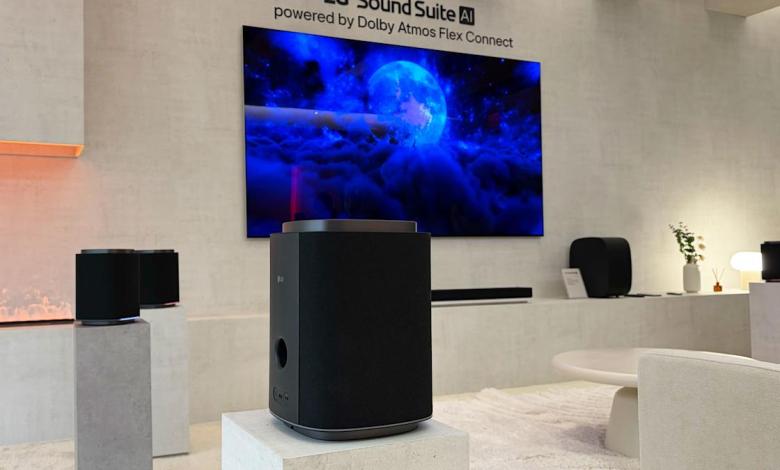
Dolby introduced its FlexConnect technology a few years ago, promising it would allow customers to position soundbars and speakers anywhere in a room. The company said the platform will then automatically reconfigure the audio, taking into account any locations that might be further from the central sweet spot. At CES 2026, LG is the first to integrate Dolby Atmos FlexConnect into a soundbar, offering what’s called Sound Suite that also includes satellite speaker options and a subwoofer. You don’t need every member of the lineup to use Dolby technology, so you can choose the items that work best for your living room.
The centerpiece of the Sound Suite is the H7 soundbar. This 9.1.6 channel speaker is configured for spatial audio (Dolby Atmos) and supports lossless audio up to 24-bit/96kHz. For me, what stands out on the spec sheet are the six upward-firing channels, which should improve the feel of overhead sounds. Most soundbars I review only have two.
Additionally, the H7 is equipped with a feature called Sound Follow that tracks your phone’s location to reconfigure the audio when your location changes. Maybe you settle into a comfy chair instead of the couch right in front of the TV. The idea is that you don’t have to suffer from poor sound during a movie or show just because you’re not in the best place.

LG Sound Suite H7 soundbar (Billy Steele for Engadget)
Then there are the M5 and M7 speakers. When used with the H7 soundbar, these are the satellite speakers, but LG warned me against calling them “rear” units. While it’s true that two of them will be positioned behind most people’s couches, the company explained that they produce more audio content than traditional rear channels provide. As such, two of the M5s or M7s used to complement the speakers of one of LG’s incredibly thin TVs do more work than just transmitting sounds designed to come from the rear.
The M5 is a 1.1.1 channel speaker while the M7 is a 2.1.1 channel speaker. Like the H7, both support Dolby Atmos and lossless music. Additionally, the entire Sound Suite arsenal has Wi-Fi and Bluetooth connectivity, including AirPlay 2, Google Cast and Spotify and Tidal Connect. The whole shebang also uses LG’s AI Sound Pro and Room Calibration Pro, and all settings are customized in the ThinQ app for Android and iOS.
Each speaker can be used independently if the need arises, and as I mentioned before, you can choose the components that suit you best – up to four speakers in total. So you can opt for the H7, one sub and two speakers or four from the M5 or M7. You can also get a smaller setup with two speakers or just the soundbar and subwoofer. Dolby Atmos FlexConnect is always in play, no matter which combination you choose. I should note that the optional W7 subwoofer is quite large, but you can use it upright or flat, according to LG.

LG SoundSuite M5 Speaker (Billy Steele for Engadget)
Of course, none of this means anything if Sound Suite doesn’t actually sound good. I’m happy to report that LG’s speaker collection is sonically impressive. I was able to get a good idea of their performance in a demo room at CES. Watching a variety of video clips in Dolby Atmos, I switched between a setup with four M7 speakers and a more robust setup of the soundbar, subwoofer, and M7 speakers. Although I preferred the overall tone and tuning of all four M7s, I can admit that the larger collection offered more immersive sound and better directional sound. That said, they both offer excellent clarity and impeccable detail.
With Sound Follow, you can quickly ask Sound Suite to reconfigure audio based on your phone’s location with a single tap. Let’s say you move from the couch to a comfortable chair and want to adjust the sound there. You can do this in the app. And while I could see a slight difference between a location on the side of the room and the central sweet spot in front of the TV, the correction offered an improvement over unadjusted audio.
I was also able to test the standalone mode, in which you can quickly use any Sound Suite speaker individually for music. Sound quality was also consistent here, and the system allowed me to add a second M7 speaker for a stereo pair with just a few clicks in the LG app. Overall, the Sound Suite range offers great flexibility in terms of features and configurations. In fact, LG claims that between the H7, W7, M5 and M7 there are 50 possible combinations.
Unfortunately, LG has yet to announce pricing or availability. Given the capabilities of the Sound Suite system, I don’t expect the more robust collections to be cheap. However, I believe the company will offer a few different bundle deals that will hopefully offer a discount compared to purchasing each component individually.


