Homeland Security says it doesn’t detain citizens. These Californians prove it has


Call it an accident, call it the plan. But don’t go so far as to call this a lie: It is a fact that federal agents have detained and arrested dozens, if not hundreds, of American citizens in immigration operations, regardless of what Kristi Noem would have us believe.
At a congressional hearing Thursday, Noem, our Secretary of Homeland Security and self-proclaimed Cruelty Barbie, reiterated her oft-used and blatantly false line that only the worst of the worst are targeted by immigration authorities. This comes after weeks of his department posting online, on its increasingly far-right social media accounts, that claims that US citizens were being arrested and held incommunicado were “fake news” or a “hoax.”
“Stop spreading fear. ICE does not arrest or deport American citizens,” Homeland Security recently posted on old Twitter.
At another congressional hearing on Tuesday, a handful of citizens – including two Californians – described being grabbed by faceless masked men and taken to holding cells where they were denied access to phones, lawyers, medicine and various other legal rights.
Their testimony accompanied the release of a congressional report by the Senate Permanent Subcommittee on Investigations in which 22 U.S. citizens, including a dozen from the Golden State, recounted their own shocking and terrifying stories of abuse and detention by what can only be described as secret police — armed officers who would not identify themselves and often appeared to lack the basic training required for safe urban policing.
These stories and the courageous Americans who are stepping up to tell them are a story in the making – a story I hope we regret but not forget.
Immigration controls, boosted by unprecedented funding, are poised to intensify even further. Noem and her agents enjoy impunity, attempting to erase and rewrite reality as they go – while our Supreme Court crushes precedent and common sense to empower this presidency. Until the midterms, there is little hope of any control of power.
Under these circumstances, for these people to come forward with their stories is both an act of bravery and patriotism, because they now know better than anyone what it means to have the chaotic brutality of this administration focused on them. It is up to all of us to hear them and peacefully protest not only the rights being violated, but also our government demanding that we believe the lies.
“I have always said that immigrants who have the great privilege of becoming citizens are also some of the most patriotic people in this country. I know you all love your country. I love our country, and this is not the America we believe in or fought so hard for. Every person, every American citizen has rights,” Rep. Robert Garcia (D-Long Beach) said at the start of the hearing.
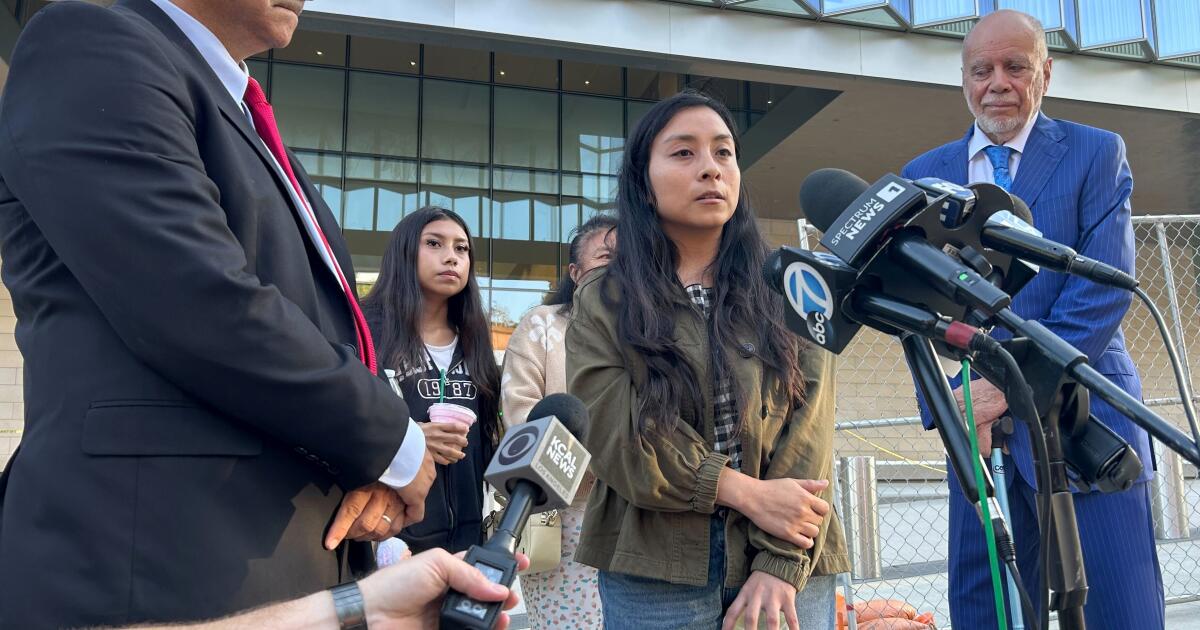
Los Angeles native Andrea Velez, whose detention was reported by my colleagues when it occurred, was one of those who put themselves in harm’s way to testify.
Less than 5 feet tall, Velez graduated from Cal Poly Pomona and was working in the garment district in June when ICE began its raids. Her mother and teenage sister had just dropped her off when masked men came streaming out of unmarked cars and began chasing people of color. Velez didn’t know what was happening, but when a man charged her, she brandished her work bag to defend herself. The bag didn’t protect her. She also did not tell agents that she was a U.S. citizen.
“He handcuffed me without checking my ID. They ignored me as I repeated over and over that I was an American citizen,” she told committee members. “They didn’t care.”
Velez, still not knowing who the man who forced her into an SUV was, managed to open the door and run toward an LAPD officer, pleading for help. But when the masked man noticed she was cowardly, he “ran, shouting, ‘She’s mine,'” the congressional report said.
The officer returned her to the unmarked car, beginning a 48-hour ordeal that ended with her being charged with assaulting a federal agent — the charges were ultimately dropped after her lawyer demanded body camera footage and statements from alleged witnesses. (The minority report was issued by Rep. Richard Blumenthal of Connecticut, the ranking Democrat on the Permanent Subcommittee on Investigations.)
“I never imagined this would happen here in America,” Velez told lawmakers. “DHS likes to… call us criminals, stripping us of our dignity. They want to paint us as the worst of the worst, but the truth is we are human beings with no criminal records.”
This “if you’re brown” tactic is likely to become more common because it’s now legal.
In Noem v. Vasquez Perdomo, a September court ruling, Supreme Court Justice Brett Kavanaugh wrote that it was reasonable for officers to arrest people who appeared foreign and who were engaged in activities associated with undocumented people — such as soliciting work at a Home Depot or attending a Spanish-speaking event, as long as authorities “promptly” let the person go if they prove their citizenship. These are now known as the “Kavanaugh rulings.”
Regardless of the racist and problematic nature of this policy, the term “quickly” seems to be open to debate.
Javier Ramirez, born in San Bernardino, testified as “a proud American citizen who never knew the burden of a criminal record.”
The father of three was working in his parking lot in June when he noticed a strange SUV idling on his private property with a group of men inside. When he approached, they jumped, armed with assault weapons, and grabbed him.
“It was a terrifying situation,” Ramirez said. But then the situation got worse.
One of the men shouted, “Get him. He’s Mexican!”
In a video shot by a passerby, Javier can be heard shouting: “I have my passport!” according to the congressional report, but the agents didn’t care. When Ramirez asked why they were detaining him, an officer told him, “We’re trying to figure that out.” »
Like Velez, Ramírez was taken into custody. Severely diabetic, he was denied medication until he became seriously ill, he told investigators. Although he requested a lawyer, he was not allowed to contact one – but the interrogation continued.
After his release five days later, he required additional medical treatment. He, too, was charged with assault on a federal agent, as well as obstructing and resisting arrest. The false accusations were also later dropped.
“I should not have to live in fear of being targeted simply because of the color of my skin or the other language I speak,” he told the committee. “I share my story not only for myself, but for all those who have been unfairly treated, for those whose voices have been silenced. »
You know the poem, friends. It begins when “they came” for the most vulnerable. Fortunately, while people like Ramirez and Velez may be vulnerable due to their pigmentation, they are not soft and will not be silenced. Our democracy, our security as a nation of law, depends not only on our ability to hear their stories, but also on our ability to peacefully fight against such abuses of power.
Because this abuse only ends when people decide they have had enough – not only of the lawlessness, but also of the lies that reinforce it.


