It’s a Sin writer Russell T Davies warns ‘HIV battle not over’


Megan DaviesAnd
Carwyn John,BBC Wales

 Ray Burmiston
The author of It’s a Sin, Russell T. Davies, has warned that “the fight is not over” when it comes to eradicating HIV.
He said misinformation about the virus had made him “desperate” and warned we must not “blunder into the future without looking back to the past”.
Davies’ warnings come as UNAIDS, the United Nations’ joint AIDS prevention programme, warned that the global response to HIV had suffered its biggest setback in decades due to cuts in global funding.
He warned that failure to meet the 2030 global HIV targets could lead to an additional 3.3 million new HIV infections over the next five years.
The World Health Organization considers HIV a “major global public health problem” and estimates that it has caused 44.1 million deaths to date.
Although they are not curable, antiviral drugs developed in the 1990s allow patients to live long, healthy lives.
Davies, 62, remembers a time when fear around the virus was at the center of public consciousness, as deaths dominated headlines.
“I was 18 in 1981, so I sort of witnessed the outbreak that followed and stood back and was horrified,” said the Swansea-born screenwriter.
 Channel 4
He said that while he remembered “the heroes who stood up, who made it count and who fought,” he was concerned and angered by the misinformation and stigma that he said still existed.
“Great dangers are looming. Today we have HIV denialism, which is a growing force… becoming almost policy in some places,” referring to an idea he says is spreading online in the United States that HIV does not cause AIDS.
He added: “I am absolutely certain that the battle is not over and sometimes I fear that it is about to start again.”
It’s a Sin tells the story of a young group of friends in London at the height of the AIDS epidemic.
Davies, who is gay, is considered a pioneer of LGBTQIA+ drama and said it was “the great privilege” of his life to have written a series that allowed people to talk about a virus that was, for so long, shrouded in shame.
“There’s not a day that goes by that someone doesn’t stop me and tell me how much this show means to them,” he said.
What is HIV?
Human immunodeficiency virus (HIV) is a virus that weakens your immune system and increases your risk of serious illness, according to the NHS.
It is most often transmitted during vaginal, anal or oral sex with an HIV-positive person, without using a condom.
AIDS (acquired immunodeficiency syndrome), or advanced HIV, is the name for a group of serious illnesses caused by the HIV virus.
With proper treatment, most people with HIV do not develop AIDS and can live long, healthy lives.
There are around 2,800 people living with HIV in Wales, according to Fast Track Cymru, a charity which aims to end HIV transmission in Wales.
There is a globally recognized goal: to end new transmissions of the virus by 2030.
 Marc Lewis
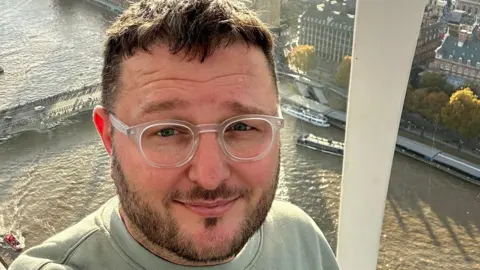
Mark Lewis, senior policy adviser to the all-party parliamentary group on HIV/AIDS at Westminster, remembers the moment he learned he had the virus.
“I was kind of living a lie because I was working in the field, I was telling other people, I was keeping a list, but I hadn’t told my own family,” the 43-year-old, from Carmarthenshire, said.
“I didn’t worry about HIV because I thought it was gone, because it wasn’t in the news as much and I thought I was an educated person myself.”
Mr Lewis said he experienced prejudice following his diagnosis in 2018, including a dentist asking if it was safe for the clinic to treat him.
He also recalled an encounter with a gay bartender, who did not know what World AIDS Day was or recognize a pin worn by Mr. Lewis that said “Can’t Pass It On” – a reference to the fact that you cannot pass on HIV if you are on effective treatment.
“That’s the problem, a lot of young people don’t know it, because we’ve made a lot of progress in treatment and prevention and all that,” he said.
“We still have a long way to go.”
 Dr Olwen Williams
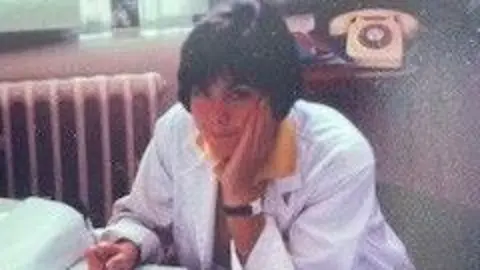
Dr Olwen Williams remembers hearing about the first reported cases of HIV in the UK in the 1980s, while she was completing her medical degree in Liverpool.
She remembers finding no information about the disease in her textbooks.
A young doctor from North Wales, she then worked in an HIV ward in London, at the height of the epidemic.
“It was very emotional because it was my peer group that I was looking after and seeing,” the now 66-year-old said.
“These were people in their 20s and 30s. What was happening was just devastating.”
Dr. Williams spoke of the joy she felt as a doctor in being able to tell people that they could live with HIV, thanks to modern medicine.
“It’s so phenomenal to be able to say in my lifetime that I’ve seen something go from incurable, a life sentence, to something that is actually a chronic illness.”