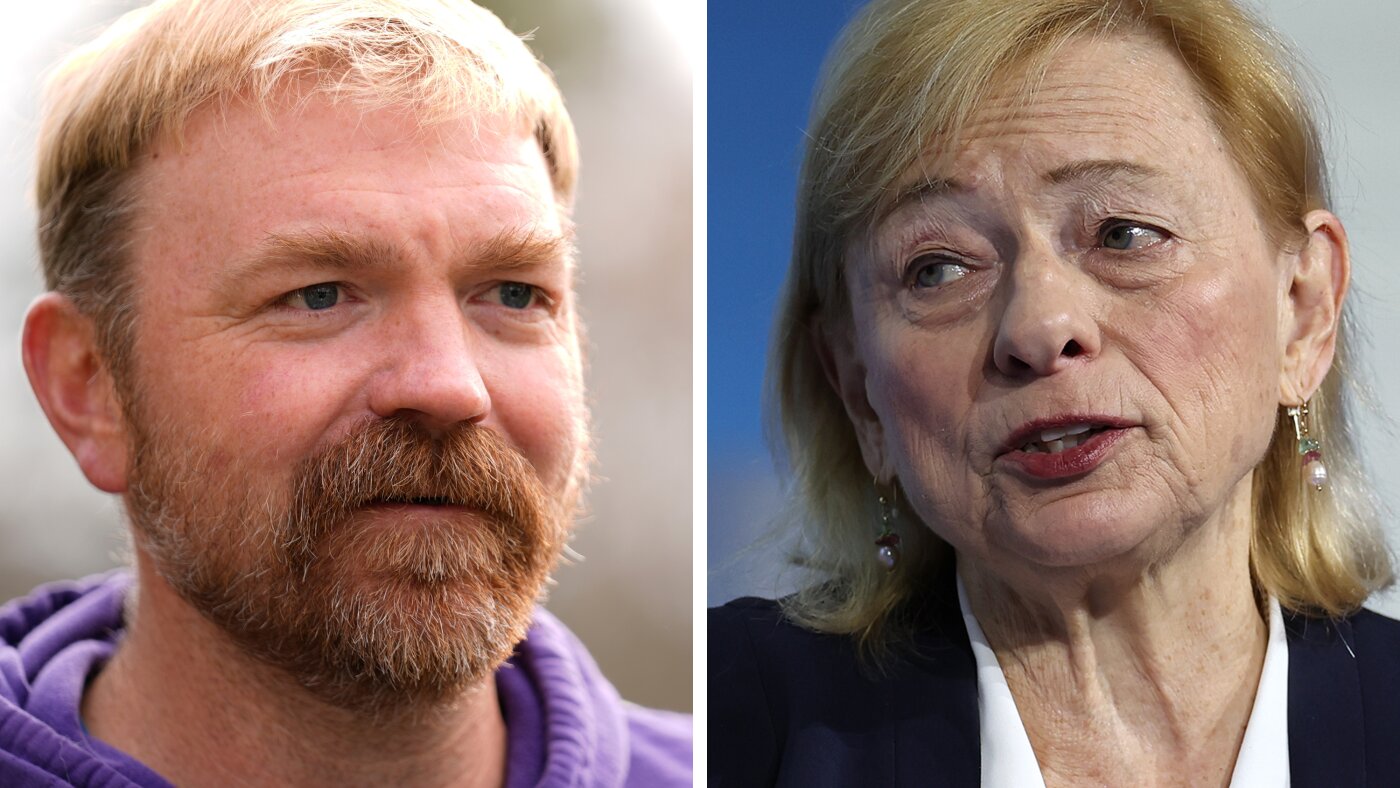

Combat veteran and oyster farmer Graham Platner in Sullivan, Maine in 2025; Maine Gov. Janet Mills in National Harbor, Md. in 2023. Both Platner and Mills are Democrats vying to defeat Sen. Susan Collins, who is running for a sixth consecutive term in Maine.
Robert F. Bukaty/AP; Kevin Dietsch/Getty Images
hide caption
toggle caption
Robert F. Bukaty/AP; Kevin Dietsch/Getty Images
AUGUSTA, Maine — An increasingly bruising primary between the two leading Democratic candidates vying to topple Republican Sen. Susan Collins has both contenders dipping deep into their campaign coffers while Collins has so far spent little on her reelection bid.
Democrats’ longshot bid to retake the U.S. Senate hinges on several key races this year, including the U.S. Senate race in Maine to defeat Collins. With over two months remaining until the June 9 primary election, Democratic Gov. Janet Mills and combat veteran turned oyster farmer Graham Platner are effectively engaged in a proxy battle between warring factions in the Democratic Party.
Meanwhile, the massive Republican effort to return Collins to the Senate for a sixth term is in high gear. The outside groups supporting Collins are outspending both the leading Democrats and the groups supporting their bids.
Dueling visions of who can unseat Collins
Mills was recruited by Senate Minority Leader Chuck Schumer, D-N.Y., while Platner, a political newcomer, quickly won the endorsement of Sen. Bernie Sanders, I-Vt., after launching his campaign in August.
Platner entered the race before Mills, quickly gaining support with a message that partially tapped Democrats’ disenchantment with party leaders in Washington, D.C., who he claimed had abandoned working class Mainers and ran unsuccessful campaigns against Collins using “the same old, tired playbook.”
He drew large crowds to his circuit of town halls, but some party leaders like Schumer have argued Mills is the better bet to beat Collins because she has won two statewide elections.
In October, just days after Mills entered the race, CNN reported on details of old and offensive social media posts that were deleted before Platner launched his campaign. Platner later acknowledged the posts belonged to him.

While the social media posts — and a now-covered tattoo mirroring Nazi iconography — first appeared to doom Platner’s bid, his campaign has proven resilient. Recent polls from the University of New Hampshire Survey Center and Maine-based Pan Atlantic SMS show Mills trailing Platner in the primary contest.
Mills attacks Platner’s past comments
This month, the governor returned to Platner’s controversial social media posts, triggering an exchange of advertising that’s largely overshadowed the Democrats’ arguments to defeat Collins.
Mills’ ad from last week focuses on Platner’s 2013 post on Reddit about a website promoting locking underwear for women to guard against sexual assault. Platner, in a post that originally surfaced in October, responded, in part, “How about people just take some responsibility for themselves and not get so f***ed up they wind up having sex with someone they don’t mean to?”
In the ad, a group of women, all Mills supporters, react to the comments while a narrator impersonating Platner’s gravelly voice reads them out loud.

Platner first responded with a media event last week featuring an array of women speaking on his behalf. He apologized for the posts, which he attributed to the anger and disillusionment he experienced while serving in combat in Iraq and Afghanistan.
“When I read through my old internet posts when they resurfaced six months ago, I was horrified,” he said during the media event. “I did not recognize in them myself or the man that I am today. I did not recognize myself in this person that was struggling to find meaning and posted awful things 13 years ago. I am sorry, but it does not in any way reflect who I am today, or the beliefs that I hold.”
His campaign then launched a direct-to-camera TV spot responding to the governor’s ad.
Collins sits on cash, while others spend
Last week, that ad buy, with at least one other ad his campaign placed, totaled more than four times that of the governor’s campaign spending during the same time period, according to an analysis of data gathered by AdImpact.
His spending follows a trend so far in this Democratic primary contest.
Platner has outspent Mills on advertising, $4.2 million to Mills’ $1.16, according to recent data from AdImpact, which has been tracking advertising spending since early last year..
His campaign overall has outraised Mills by nearly three to one, according to the latest Federal Election Commission filings, which run through last year.
There are outside groups aligned with Democrats, yet much of their spending has focused on attacking Collins, rather than supporting a Democratic primary candidate. Collins, meanwhile, has spent roughly $240,000 overall, according to AdImpact data. She announced her reelection bid in February.
“She can avoid spending money and let the others do battle,” said Ron Schmidt, a political science professor at the University of Southern Maine.
The Republican effort to reelect Collins is in full swing.
In addition to super PAC support, she is also getting a boost from the biggest spender in the race so far, One Nation. One Nation operates as an issue advocacy group, a designation that allows it to spend on Collins’ behalf and shield the identity of its donors as long as its messaging doesn’t directly call for her reelection. Its just over $10 million in ad spending so far have been prolific, coming via television spots, web ads, text messages and mail. All focus on the issue Collins used to great advantage during her successful 2020 reelection: her ability to secure federal funding.
Democrats also have a similar array of super PACs and so-called dark money groups spending to influence the race, but those efforts have been largely overshadowed by the direct Platner-Mills contest.
Will infighting, now, affect Democrats’ chances later?
Schmidt, with the University of Southern Maine, says early spending by Mills and Platner makes strategic sense. Platner is racing to define himself to Maine voters who don’t know him, while the governor is trying to highlight a past that might dissuade Democratic primary voters from supporting him come June.
The recent attack ad, Schmidt says, is a direct appeal to female voters in Maine, who the governor hopes will back her primary bid and, ultimately, boost her chances of defeating Collins. The governor’s decision to attack Platner could pay off in the primary, but Schmidt warns, it comes with some risk of alienating his supporters.
“They might just turn off for this election period, which could benefit her in a primary, but it could definitely work against her in a general election,” he said.
Mills, who has framed her candidacy around her confrontations with President Donald Trump and electability, told reporters last week that her focus on her rival’s social media history is necessary and that “it’s important that Maine voters hear Platner’s own words and the absolutely abhorrent things that he has said.”
Platner, meanwhile, has described the attacks as an effort by the Democratic establishment to destroy his candidacy.
“It takes political courage to come out against those in power and it is not lost on me what this means,” he said after thanking supporters last week.


