Italian YouTuber investigated for playing ROMs


The retro emulation gadgets, those that resemble an alternative version of a game advance, are extremely popular. They are inexpensive, portable and capable of performing almost any console game made before approximately 2000 (and sometimes beyond). But the companies that manage them sometimes have a less than legal approach to the ROM themselves, and this creates problems.
The Italian Youtube player Francesco Salicini, alias formerly Nerd, documents and examines these gadgets professionally. And for that, he was the subject of a police investigation, and his house and his computers were searched. The fact is the fact that some of these gadgets are preloaded with hundreds, even thousands of Roma games of game, which is technically hacking and violation of copyright almost everywhere. Salicini is currently the subject of an investigation to have copyright with a maximum penalty of 15,000 euros and up to three years in prison, and its YouTube, Instagram and Facebook accounts could be closed. Under Italian law, these closures can apparently occur before it is even accused of a crime, if it has already been charged.
As part of the investigation, the house of Salicini was excavated and “more than 30” consoles seized, with Tom equipment signaling well -known brands in this small space like Anbernic, Trimui and Powkiddy. The presence of roma pirated on these consoles could be evidence against the salicini, although he obtained the Roma himself (and if he did so legally) or that they were preloaded on the consoles before the purchase will probably be relevant.
Some of these companies are known to preload ROM on their consoles and microSD cards that often accompany them, which, once again, is the hacking of manuals. And many of them do not hesitate on this. Here is a battery announcement on Yahoo for a decoder that proudly proclaims that it is “preloaded with more than 70,000 retro titles of more than 40 consoles”. This quantity of games would be essentially impossible to obtain without hacking. The list of gadget stores says it flat: it is preloaded with Dark Souls, The Last of Us, Counter-Strike, Zelda: Ocarina of Time, Sonic the Hedgehog, And Final Fantasy VIIAmong “thousands” others.
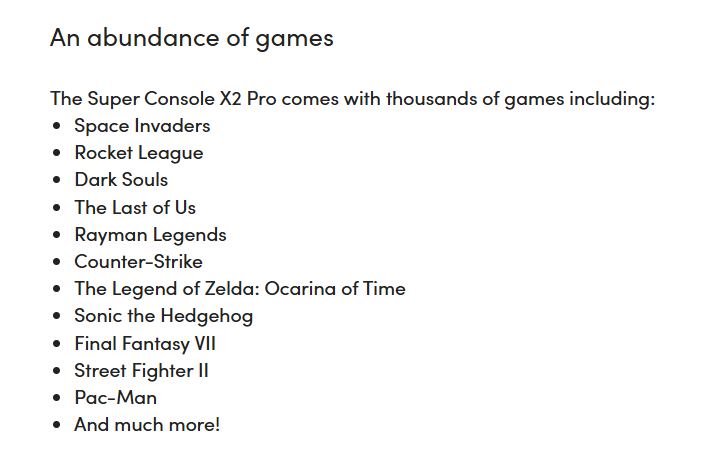
A “retro game emulator” sold to American buyers on Stacksocial Bralyly boasts of popular games protected by copyright taken from the system.
Stack
Normally, I would be reversed on the accusations of real criminal activity. But come on, you do not get famous games and at the request of companies like Nintendo, Sega, Square-Enix and Naughty Dog together on a gadget, mainly thrown free, without resorting to hacking. Either this announcement fully lies on the games included in the device, or the company illegally loaded stolen game files. There is simply no other way to get around this, and anyone who is vaguely knows how the distribution of video games works.
After finishing this story, and knowing that Stacksocial is a PCWORLD partner, I quickly looked for our own site and found the same console available. I alerted my publishers, who were deleted, but I agreed that documenting it here as part of this story was important.
There are many similar examples well documented, up to and including a kind of “app store” for preloaded pirated ROMs on devices for easy navigation and download. The well-known company Anbernic has raised eyebrows earlier this year by pre-loading the devices with said application, allowing copyright offense and inviting its users of gadgets to choose and actively download the said ROM, before going back from the self-preservation.
So, if you buy one of these gadgets in the reasonable knowledge that you engage in used hacking, are you legally guilty for the manufacturer’s actions? And is the revision of the gadget on YouTube considered to be “advertising”, as the Italian authorities apparently indicate, and thus also count as proof of your crime?
It seems unlikely that the average purchase joe to buy these gadgets gets their bilated door by the police. The Salicini YouTube channel has a modest 50,000 subscribers at the time of the editorial staff, but that may be enough to attract the anger of disputed companies like Nintendo, and its army of lawyers who salivate the mention of emulators and Roma.
A more likely result is that companies will simply pursue these manufacturers of existence (or at least outside the main markets beyond China), just like Nintendo’s approach to the software side of emulation. But it is hardly a balm for a YouTube player who is caught in the cross fires.


