This Worm’s Golden Color Is Toxic, But Is Necessary to Survive in the Deep Sea


Orpiment is a brilliant golden pigment adored by Renaissance painters. It also happens to be deeply toxic.
Despite its toxicity, the substance is the key to the survival of a particularly robust species of deep sea, which allows it to counter harmful chemicals that persist in its habitat – allowing the creature effectively to fight against poison with poison.
“We hope that this model” Fighting Poison With Poison “will encourage scientists to rethink how marine invertebrates interact and possibly exploit toxic elements in their environment,” said the authors in the study that was recently published in Biology PLOS.
A golden and deep sea
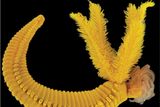
Unlike the vast majority of the inhabitants of the deep sea who take deaf tones, the Alvinellid worm (Paralvinella Hessleri) Put on a brilliant golden yellow shade. This contrasts strongly with its dark environment – the worm lives well below the surface of the Pacific West Ocean, in hydrothermal vents rich in minerals where hydrothermal fluids mix with the waters of the deep sea and no other species dares the adventure.
Not only does the worm face extraordinary hot temperatures, but this part of the ocean is prevented from high levels of arsenic and sulfide that would prove to be fatal to most animals.
“It was my first expedition on the high seas, and I was amazed by what I saw on the Rov Monitor – Le Yellow Paralvinella Hessleri The worms were different from everything I had ever seen, standing out alive against the white biofilm and the landscape of the dark hydrothermal skill, “said Dr. Ha Hao Wang of the Institute of Oceanology of the Chinese Academy of Sciences (CAS) in a declaration of support.
Learn more: Thorny and star -shaped creatures show that the deep sea is “connected superhigne”
Adapt to extreme environments
These extreme accommodation offer certain advantages. The intense heat and pure toxicity of the habitat dissuade predators and discourage competitors, granting P. Hessleri Access to abundant food supply.
But how does that survive dangerous environments alone? Using advanced microscopy in combination with DNA, protein and chemical analyzes, the team discovered a new detoxification process.
The results suggest that arsenic particles can accumulate to the point where the chemical product represents almost 1% of the total corporal weight of the worm. These arsenic particles react with the sulfides found in the habitat, neutralizing the two substances and converting the chemicals into small tufts of a material which proves to be less harmful to the worm.
“This process represents a remarkable adaptation to extreme chemical environments,” write the authors of the study. “Our study provides new information on understanding the mechanisms of adapting the environment of animals and the diversity and plasticity of biomineralization.”
As well as to allow P. Hessleri With such a toxic environment, the presence of orpiment in the epidermal tissues of the creature is responsible for its unusually brilliant coloring.
Learn more: These 12 creatures in the deep sea are more comical than frightening
Article Sources
Our writers at Discovermagazine.com Use studies evaluated by high quality peers and sources for our articles, and our publishers examine scientific precision and editorial standards. Review the sources used below for this article:


