The Insurrection Act, explained : NPR

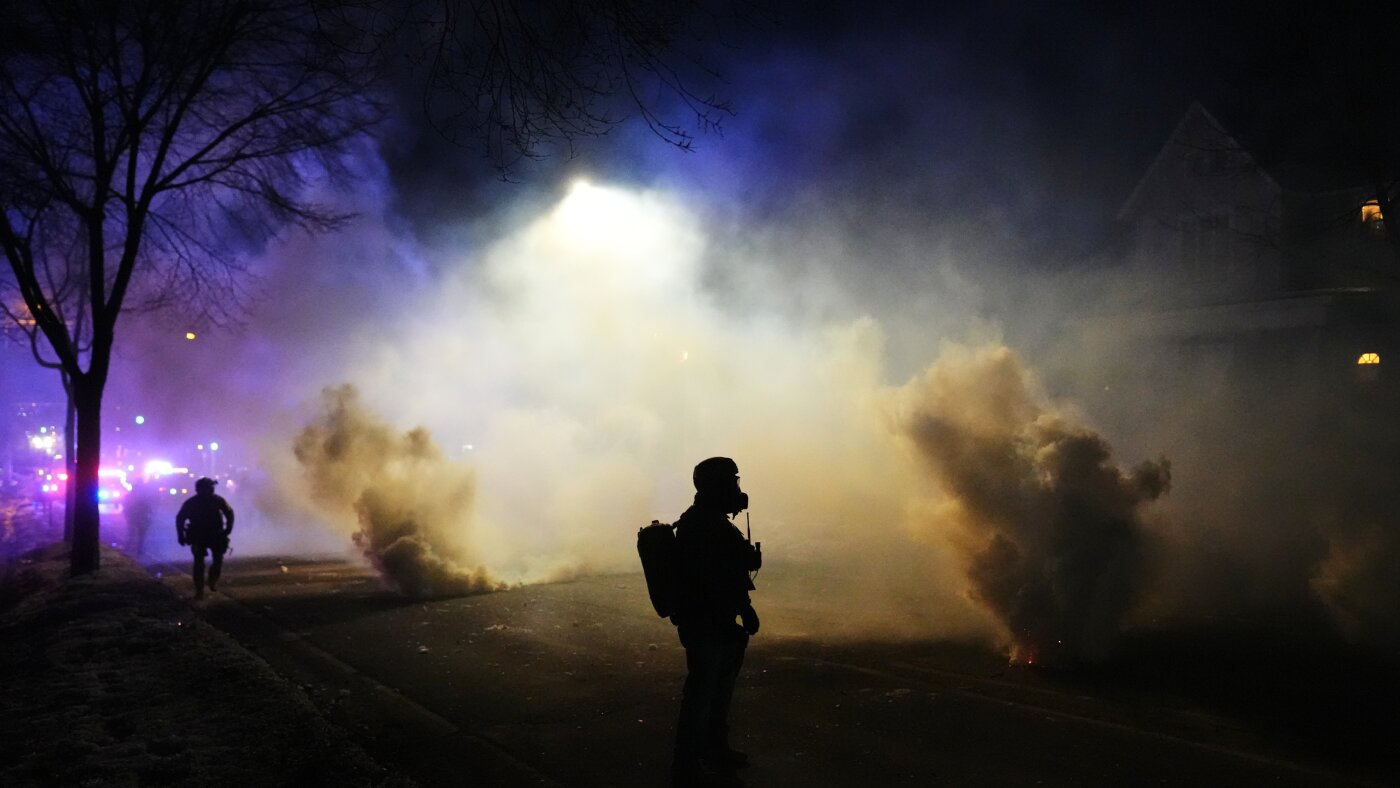

Law enforcement officers stand amid tear gas at the scene of a shooting Wednesday in Minneapolis.
Adam Gray/AP
hide caption
toggle caption
Adam Gray/AP
President Trump on Thursday threatened to invoke the Insurrection Act to quell protests in Minnesota, a week after an ICE agent fatally shot a 37-year-old woman in Minneapolis.
The shooting death of Renee Macklin Good sparked nationwide protests against the continued presence of ICE in Minnesota and across the country.
Protesters were further enraged Wednesday night when ICE agents in Minneapolis shot a Venezuelan immigrant in the leg during an attempted arrest.

Writing on Truth Social, Trump said: “If Minnesota’s corrupt politicians do not obey the law and stop professional agitators and insurrectionists from attacking ICE Patriots, who are only trying to do their jobs, I will institute the INSURRECTION ACT, which many presidents have done before me, and I will quickly end the travesty taking place in this once great state.” »
This law is a way for the president to send troops into the states to restore law and order. But unlike Trump’s National Guard deployments in 2025, the Insurrection Act would allow the armed forces to carry out law enforcement functions, such as making arrests and conducting searches.
Beyond suppressing protests, the law could also open the door to significantly expanding the military’s role in protecting federal buildings and controlling immigration, something some Trump aides have suggested it do.
Since Thomas Jefferson signed it into law in 1807, the Insurrection Act has only been invoked about thirty times. The last case dates back more than thirty years. During his second term, Trump repeatedly floated the idea of using this status. Last June, when asked whether he would invoke the law during anti-ICE protests in Los Angeles, Trump said it “depends on whether there is an insurrection.” In October, when asked under what conditions he would use the Insurrection Act, Trump replied: “I would if it was necessary. So far it hasn’t been necessary.”
He continued: “If people were being killed and the courts were holding us back or the governors or the mayors were holding us back, of course I would do it.”
Trump also falsely claimed that nearly half of all U.S. presidents have invoked this law and that it has been invoked 28 times by a single president, as he said in a press conference. interview with CBS’ 60 minutes end of October.

In fact, according to the Brennan Center for Justice, a nonpartisan legal and policy organization, in 2022 only 17 out of 45 presidents – or 37% – have used the law. followed by all invocations of the Insurrection Act. The group also did not find a president who invoked emergency powers more than six times, as Ulysses S. Grant did during the Reconstruction period.
The White House has not released a statement on the president’s threat.
Here’s what you need to know.
How would the Insurrection Act be used?
There is three ways that the president can invoke the Insurrection Act, according to the Brennan Center for Justice.
The first is at the request of the legislature or governor of a state facing an “insurrection.” The law itself does not specify what constitutes an insurrection, but legal scholars generally understand the term to refer to some kind of violent uprising.
Under the second track, the president does not need a state’s consent to deploy troops when “obstruction, unlawful combination or assembly, or rebellion” makes enforcement of federal laws “impractical.”
The third way also does not require support from the relevant state. In this case, the president can send the military to suppress an insurrection that “obstructs the execution of the laws” or “opposes or obstructs the execution of the laws of the United States or obstructs the course of justice under such laws.”
Before invoking the Insurrection Act, the president must first order the “insurrectionists” to disperse within a limited period of time.
How would troop deployments be different under the Insurrection Act?
So far in Trump’s second term, National Guard troops have been called to Los Angeles, Chicago and Portland, Oregon, under a law known as Title 10, which puts the force under federal control. Operations in Memphis and Washington, D.C., were authorized under Title 32, meaning they were under state command. (The situation in Washington DC is unique since the federal district is not a state and therefore does not have a governor.)

As part of these deployments, Guard forces are subject to the Posse Comitatus Act, which generally prohibits federal military personnel from acting as police on American streets. It is rooted in one of the founding principles of the nationwhich opposes military involvement in civilian affairs.
The Insurrection Act, however, constitutes a key exception to the law.
The controversial emergency powers were last used during the 1992 Los Angeles riots, after four police officers were acquitted in the beating of Rodney King.
Former President George HW Bush invoked the law at the request of then-California Governor Pete Wilson, who was concerned that local law enforcement alone could not quell the unrest.
But the deployment also showed the risks of relying on military personnel to enforce the law. In a infamous At that point, Los Angeles police officers asked a group of Marines to “cover” them as they approached a house. The Marines interpreted their request as asking them to open fire, when the police actually wanted them to remain on guard.
“The Marines then stopped shooting. The police were completely appalled,” said Mick Wagoner, a retired Marine Corps lieutenant colonel. NPR earlier this year.
What power does the Insurrection Act give to the president?
Part of the power of the Insurrection Act comes from what’s not actually in it.
Terms like “insurrection,” “rebellion” and “impractical” are loosely defined and give great deference to the president, according to William Banks, a professor emeritus of law at Syracuse University and an expert on national security and emergency powers.
“It’s incredibly open-ended and gives him considerable discretion to federalize an incident,” he added.
The law also does not mention time constraints regarding the deployment of troops. It also doesn’t involve Congress in the process of maintaining checks and balances, Banks added.
The insurrection law has also rarely been tested in court. Trump himself has described the Insurrection Act as providing legal cover.

“Do you know I could use it immediately and no judge can even challenge you on that. But I didn’t choose to do that because I didn’t feel we needed it,” he said at the October hearing. 60 minutes interview.
Despite its broad language, legal experts argue that historical precedent is important when it comes to insurrection law.
If Trump were to invoke the law to fight crime or enforce immigration laws, it would represent a dramatic departure from past uses and would likely face legal challenges, according to Laura A. Dickinson, a professor at George Washington University Law School who focuses on national security.
“While this seems very broad at first glance, it is not a blank check,” she said.