How a poet uses AI to write and why her work is now at MoMA


February 23, 2026
4 min reading
 Add us on GoogleAdd SciAm
Poetry was humanity’s first linguistic technology. AI is next
Sasha Stiles turned GPT-2 experiments into a self-written poem in a Museum of Modern Art installation and a new way of thinking about optimizing text-generating AI
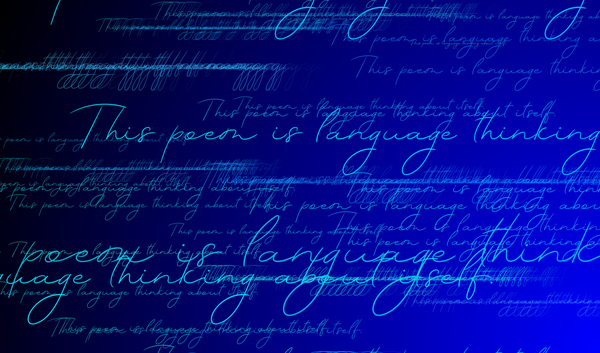
A photograph of a layered animated screen from A LIVING POEM, where lines of text unfold and overlap in real time as part of Sasha Stiles’ AI-assisted poetry performance.
Poetry and artificial intelligence can appear as opposites: one deeply human; the other cold and mechanical. Sasha Stiles sees them as expressions of the same impulse. Poetry, the Kalmyk-American poet asserts, is “one of our oldest and most enduring technologies,” a system of meter and rhyme invented to store vital information. She considers AI to be her natural heir.
Stiles’ path to AI began with literature, not code. But science was never distant: His parents are documentarians who worked with Carl Sagan on the original film. Cosmos series, and she grew up traveling with them as they interviewed scientists and philosophers. She grew up with the Internet and felt how it shaped the way she thought and wrote. When she discovered the technology behind modern AI in 2019, she didn’t just want to write about it, she wanted to write with it.
Scientific American spoke to Stiles about why language may be the defining medium of AI’s moment.
On supporting science journalism
If you enjoy this article, please consider supporting our award-winning journalism by subscription. By purchasing a subscription, you are helping to ensure the future of impactful stories about the discoveries and ideas shaping our world today.
[An edited transcript of the interview follows.]
How did you come to create art at the intersection of poetry and AI?
In 2017, I heard about transformer-based architectures that drive natural language processing, and something clicked. That’s when I realized that I didn’t just want to write around this idea: I wanted to understand what it felt like to write using these models, to use AI as a tool, as a collaborator, and as a medium.
I started doing research and looking at who was using these early versions, who was doing interesting things with the language. This was long before ChatGPT. I was reading the work of people like [data poet, artist and creative technologist] Ross Goodwin and [computer programmer, poet and game designer] Allison Parrish, who created poetry bots on Twitter. And I tried to understand how someone with a background in the humanities could take small steps in this world.

In this moment of A LIVING POEM, the generative textual installation displays a grid of evolving poetic prompts that explore states of reflection, action, and language as a living system.
What were those first sessions like?
I started working with GPT-2 in 2019, taking lines from my own poetry and integrating them to see what would happen if I asked a language model to take an idea I had and execute it.
One of the first poems I wrote came from the phrase “Are you ready for the future?” » over and over again in the same system, adjusting the parameters to see how the output would change. This was not intended to be a poem, just research. But I found it really interesting and ended up putting together 30 of these hundreds of productions into a little poetry cycle. The results ranged from very sublime and beautiful to very misogynistic or pornographic – really looking at the spectrum of what you could produce at that time.
How did you go from feeding lines into a generic template to building something driven by your own voice?
I took a manuscript that I had pretty much written at that point (200 pages of poems) and put it all into one dataset to create a refined version of GPT-2.
So I had a system that actually knew my own writing, not just [knowledge of] canonical poetry already in the archives but a sense of my style, my vernacular, my thematic areas of fascination. I could use lines from my own poetry as input, knowing that the system had an idea of how I had already written that poem.
This process ultimately led to A living poem at the Museum of Modern Art in New York. How does this part work?
I think of A living poem as a living linguistic system – an hour-long script for an unfixed, ever-evolving poem in which code sketches, data sets, prompt architectures, and human influence converge to perform real-time loops of verse, images, and voices. It’s essentially an environment where I can think about language and let it reflect on itself while making that process tangible.
I have long been attracted to metapoetics and to generative or automatic writing in its many forms. One of my first encounters with computer text art was The House of Dust (1967), by [the late] Alison Knowles, poet of Fluxus, one of the first computer-generated poems. And contemporary language artists such as [Jenny] Holzer, [Edward] Rusha and [Barbara] Kruger was a trainer for me.
A living poem is rooted in this lineage and in the technological and cultural conditions of the 20th century – mass media, audiovisual culture, industrial printing, early computing – that shaped modern textual art, which in turn shaped me. At the same time, it is a place where I can experiment with new modes of expression emerging from the technocultural conditions of the 21st century: language as a living, generative field where meaning is created at high speed and on a large scale through recursion, probability, multiplicity and networked imagination.
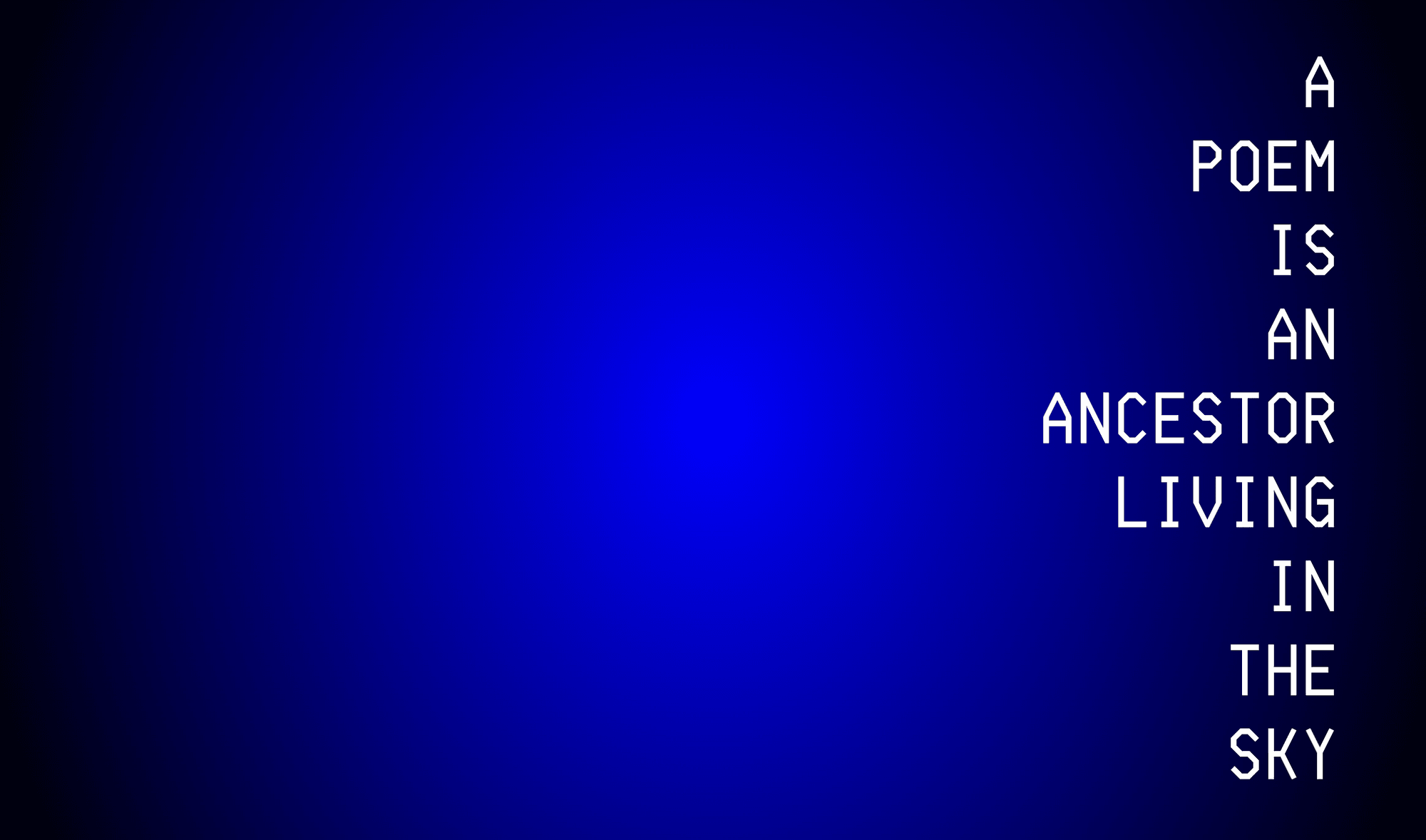
In this view of A LIVING POEM, stark white text on a deep blue background declares a line of poetry.
You have described poetry itself as a technology. What do you mean by that?
Many people think that poetry and technology are antithetical, but I find them resonant. Poetry is not just an art form or a decorative language. Humans invented poetic language before we wrote alphabets because we needed a way to store information, preserve it, and pass it down from generation to generation. We invented meter, rhythm and rhyme to be able to memorize really important human data. Poetry is one of our oldest and most enduring technologies: a very primal data storage system.
Does this change the way you view AI?
Looking at AI through the lens of poetry is a way of saying that there is something very human about the fundamental impulses behind technologies like AI. I consider poetry to be our oldest hybrid intelligence, a way of linking algorithm and emotion, like our new technologies.
If we can recognize that these technologies have enabled self-awareness, consciousness, and our ability to articulate inner worlds, perhaps this is helpful to conversations around artificial intelligence today. Perhaps these tools can take us to new territories of consciousness, just as poetry has allowed us to do for thousands of years.


