How Archaeology Is Reviving the Smell of History


What is the first thing you notice when you enter a museum? Is it the long-faded colors of ancient objects from around the world or the hushed sounds of visitors discussing what they see? Perhaps there is a replica of a rough old fabric that you can touch. Some places may even offer an edible treat inspired by an ancient recipe. Museums allow us to indirectly “experience” the past by appealing to our primary senses – sight, hearing, taste, touch – but more often than not, smell is lacking.
The past is often presented to us as odorless. But that doesn’t take into account the enormous role that smell likely played in many historical realities, says Barbara Huber, an archaeochemist at the Max Planck Institute for Geoanthropology in Jena, Germany. The frequent absence of smell (not to mention the musty smell of many museums) in our study of history has inspired Huber and a growing community of chemists and archaeologists to track down certain molecular remains that may allow us to smell the past. For example, she created “Scent of the Afterlife,” a fragrance blend that captures the range of smells that would have accompanied mummification processes in ancient Egypt.
LEARN MORE: What Sniffing Mummies Taught Scientists About an Ancient Society
On supporting science journalism
If you enjoy this article, please consider supporting our award-winning journalism by subscription. By purchasing a subscription, you are helping to ensure the future of impactful stories about the discoveries and ideas shaping our world today.
Some of the recent advances in the quest for a whiff of history are featured in the new book Arabian scents: interdisciplinary approaches to ancient olfactory worldsco-edited by Huber. Scientific American spoke to him about the “science of smell” and its importance to our understanding of lives long gone.
[An edited transcript of the interview follows.]
We know that smell is linked to very specific areas of the brain. What are these areas? And why does this link make olfactory interactions so important throughout history?
The sense of smell is closely linked to the parts of our brain that process emotions and memory. There is also a very direct connection between our olfactory bulb in the nose and the amygdala and hippocampus. react to something we feel before we even think about it. And this concept comes from a very long evolutionary tradition. Our ancestors essentially needed this ability to memorize specific smells because it also alerted them to danger.
I think today we don’t really think about how this has a major effect on how we perceive and navigate the world. And it has a huge effect on our well-being – an interesting fact that COVID has reiterated to us because people have relearned how important smell is when they lost he.
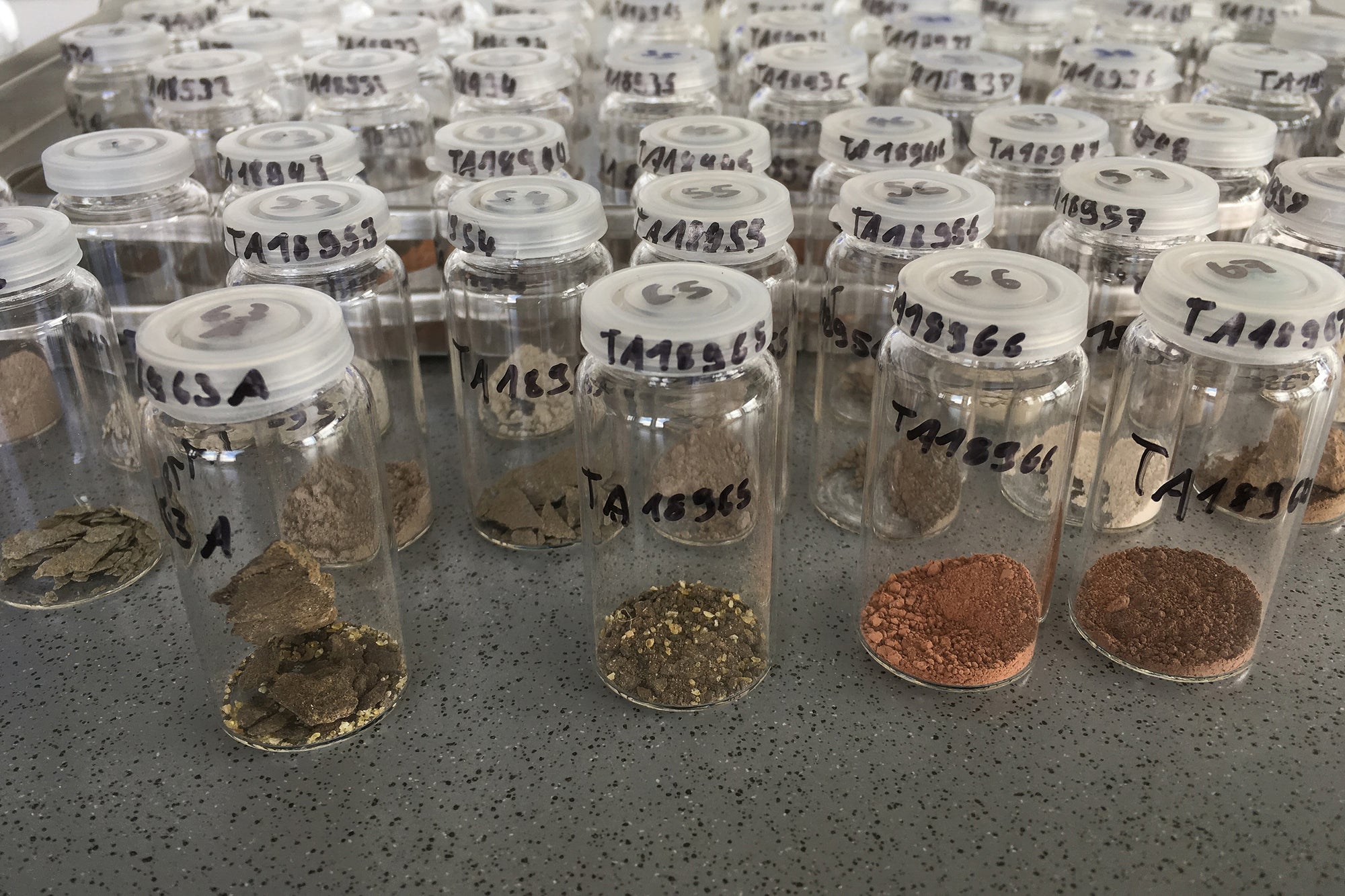
Glass vials hold samples of ancient incense burners for chemical testing.
And we don’t really think about the smell [when studying the past]. One of the problems is that, methodologically, it’s incredibly difficult to study. The scents, smells, and stenches – whatever had been there in the past – were already gone before archaeologists could come and study the sites. Only new chemical and biomolecular methods in archeology have somehow reopened the door to the further study of these things. And of course, what we learn from ancient texts can also be of great help.
When we find all these details, they can really enrich our understanding of many aspects of past lifestyles, from medicine to perfumery and cosmetics to commerce, but also things like identity or social status. There were wars over spices: these tiny powders and resins had such a powerful effect on people that they went to war over them!
What really fascinates me about smell is that, in a way, it is tangible. And intangible. Even though we can’t directly sense the past, we can know a lot about how things are. could felt, as with Perfume of the afterlife. How has studying something with this kind of duality changed your perspective on research?
What is interesting about smell is that these molecules that we detect, or that we are still able to detect, can teach us a lot about ancient materials. At the same time, when we rebuild and recreate them like we did with Scent of the Afterlife, we can also bring a piece of the past to visitors today. And it’s not just about owning a found and excavated object and then displaying it in a museum. [In a scent exhibit]people can actually perceive it. This way of perceiving amounts, in a way, to “participating” in the past. If you walk into a room and you can actually smell what it must have smelled like in an ancient ancient Egyptian mummification room – and you see all the raw materials and everything – then you are in a different way, immersed in history and in learning.
Some studies have also shown that this multisensory learning method, especially smell, can actually improve the way you think about specific things and improve learning effects. And I think that’s because it’s so tied to emotions. When you attend an exhibition, you might recall memories by feeling something that is very special to you. This connects us more deeply to previous ways of life.
It’s really interesting that you mention that because I was just thinking about Scent of the Afterlife, the perfume that you pieced together from ancient Egyptian mummies, and how everyone SciAm I was thinking about the sample we had. My colleagues’ descriptions referred to very specific experiences from their own lives – for example, I said it smelled like a very well-run “grandpa’s car.”
[Laughs.] It’s great.
I would like to know more about the scientific details involved in performing the type of analysis necessary to recreate smells like this.
We work with organic materials. Sometimes the original substance isn’t even there [anymore]- but what we do is: we search for what we call olfactory archives. So these are specific objects – for example a perfume bottle or a cosmetic container or an incense burner – that are linked to the type of practices or actions that require scented materials. Let’s say you have a flavored cream and there are some leftovers, a crust or something like that, in your jar. Then we can take small amounts of samples and do an analysis on them. We first identify all the different compounds in the sample using gas chromatography to separate all the different molecules present in the sample, and then we analyze it using mass spectrometry. [an analytic method that identifies an unknown chemical compound by studying its spectral behavior]. Then we are able to identify each compound.
And that gives us clues about trade, for example. If we find all the different ingredients and check to see if those ingredients are local, can people just go and harvest them? Or do they have to import them from distant countries?
How does decomposition affect the process? From what I understand, the compound you detected may not be the original compound.
Take, say, vanillin. It’s a molecule that has this vanilla scent. And when we find vanillin, you might jump to the conclusion and say, “Oh, my God, we have vanilla! Oh, cool! They used vanilla in the past!” But vanillin is also a breakdown product of a larger molecule, called lignin, which is a very common breakdown product of woody tissues. So many wooden objects contain this vanillin compound when they decompose. And so when you find that out, you have to be very careful because it doesn’t always mean that there’s only one possibility of where it could come from. We do a lot of detective work to analyze what we have and try to make sense of it.
Something I found really interesting in the introduction to Arabian perfumes it was the way this book “challenges traditional commerce-driven narratives.” What do we mean by “commerce-driven stories”? And how does the book challenge this?
In the study of ancient materials, notably aromatic materials in Arabia, the study of the incense trade and route [a trade network covering a broad area from the Arabian Peninsula to the Mediterranean and mostly dealing with the circulation of incense] has always been an interesting point for researchers. But the problem is that the incense route was very often viewed from the perspective of classical scholars – that is, ancient Greek or ancient Roman texts. From the beginning, the story of the Incense Road was told by outsiders, who were also not really contemporary. We don’t really have evidence for earlier periods, the Iron Age and the Bronze Age in ancient Arabia. So for us, it was very interesting to examine evidence other than ancient texts that can tell us a little more about the spice trade.

Examples of ancient incense burners from the Tayma oasis, in present-day Saudi Arabia.
M. Cusin/Department of the Orient, German Archaeological Institute/“Incense burners at the Tayma oasis, North-West Arabia: an olfactory perspective”, by Barbara Huber, in Polish archeology in the Mediterranean, Flight. 29, no. 1. December 30, 2020 (CC PAR 3.0 PL)
Is there a particular chapter or case study that comes to mind when thinking about the overall framework or goals of the anthology?
In one case study, we looked at the contents of incense burners and discovered a plant called Peganum. The common name is Syrian rue, and it is a medicinal and psychoactive plant. So we realized that in these particular incense burners, people were using it for therapeutic or psychoactive purposes. This was very interesting because the practice of burning incense seems to not only be sensory but also to have this medicinal component.
The in-depth study of these incense burners has actually revealed something we had absolutely no idea about: medicinal practices in Arabia before the Islamic period. We suddenly had an idea of how people used their local pharmacopoeia. [archival document of medicinal ingredients issued by the government] to treat illnesses; [in this case] they burned it and then probably inhaled the smoke – and did not just apply it to the skin or drink it as an infusion.
The practice of burning incense, closely linked to Arabia – there is the incense route and emblematic scents, such as frankincense and myrrh – has left a legacy that is still alive today. It’s part of people’s lives today, but it goes back a long way. And we [in the book] basically follow it back to its roots, where it started, how it has shaped the societies and identity of a particular part of the world – and of course, how it is still connected.
For me, the collection reminds me that history is not something we see.