How archaeology turns political in the West Bank


In the Judean Desert, a complex past is being revealed in a complicated present. This site, at Tala’at Ad-Dam, lies along an ancient pilgrimage route to Jerusalem, which the parents of a Jesus are said to have traveled.
At the time, this land was called Judea, after the people who would become Jews. Over the centuries, it was conquered by empires with diverse beliefs. It is one of 5,000 archaeological sites in the West Bank. Some call it by its ancient or biblical name: Judea and Samaria. The UN says it is occupied Palestinian territory.
Eyal Freiman, deputy officer for archeology for the Israeli Civil Administration of Judea and Samaria, is well aware of the complexity of the excavations here. “I don’t act based on political opinions,” he said. “If we hadn’t excavated this site, it would probably be half buried.”
CBS News 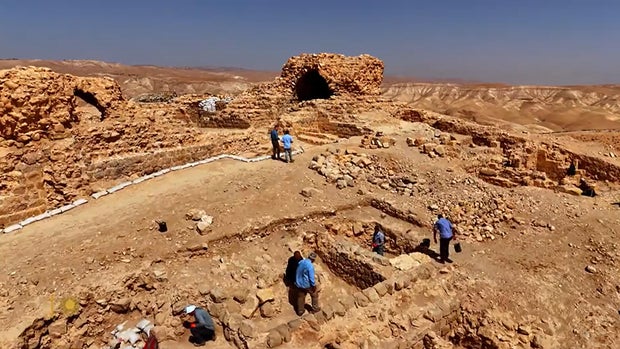
When asked if his role was inherently political, being an Israeli on Palestinian land, Freiman replied: “I am just an employee of a civilian administration. My job is to protect, preserve and make accessible all the archaeological sites.”
But for whom? This is the question that Talya Ezrahi raises. “Archeology became a way to prove that we were here,” she said. “So every time we look into the ground, we always hope to find something that has some indication of Jewish life in the land of Israel” – to assert we were here first.
Ezrahi is part of the left-wing Israeli archeology group Emek Shaveh. She says archeology has been used as a weapon to make certain lands inaccessible to Palestinians: “It has been used as a weapon to strengthen and consolidate settlements and claim more and more land that was once Palestinian land,” she said.
Take Nebi Samuel, where the prophet Samuel is believed to have been buried a thousand years BC. A Palestinian village was dismantled to make way for what has become a tourist site.
Eid Barakat was forced to move from here when his house was demolished. He has lived in temporary accommodation since 1971, because he claims he cannot obtain building permits. Israel now spends nearly $100 million on the development of archaeological and tourist sites in the West Bank.
When asked if it was good that the land where Barakat once lived had been excavated, Ezrahi replied: “First of all, it is a beautiful site. But at the same time, a very important chapter of the site is missing, namely the history of the Palestinian village that lived here.
Sébastia
We met Israeli archaeologist Adi Shragai in the West Bank town of Sebastia, once the capital of the Kingdom of Israel. “Many parts of history have been completely erased simply because someone decided to come and build on them,” she said.
Shragai says humanity benefits from the protection of these ancient sites. She is part of an Israeli archeology group called Preserving the Eternal, which works in the West Bank. “For 100 years, there have been no real excavations on this site, [or] academic research,” she said.
But can the carrying out of excavations be completely dissociated from today’s political realities? “The political reality is that sites are being destroyed,” Shragai said.
The group identifies archaeological sites that they believe need to be preserved, including this theater that is more than two thousand years old.
CBS News 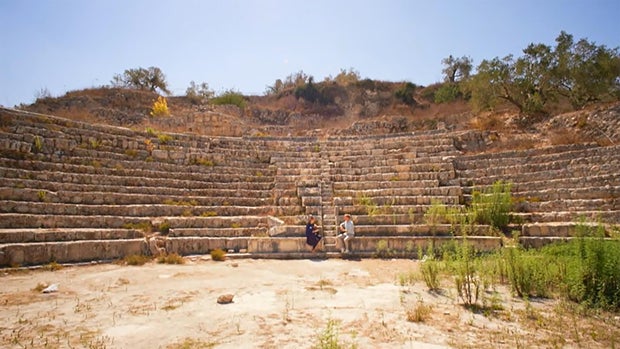
But to get here, the Israelis had to go around the Palestinian town by off-road vehicle, because tensions are very high.
When asked if such excavations by the Israelis amounted to a land grab in the West Bank, Shragai replied: “My main mission is to ensure the security, protection and preservation of these sites. If this were to be done by the Palestinian Authority, fine. But unfortunately, they don’t.
Zaid Azhari says his family has lived in Sebastia for at least 20 generations. He earns his living by organizing tours of these sites, particularly the theater. As a Palestinian, he says he is not allowed near them when the Israelis are working on the site.
“The Israelis do not allow us to work inside this site,” he said. “If you start working here, you will see the drones above you. The soldiers will come. The settlers will come.”
CBS News 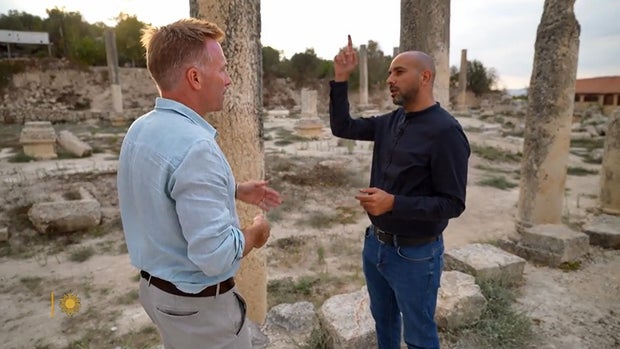
In November, Israel issued a land expropriation order to take control of more than 300 acres of Sebastia. Azhari says it would cut the city off from its heritage, its agricultural land and much of its economy. “It’s just about controlling the land, stealing it,” he said.
To Israelis who say it’s just a matter of archeology and not political, Azhari responded: “It’s totally political. We have been protecting our culture and our ruins for thousands of years.”
Rafi Greenberg is professor of archeology at Tel Aviv University and co-founder of the Emek Shaveh Group. “I thought archeology would only be about facts,” he said. “The discoveries themselves do not belong to the past, they belong to the present.”
He remembers being a student and first studying the artifacts: “They’re on our table, they’re looking at us.
Archeology is a story, Greenberg says, as evidenced by the City of David, the site where Israeli archaeologists are convinced that Israel’s most powerful king built his capital a thousand years before Christ. Greenberg was digging there around the same time CBS’s Bob Simon visited in 1980. Simon later reported that the United Nations had condemned Israeli archaeologists for digging in what the UN called occupied territory.
Today, the City of David is a national park with a zip line.
“So it became kind of a plan,” Greenberg said…a plan that he said is part “settlement project” and part road map for other archaeological sites.
In the neighboring town of Silwan, dozens of Palestinian families have been displaced or are subject to eviction proceedings. (Israeli authorities say they only demolish structures without proper permits and after all legal procedures have been exhausted.)
Greenberg said: “They are using antiquities and control of antiquities to connect different dots in this part of Jerusalem, to prevent the Palestinians from expanding their footprint. And their end goal is to drive them away. »
City of David
We wanted to hear what someone at the top of the Israeli government thought about these allegations and met with Israeli Heritage Minister Amichai Eliyahu at the City of David. “We are basically walking on the story that the whole Bible is based on,” he told us.
The minister, who is part of a far-right political faction, took us to the aqueducts of the old city, stopping at one point to take what he calls a “magic” ring from his jacket pocket: “Why magic? Because it’s been waiting in the ground for 2,000 years,” he explained.
It was found on Mount Gerizim in the West Bank. Engraved in Hebrew is the holiest prayer in Judaism, the shema. “If people ask, is this land ours? Here is the simplest and most moving proof,” he said.
Throughout the site, stories from King David’s reign are linked to archaeology.
CBS News 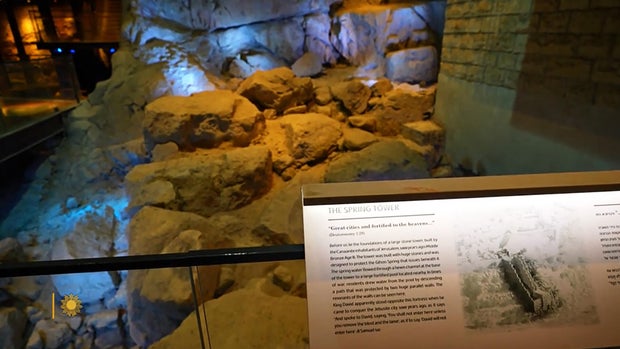
We asked, “What about the history of the Palestinians, even the Palestinians who once lived here?”
“So, according to history, there was no Palestinian people,” the minister said. “We don’t know who the Palestinian king was. They are a people who were invented 60 years ago.”
This made us think of something we had heard in Sebastia, when Zaid Azhari had taken us to see a plaque that did not mention that Sebastia had been the capital of the Kingdom of Israel.
We asked: “It seems that on both sides there is an erasure of history. Here you are not including the Jewish history of this city. »
“Here we are talking about a period,” Azhari replied.
“You mention Herod, the Roman leader. You mention the Canaanites. But the Israelites are missing.”
“To say it’s a Jewish kingdom or a Jewish city, that’s not really accurate,” Azhari said. “It’s my heritage. It’s not Zionist history or culture, it’s mine.”
It’s mine – that’s what we heard from both sides.
When he asked Heritage Minister Eliyahu about Israeli group Emek Shaveh’s statement that Israeli control of archaeological sites in the West Bank is essentially a territorial claim, he responded: “Does Emek Shaveh agree that these historical sites belong to the history of the Jewish people?”
For Professor Rafi Greenberg, this attitude is “another way of militarizing. In other words, you attach more importance to certain types of heritage and less importance to other types of heritage.”
Upon the establishment of Israel in 1948, the first Prime Minister Ben-Gurion emphasized the importance of archeology to the State of Israel itself. “Every nation needs a unifying myth, something that will bring everyone together to identify with a story that is theirs,” Greenberg said. He insists that despite efforts to make archeology a national story, it is generally a shared story – one that was exposed during the excavations on the pilgrimage route with Eyal Freiman.
“We have Jewish culture, we have Christian culture, we have Muslim cultures,” Freiman said. “It’s all combined. Sites that started as one and ended as another. Sometimes it’s not as black and white as we see.”
CBS News 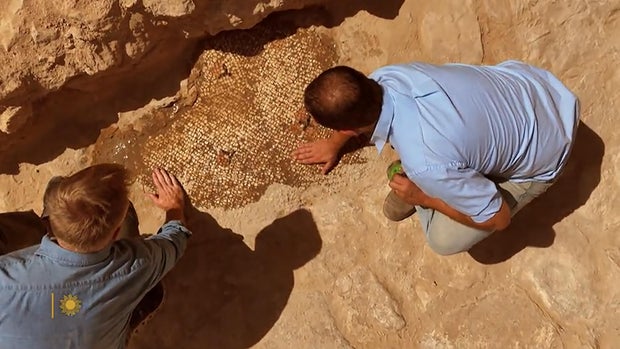
Rather, these finds may be a dusty, sandy gray. They are part of a continuum… tantalizing glimpses of another era seen through the lens of today.
For more information:
Story produced by Sari Aviv. Editor: Ed Givnish.


