How do they work, what do they cost and are they noisy?



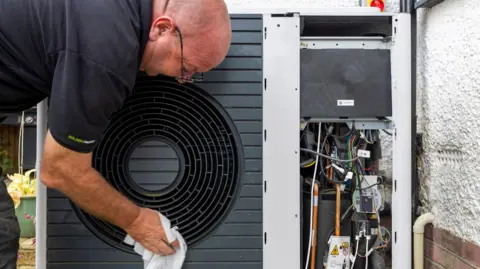 Andrew Aitchison/Getty Images
The government’s Warm Homes plan pledges £15 billion to help UK households pay for green technology such as heat pumps, as part of its efforts to cut energy bills and emissions linked to global warming.
Heating homes accounts for around a fifth of the UK’s greenhouse gas emissions, so switching from gas and oil to heat pumps is seen as a priority.
What are heat pumps and how do they work?
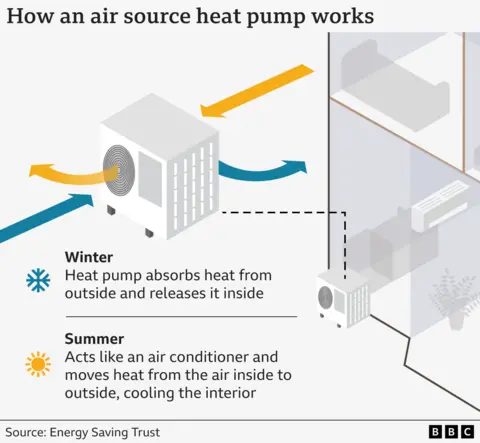
Heat pumps run on electricity rather than gas. They warm buildings by absorbing and amplifying heat from the air, ground or water.
They are widely seen as the best way to reduce carbon dioxide emissions and help achieve net zero emissions targets.
Heat pumps are more efficient than gas boilers. They can use electricity generated from increasingly cleaner sources as wind and solar power replace dirty fossil fuels.
Air source heat pumps – the most common type – draw in outside air and pass it through tubes containing refrigerant fluids. Heat from the outside air causes the refrigerants to evaporate into a gas, which is then compressed, causing its temperature to increase, and the heat circulates throughout the house.
The system consists of a box measuring approximately 1m x 1m x 0.4m located outside the property, together with a heat pump and hot water tank inside the property.
The indoor unit is about the size of a gas boiler, while the cylinder depends on the size of the house.
Geothermal heat pumps are more efficient than air models.
However, they are generally more expensive and less commonly used, as they require either deep drilling or a horizontal system dug into the ground over a large area.
How much do they cost and what support is there?
The Boiler Upgrade Scheme offers a grant of £7,500 towards an air source or ground source heat pump, to homeowners in England and Wales.
The grant means households are spending an extra £5,000 on average, which the UK’s spending watchdog says is too much for many.
The grant can be used for existing homes and non-residential buildings. The property must have an eligible Energy Performance Certificate (EPC), issued within the last 10 years.
The government’s latest Warm Homes plan extended this scheme until 2029/30.
Changes to the rules mean homes are no longer required to have existing loft or cavity wall insulation, which could save around £2,500 in upfront costs. A well-insulated home can help a heat pump work more efficiently.
For low-income households and those in social housing, the government is extending £5 billion of funding to the Social Housing Fund and the Warm Homes Local Grant.
The Warm Homes Local Grant provides funding for insulation, solar panels and air source heat pump through your local authority.
You must be in England, own or rent your property privately and have an Energy Performance Certificate (EPC) – a measure of energy efficiency – between D and G.
Scotland and Northern Ireland have separate programs to help make housing more efficient, but the plan allocates more funding to these devolved programs.
Could a heat pump save me money?
Although initial costs remain substantial, heat pumps could become cheaper to run than gas boilers, according to the Committee on Climate Change (CCC), which advises the UK government on reducing emissions.
The cost depends on energy prices and the operating efficiency of the heat pump.
Electric heat pumps use much less energy than gas boilers, but electricity generally costs more than gas.
Energy deals designed for heat pump owners can help households save money and install solar panels, meaning they can produce their own energy rather than relying on the grid.
Nesta, the social charity, has estimated that with solar panels and a heat pump, the average home could save almost £1,000 on their energy bills a year.
Are heat pumps noisy?
Previously, homeowners needed planning permission if they wanted to install a heat pump within one meter of their neighbor’s property, due to noise concerns.
The rule was dropped to speed adoption of heat pumps.
Noise concerns are also less of an issue with newer devices, although units will still need to be below a certain volume level. This was set at 42 dB, which corresponds to a power similar to that of a refrigerator.
Rules on the size and number of heat pumps that households can install have also been relaxed.
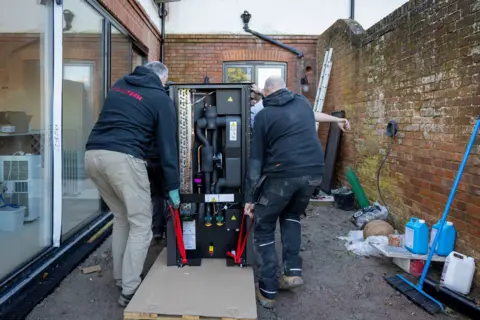 Andrew Aitchison/Getty Images
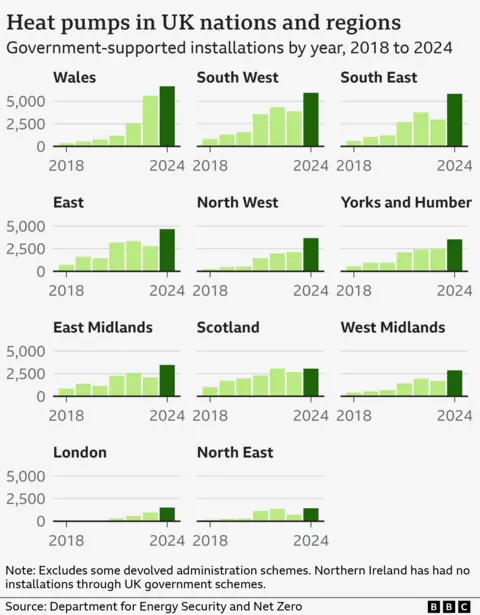
How many heat pumps have been installed in the UK?
What other support is offered under the Warm Homes Plan?
The plan includes the Warm Homes Fund, which aims to provide all households with low- or zero-interest loans to purchase solar panels and home storage batteries.
The government has not yet decided when or how households will be able to access these funds, but said it would announce more details later this year.
Low-income people will be able to benefit from the technologies covered under the existing social housing fund and local subsidy.



