How dolphins communicate – new discoveries from a long-term study in Sarasota, Florida

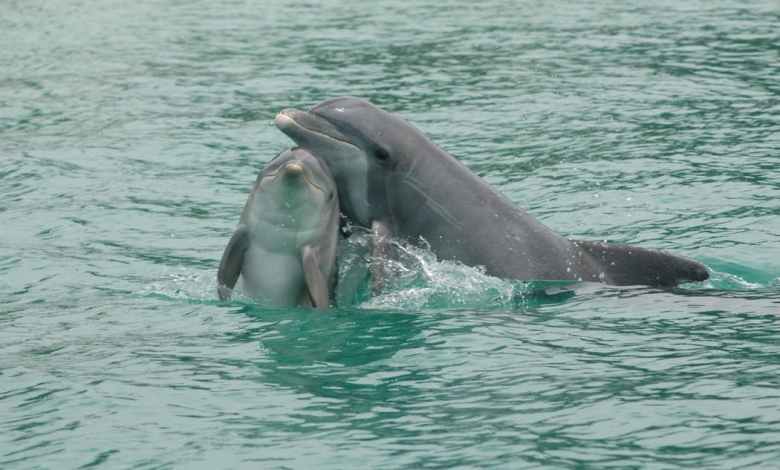
Human fascination with bottlenose dolphins dates back thousands of years, at least as far back as Greek mythology.
But it wasn’t until the 1960s that methodical research into dolphin communication began. Scientists like John Lilly and the husband-and-wife team of Melba and David Caldwell have attempted various experiments to decipher the sounds dolphins can make.
The Caldwells found a way to record isolated animals in human care. They found that each dolphin communicated primarily with a unique whistle, which they called the “signature whistle.” Researchers now know that these whistles convey identities, just like human names. Dolphins use them to stay in contact with each other in their dark habitat, where vision is limited. It’s like announcing “I’m here!” when someone can’t see you.
This discovery is fundamental to my own research. I have been studying communication in wild dolphins since the mid-1980s, when I joined my mentor Peter Tyack to first document the characteristic whistles of wild dolphins. Our team’s research focused on a resident community of free-ranging bottlenose dolphins in the waters near Sarasota, Florida, where I continue to work today.
This collaborative study, led by Randall Wells of the Sarasota Dolphin Research Program at Brookfield Zoo in Chicago, involves numerous researchers from various institutions, studying different aspects of dolphin biology, health, ecology and behavior. Launched in 1970, it is the world’s oldest research project on a population of wild cetaceans – whales, dolphins and porpoises.

Each dolphin has distinctive markings on its dorsal fin. Experienced researchers can sometimes visually identify them in the field and photograph them to confirm their identity in the laboratory. Photo of the Sarasota Dolphin Research Program at Brookfield Zoo in Chicago, taken under NMFS MMPA Scientific Research Permit
Record and observe
Researchers know the age, sex and maternal relationship of almost all of the approximately 170 dolphins in the Sarasota community. This depth of knowledge provides an unprecedented opportunity to study communication in a wild cetacean species.
Sarasota Project dolphins are periodically subjected to brief health assessments upon capture and release, during which researchers, including myself, briefly handle individual dolphins.
Our team attaches suction cup hydrophones directly to each dolphin’s melon, i.e. on its forehead. We then record the dolphins continuously throughout the health assessments, taking notes on who is being recorded, when, and what is happening at that time.
This is how my colleagues and I were able to confirm that wild dolphins, like captive animals, produced a large number of distinctive whistles when briefly isolated from other dolphins. Through observations and recordings of free-swimming dolphins, we were further able to confirm that they produced these same characteristic whistles in undisturbed contexts.
We organized these recordings into the Sarasota Dolphin Whistle database, which now contains nearly 1,000 recording sessions from 324 individual dolphins. More than half of the dolphins in the database have been recorded more than once.
We identify each dolphin’s characteristic whistle based on its prevalence: in the context of catch and release, approximately 85% of whistles produced by dolphins are characteristic whistles. We can identify them visually, by viewing plots of frequency versus time called spectrograms.

Spectrograms of characteristic whistles of 269 individual bottlenose dolphins recorded in Sarasota. Figure created by Frants Jensen, with sound files by Laela Sayigh
Signature and “motherese” whistles
The Sarasota Dolphin Whistle Database has proven to be a rich resource for understanding dolphin communication. For example, we found that some calves develop signature whistles similar to those of their mothers, but many do not, raising questions about the factors that influence signature whistle development.
We also found that once developed, signature whistles are very stable throughout an animal’s life, especially for females. Males often form strong pair bonds with another adult male, and in some cases their whistles become more similar over time. We are still trying to understand when and why this happens.
Mother dolphins modify their characteristic whistles when communicating with their young by increasing the maximum frequency, or pitch. This is similar to human caregivers who use a higher pitched voice when communicating with young children – a phenomenon known as “mothering.”
Slow motion recording of a bottlenose dolphin without its calf, then with its calf. Courtesy of Laela Sayigh of the Woods Hole Oceanographic Institution and the Sarasota Dolphin Research Program at Brookfield Zoo Chicago. These sounds were obtained under a federal scientific research permit issued to R. Wells of SDRP.72 KB (download)
The way dolphins initiate contact with another dolphin by imitating their signature whistle – what we call a copy of the signature whistle is also similar to humans. This is similar to how you would use someone’s name to call them.
Our team wants to find out if dolphins also copy the whistles of other people who are not there, and could possibly talk about them. We have seen evidence of this in our recordings of dolphins during health assessments, which provide a rare context to convincingly document this phenomenon. But we still have work to do to confirm that these aren’t just coincidental similarities in the whistles.
Types of shared whistles
Another exciting development was our recent discovery of shared whistle types, those that are used by multiple animals and are not signature whistles. We call these unsigned whistles.
I could hardly believe my ears when I first discovered a type of repeated, shared, unsigned whistle produced by several dolphins in response to sounds we played back to them through an underwater speaker. We had previously believed that these unsigned whistles were somewhat random, but now I was hearing many different dolphins produce a similar type of whistle.
Originally, our team used the recordings to try to determine whether dolphins used “vocal cues” to recognize each other – the same way you can recognize the voice of someone you know. Although we found that dolphins did not use vocal cues, our discovery of shared, unsigned whistle types led to an entirely new research direction.

The author listens to the whistling of dolphins on a boat in Sarasota. Jonathan Bird from “Call of the Dolphins”/Oceanic Research Group, Inc.
So far, I have identified at least 20 different types of unsigned shared whistles and continue to expand our catalog. We hope that artificial intelligence methods can help us categorize these types of whistles in the future.
To understand how these types of shared, unsigned whistles work, we are conducting more playback experiments, filming the dolphins’ responses with drones. We found that such a whistle often leads to avoidance of drones, suggesting a possible alarm-type function. We also discovered that another type could be an expression of surprise, as we have seen animals produce when they hear unexpected stimuli.
More difficult, more interesting
The main takeaway from our experiments so far is that communication with dolphins is complex and there will be no universal answers to any type of unsigned whistle. This is not surprising, given that, like us, these animals have complex social relationships that could affect their response to different types of sounds.
For example, when you hear someone calling your name, you may react differently if you are with a group of people or alone, or if you recently had an argument with someone, or if you are hungry and about to eat.
Our team still has much work to do to sample as many dolphins in as many contexts as possible, such as different ages, sexes, group compositions and activities.
It makes my job more difficult – and much more interesting. I feel lucky every day to be able to work on the seemingly endless number of fascinating research questions about dolphin communication that await answers.
Read more stories from The Conversation about Florida.
This article is republished from The Conversation, an independent, nonprofit news organization that brings you trusted facts and analysis to help you make sense of our complex world. It was written by: Laela Sayigh, Woods Hole Oceanographic Institution
Learn more:
Laela Sayigh works for the Woods Hole Oceanographic Institution. It receives funding from various government and philanthropic organizations. She is a board member of the nonprofit Cetacean Communication Research, Inc. She works closely with the Sarasota Dolphin Research program at Brookfield Zoo Chicago.


