How fast is the universe expanding? Astronomers may be one step closer to resolving ‘Hubble trouble’

When you purchase through links on our articles, Future and its syndication partners may earn a commission.

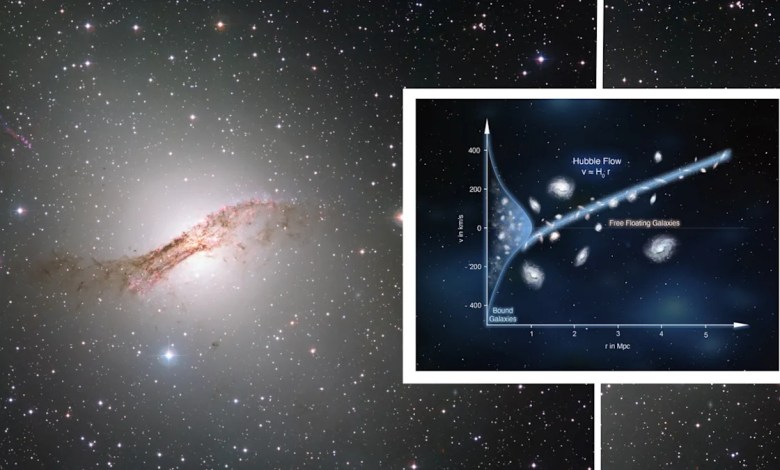
(Main) the Centaurus A galaxy as seen by the MPG/ESO 2.2-meter telescope at the La Silla Observatory in Chile. (Inset) The velocities of galaxies in groups as a function of distance. | Credit: ESO/ AIP/ D. Benisty / J. Fohlmeister
The local universe may be expanding more slowly than previously thought, scientists have discovered. This discovery, made in two separate investigations, could alleviate one of cosmology’s most troubling headaches, Hubble tension.
THE Hubble constant – named after Edwin Hubblethe astronomer who discovered in the early 1900s that the universe was expanding, is the speed at which this expansion is occurring.
THE Hubble voltage follows from the fact that the observation of the local universe provides a value of the Hubble constant different from that derived using the cosmic microwave background (CMB) — the first light of the universe, which shone shortly after the Big Bang. Astronomers take CMB measurements, then move forward using the standard model of cosmology, the so-called Lambda cold dark matter model (LCDM).
The discrepancy persisted even as the two separate measurement techniques became more precise. This is troubling because it suggests that a crucial physical ingredient is missing from our recipe for the cosmos. This is why many astronomers are talking about the need for a third method to help bridge this disparity, or at least shed light on why it exists.
Two new studies suggest a new way to measure expansion in the immediate cosmos by analyzing the motion of two groups of nearby galaxies. Galaxies within these groups are simultaneously linked together by mutual gravity and separated by the cosmic flow caused by the stretching of the space in which they are embedded.
Both results indicate that the universe is growing more slowly in our neighborhood than previously estimated. Not only does this technique bring measurements of the Hubble constant in the near universe closer to those made using the CMB and LCDM model, but it also suggests that less dark matter is necessary to explain cosmic observations and galaxy dynamics.
Halo or not?
The teams reached their conclusions by examining two groups of galaxies: the Centaurus A group (one of the closest to us, with the exception of Milky Way(local group of ) and the M81 group. Rather than using nearby Type Ia observations supernovas or the cosmic fossil of the first light of the universe represented by the CMB to measure the Hubble constant, researchers used the movement of these galaxies grouped under the balance of the attractive influence of gravity and the repulsive effect of the expansion of the universe.
Astronomers have discovered that the dozens of small galaxies that make up the Centaurus A group are actually not dominated by the giant elliptical galaxy of the same name. This galaxy instead forms a binary galaxy with the M83 galaxy in the group.
We already knew that the M81 group had binary galaxies (M81 and M82) at its heart. The new research found that although the structure of this group is well organized, the inland region of around 1 million people light years is tilted approximately 34 degrees relative to its wider surroundings. At a distance of about 10 million light years, the orientation of the M81 group aligns with that of a large sheet-like structure of matter that extends to the Centaurus A group.

The velocities of galaxies in groups as a function of distance. Embedded in the expanding universe, the gravitational forces of gravity pull group members together and cosmic expansion tears away outer galaxies. This balancing act jointly constrains the mass of the gravitationally bound group and the Hubble constant. | Credit: AIP/ D. Benisty / J. Fohlmeister
The two teams of scientists also discovered that in addition to the two groups of galaxies sharing a similar environment, the masses of the brightest galaxies in these groupings account for most of the total mass. Thus, the movements of all galaxies within the groupings can be seen as the result of the interaction of the gravitational influence of these bright galaxies and the cosmic flow of the expanding universe.
This means that, contrary to predictions from cosmic simulations, galaxy groups do not need to be embedded in a vast, all-encompassing halo of dark matter exerting its gravitational influence.
What does this mean for the Hubble constant?
The Hubble constant is measured in kilometers per second per megaparsec (km/s/Mpc), with 1 megaparsec equivalent to approximately 3.3 million light years. Currently, when researchers calculate the expansion rate of the universe using local Type Ia supernovas, they obtain a Hubble constant of 73 km/s/Mpc. However, when the Hubble constant is calculated using the CMB, theorists calculate a lower value of 68 km/s/Mpc.
The teams involved in this research arrived at a Hubble constant value of 64 km/s/Mpc. This implied to the researchers that part of the Hubble voltage was caused by the methods scientists used to measure the Hubble constant. This could mean that an additional element of the cosmos, currently unknown, is not necessary to dissipate the Hubble tension; we can complete this cosmic recipe with the ingredients we have available.
Of course, there is still a long way to go before this method disrupts existing paradigms. With the technique applied to only two local galaxy groups, the Hubble tension is bound to be a headache for at least a little while longer.
The next step in this investigation will be to apply this technique of studying galaxy groups to a broader region of space within our local universe. This may become possible when observations of galaxy groups at greater distances become available in the next release of data from the 4 Meter Multi-Object Spectroscopic Telescope (4MOST).
The team’s research was published in two papers in the magazine Astronomy and astrophysics.


