How fetal and maternal cells evolved to work together


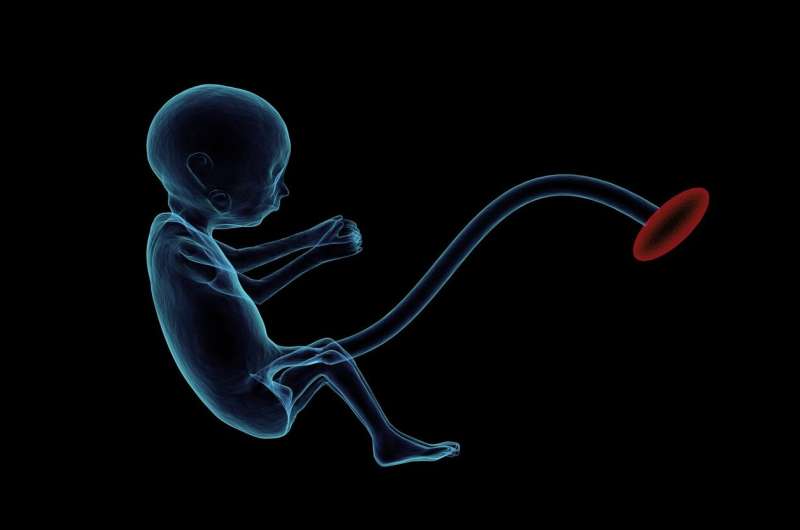
Credit: Public Pixabay / CC0 domain
The maternal-fetal interface is the meeting point for maternal and fetal cells during pregnancy. It has long been understood as an area of conflict, where the placenta – a fetal organ – is in the process of accessing the mother to access the nutrients.
This is an unusual situation, because in normal cases, foreign cells must be rejected by the immune system. During pregnancy, they are tolerated. However, the mother’s cells also limit this invasion to an optimal state. The fight has been continuing for millions of years in evolution.
In the last issue of Proceedings of the National Academy of SciencesA team led by Kshitiz, an associate professor of biomedical engineering at the Uconn School of Dental Medicine, shows that pregnancy is not only a conflict between the mother and the baby, but rather, a delicate balance of cooperation and competition which has evolved overtime to ensure a successful pregnancy.
Postdoctoral scholarship holders Yasir Suhail and Wenqiang du, as well as Gunter Wagner in Yale and Junaid Afzal at the University of California San Francisco (UCS) also contributed to this research.
Wagner, former president of evolutionary biology in Yale, and Kshitiz previously argued that there should be cooperation between the mother and the fetus to support pregnancy. Although scientific discipline has mainly talked about genetic conflict, evidence of cooperation that modulates this conflict is missing.
“The maternal -fetal interface – because this is what Placenta -Uterus interaction is called – is like an unresolved border between countries. There is so much difference between different species, which are not for any other organ,” said Kshitiz.
In anticipation of pregnancy, the endometrium undergoes a process called decidualization, the thickening of the tissues that women experience in each menstrual cycle. This matrix deposit process prevents excessive invasion by placental cells in the endometrium. AFZAL and DU have shown that placental cells influence the mother’s own cells to degrade their own matrix – a surprising discovery.
“It is this active persuasion of the placental cells that made the mother’s endometrium cells reduce her own defenses by secreting a protein, which was so surprising,” said Wagner.
Suhail has modeled molecular interactions between placental and endometrial cells as an electrical flow problem, identifying the underlying key circuit with this handling.
“It is rare and encouraging to see an integrated collaboration as close between calculation and experimentation. My model was created using experimental data, and the discovery was validated by experiences,” said Suhail.
In game theory, the mixture of competition and cooperation is known as cooperation. The maternal-fetal interface, according to researchers, houses a myriad of cellular interactions that embody the true meaning of cooperation.
Kshitiz attributes a conversation with a teacher of economics from the United Kingdom, Dr. Anshuman Chutani, who told him about the vast literature in cooperation econometrics.
“This is a term that we borrowed with pleasure,” said Kshitiz. “It is not only cooperation by the endometrium, but has induced cooperation between competitors.”
In the maternal-fetal interface, fetal cells strive to actively persuade maternal cells to stop building protective tissues so that fetal cells can effectively invade the placenta and recover nutrients. Above all, this interaction does not occur alone – it depends on the will of the mother’s cells to respond to signals from the placenta. This proves that the placental invasion is more a combination of competition and cooperation between maternal and fetal tissues, not just an area of conflict as previously believed.
This discovery does not only shed light on the complications of pregnancy which imply problems of placental invasion, such as the placenta accreta and preeclampsia, but can also have wider implications on the metastases of cancer and the understanding of the way in which certain cancers invade the body.
“This study, carried out jointly by scientists from Uconn Health, Yale and UCS, can change our way of thinking about the conflicts between generations, just when the fetus is still in the mother’s belly,” said Kshitiz.
More information:
Junaid Afzal et al, proof of cooperation at the maternal-fetal interface shaping the placental invasion, Proceedings of the National Academy of Sciences (2025). DOI: 10.1073 / PNAS. 2323038122
Provided by the University of Connecticut
Quote: Cooperation and competition: How fetal and maternal cells have evolved to work together (2025, September 8) recovered on September 9, 2025 from https://phys.org/news/2025-09-copener-cocompection-fetal-maternal-cells.html
This document is subject to copyright. In addition to any fair program for private or research purposes, no part can be reproduced without written authorization. The content is provided only for information purposes.


