How group singing is helping new mums with postnatal depression


Specially designed singing lessons are clinically effective in treating mums suffering from postnatal depression, according to a major three-year study. The authors say they could also be cost-effective for the NHS at a time when mental health services are under pressure.
At a children’s center on a south London housing estate, a group of 12 young mothers sit in a circle on the floor while their babies cry, crawl and sleep on mats in front of them.
But in this music class, there are no bells or tambourines, no wheels on the bus or baby sharks.
Instead, the group works through a mix of lullabies, folk and gospel, moving from Spanish to Congolese to Swahili in rounds of four-part harmonies.
The entire session, from the music selection to the size of the group, to the layout of the room itself, has been carefully designed to address the symptoms of postnatal depression.
“I can’t stress enough how game-changing it was for me,” says Holly, 30, who started the course earlier this year after it was recommended by her care coordinator.
She says she started feeling bad during her pregnancy after “my hormones, or something like that, went a little wrong.”
Although these symptoms began to improve after giving birth to her daughter Ettie, she still felt “vulnerable and very anxious.”
“Being a new mom is one of the loneliest times, because you’re kind of in this island bubble,” she says.
“And from the first session here, I walked in and I was like, ‘oh, this is my safe place.’ I’m safe here.”

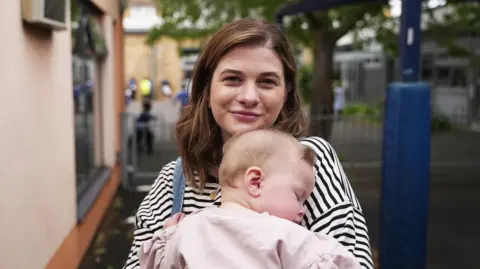
Postnatal depression is a common problem, affecting more than one in 10 women in the year after giving birth, according to the NHS.
Symptoms are varied, but can include persistent sadness or low mood, difficulty taking care of oneself, insomnia, and withdrawal from others.
Melodies for Mums began in 2017 as a free weekly class in Southwark, south London, based on previous research suggesting that group singing could reduce stress and anxiety.
It has grown rapidly and now offers face-to-face sessions for 400 women a year in five London boroughs and online courses across the UK.
“We know that women with symptoms of postnatal depression may have difficulty communicating with their peers,” says Yvonne Farquharson, founder of Breathe Arts Health Research, the nonprofit organization behind the idea.
“By singing, we get them to really look at each other and make that kind of connection and social connection.”
New mothers often join the program after it has been suggested by their midwife, GP or local authority, or after finding it through social media or word of mouth.
There is a screening process to check they will benefit before starting the 10-week course.
A “lasting” impact
In 2019, the sessions were part of a study funded by a £2.6 million grant from the Wellcome Trust to research how local arts projects could improve physical and mental health on a wider scale.
The results, published this week in the British Journal of Psychiatry, involved almost 200 mothers suffering from postnatal depression over an eight-month period.
The women were divided into two groups, with one group assigned the singing lesson and the other providing more typical support like community acting classes.
All mothers reported a reduction in their symptoms by week 10, but this improvement continued in the singing group for another six months after the sessions ended.
“This is really important because it shows that singing intervention is not only immediately effective for depression, but has a long-term impact,” says Dr Rebecca Bind, a research associate at Kings College London and one of the lead authors of the study.
Women in the singing group also had a much lower dropout rate and were more likely to say they found the program suited their needs and easy to use.
The published article does not specifically examine why singing itself appears to have a beneficial effect. But researchers have their theories.
“I think part of it was because the women were in the presence of other mothers who were going through the same kinds of experiences, even though they didn’t necessarily have to talk about it,” says Dr. Bind.
“And on top of that, the act of singing itself can have a very relaxing effect.”
A second stage of the analysis has already involved taking saliva samples from women to measure levels of the stress hormone cortisol.
Initial results suggest that mothers in the singing group saw a “steady decline in these levels throughout the intervention period”, according to Carmine Pariante, professor of biological psychiatry at Kings College London.
The music lessons also helped mothers bond with their babies, which continued after the lesson ended, with the songs and music being used at home.
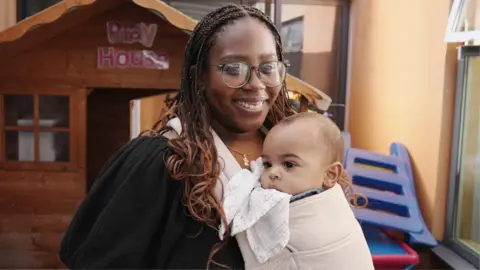
At the children’s center, Jay, holding his young son Ezra, describes postnatal depression as “feeling down when I know I should have been at the happiest time of my life.”
“Just being able to be with people who are also struggling, even if that’s not what the session is about. [is important]”, she said.
“You’re there, you’re having a good time and you’re singing, but you know these people are going through what you’re going through too.”
Long NHS waiting lists
Organizers emphasize that singing lessons should not replace talking therapies or medications.
But they could either be complementary or a quicker, easier-to-access alternative for some women, at a time when waits for NHS mental health services can be long.
Some mothers can wait up to six months for an evaluation and up to a year for individual treatment, according to a 2024 report from the Maternal Mental Health Alliance.
The study by Kings College London found that the cost of the music course, ranging from £126 to £539 per mother and baby depending on how it is measured, was comparable to alternatives such as educational programs and considerably lower than the cost of group therapy or home visits.
Yvonne Farquharson from Breathe says the arts organization has now piloted its first singing sessions aimed at young dads.
The World Health Organization also asked him to form teams to roll out the courses in Denmark, Italy, Romania and other countries.
At the children’s center in south London, the group talk not only about the friendships they made, but also the skills they learned over the 10 weeks.
“I have two very young children, so things can get very stressful at home,” Stella says as she holds tightly to Evie, a squirming baby.
“I bring the singing home with me, so now I start humming when things get stressful, and I don’t even think about it, it just happens and I can deal with it.”
Examples of songs from Melodies for Moms:
- Arrorró mi niño – Spanish lullaby
- Simama Kaa – Swahili folk song
- Bele Mama – Cameroonian folk song
- Yani Yoni Ya Hu Wey Hey – Native American Birth Song
- A list of organizations in the UK offering support and information on some of the issues covered in this story is available at BBC action line