How I reclaimed 7TB for free


I have plenty of storage space for my Plex server – over 60TB in fact. However, even I sometimes run into space issues and need to find ways to free up storage space on the hard drive without deleting items. That’s where Tdarr comes in, and here’s how I used it to free up over 7TB of space on my server.
I used Tdarr to optimize my movie and TV show files
Who knew I was wasting so much space?

Several months ago, I tried setting up Unmanic to convert my larger movies and TV shows into smaller, more compact files. It seemed easy on the surface, but the setup I had (using remote nodes) put me off. Eventually I gave up, until I found Tdarr.
Tdarr was actually quite easy to configure and worked well with remote nodes, which was essential for my setup. I had a fairly large library for Tdarr to process, and the desktop I was running it on with an i9-13900K wasn’t going to be enough to process the media quickly.
I actually used Google’s Gemini to help me optimize orders and it worked pretty well. I had to tweak things over time, but overall I was very happy with the process.
I used two systems to perform the optimization: my i9-13900K desktop (with Tdarr using the iGPU) and my gaming computer with an RTX 3080. For both systems, I had the same workflow: filter by bitrate (to ignore any movies above 4000 Kbps and TV shows below 2500 Kbps), remux (to mp4), clean audio streams, then two ffmpeg scripts (one for Intel and one for NVIDIA), and finally a recheck of the file size (to make sure the new file size was actually smaller).
Configuring Tdarr this way saved me over 7TB of storage space on my server without deleting a single file. Tdarr processed 23,956 files, but only transcoded 5,466. It was pretty crazy to see that number grow to the point where it almost freed up an entire 8TB hard drive.
Tdarr is not without flaws or faults
Not all transcodings were perfect

I encountered quite a few transcoding issues during the process of using Tdarr. There were times when files would skip because there was a stray audio track, or the subtitles were poorly integrated (or the hardware couldn’t handle the integrated subtitles at all).
I spent several hours over a few weeks tuning the ffmpeg scripts. Small changes from time to time, and sometimes you have to completely change the flow of the plugin, before everything works the way I wanted.
In total, Tdarr took about three weeks to process everything I was working on. This meant a lot of downtime when things failed and I couldn’t immediately jump in and fix the problem. But it’s a small price to pay for such great space savings.
Now, downtime and script tuning wasn’t the only fault I encountered with Tdarr. So far I have only discovered one corrupted transcoded file and I had to re-extract the content to the server and transcode it manually. However, I’m sure I’ll discover more as time goes on.
I’m also glad I don’t watch regularly
Haven’t watched it in six months? It’s time to delete
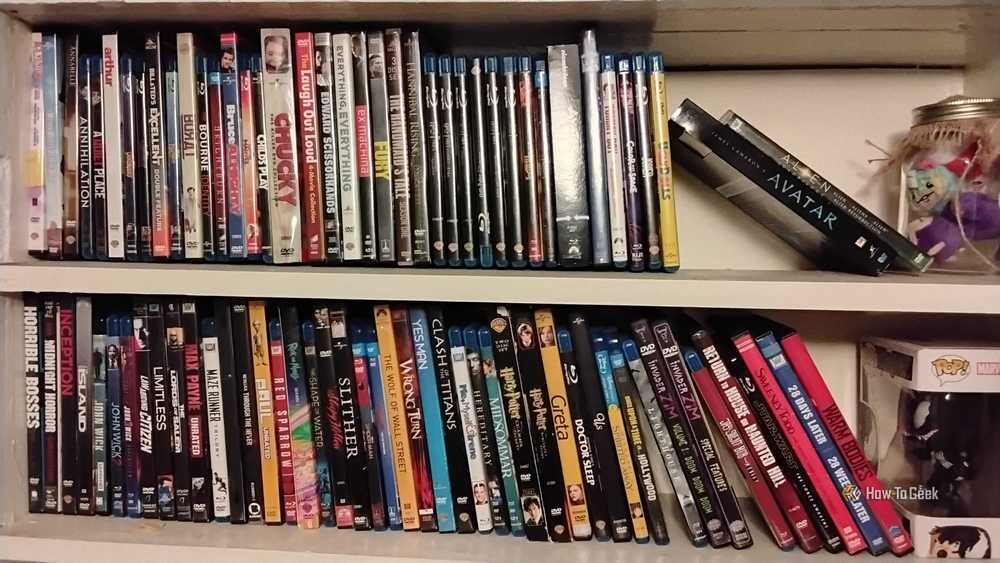
Tdarr alone saved me over 7TB of storage, but it’s not the only way to optimize my Plex server, so I’m not constantly buying new hard drives. While I don’t keep track of every time I watch something (although I’m working on creating an app for that), if I start to run out of storage and need to free up some space, I’ll usually look through my TV show library to see what the least-watched series is and how much space it’s taking up.
You’d be surprised how much space some old TV shows take up. Monk, one of my wife’s favorite series that I bought a long time ago and tore apart, takes up almost 600 GB of space. JAG, an even older show, takes up almost 500 GB. These two shows alone take up 1 TB of server space.
So deleting these old TV shows frees up a lot more space than deleting a handful of movies. I chose to do this manually, because I only want to purge content if I to have has. However, Ensureerr can fully automate the process for you. With Ensureerr, you can specify all kinds of parameters to follow before deleting content.
One of the best features of Ensureerr is that you can configure it to remove content that hasn’t been watched in X days/weeks/months/years. This means you may never have to think about deleting unwatched content again and your disk space remains freed up for you to rip more content in the future.
Keeping my Plex server clean and tidy isn’t just about deleting old content: I use several software programs to organize my media for me. Sonarr and Radarr are my two go-to tools for curating movies and TV shows.
One of the best aspects of Sonarr is that it not only organizes my shows, but also names them the way Plex requires for proper categorization and gives me a web interface to see which episodes I might be missing as well.
If your Plex library is cluttered and disorganized, take the time to fix it, you won’t regret it.


