How Interstellar Comet 3I/ATLAS Met Unlikely Observer


En route to Jupiter, ESA’s Juice spacecraft briefly turned its gaze on a rare interstellar visitor, 3I/ATLAS, capturing valuable data from an object born beyond our solar system.
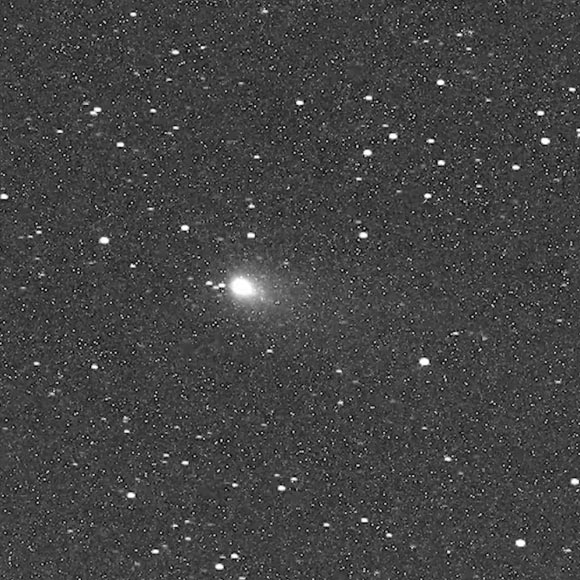
This 3I/ATLAS image was captured by the navigation camera (NavCam) aboard Juice in November 2025. Image credit: ESA / Juice / NavCam.
3I/ATLAS was first spotted on July 1, 2025 by the NASA-funded ATLAS survey telescope in Rio Hurtado, Chile.
Also known as C/2025 N1 (ATLAS) and A11pl3Z, the interstellar comet appears to have entered the solar system from the direction of the constellation Sagittarius.
The object follows the most dynamically extreme orbit ever measured in the solar system, highlighting its interstellar origins and extraordinary speed.
On October 30, 2025, 3I/ATLAS reached perihelion, its closest point to the Sun. It came within 1.4 AU (astronomical units) of our home star, just inside the orbit of Mars.
“Almost since the time of discovery, we realized that the geometry of the orbit would allow observations from the Juice spacecraft, which would observe the comet from a completely different angle than we can from Earth,” said Dr. Marco Fenucci, mathematician and Near-Earth Object Dynamicist at ESA’s Near-Earth Object Coordination Center.
Calculations predicted that Juice would be the closest spacecraft to 3I/ATLAS just after the object reached perihelion, in November 2025.
“Preparations for things like payload pointing campaigns or flybys typically last on the order of nine months,” said Angela Dietz, operations manager for the Juice spacecraft.
“When ATLAS arrived, we knew we didn’t have much time. »
Juice officially began its 3I/ATLAS observations on November 2, 2025 and will continue until November 25. The closest approach occurred on November 4 at approximately 0.4 AU.
The spacecraft used five of its instruments – JANUS, MAJIS, UVS, SWI and PEP – to take measurements of the interstellar visitor.
Thermal constraints limited these observations to six 45-minute slots and a final 4-hour slot.
Together these generated 126 scientific files with a total of 11.18 Gbits of data.
But scientists will have to wait to see the results.
Only after the spacecraft entered the cold cruise phase in mid-January 2026 would high-speed downlink be possible.
The long-awaited data downlink took place in two 11-hour passes on February 17 and 20, 2026 via ESTRACK’s New Norcia and Malargüe deep space antennas, respectively.
“That’s the great thing about our job – it’s always a team effort of multiple parties involved,” Dietz said.
“I think the fact that we were able to optimize this campaign in a short time and maximize the yield is something to be proud of! »
“At Jupiter, we will perform flybys of the icy moons at a high rate, sometimes only a few weeks apart.”
“The 3I/ATLAS campaign has made me even more convinced that Juice can quickly achieve its science objectives with short warning times, and that complex operations can be planned and executed in very limited time frames,” said Federico Gianneto, Juice spacecraft operations engineer.