How much sewage is spilled in rivers, lakes and the sea near you?



 Getty images
The water companies overturned raw wastewater for a record time of 3.61 million hours in the sea and the rivers in England in 2024, according to data from the Environment Agency.
The rules allow limited release of wastewater in excessive rain, but environmental groups remain concerned that the levels display a threat to wildlife and a risk for health swimmers.
How much wastewater is released in the seas and rivers in England?
Wastewater spills into lakes, rivers and anger with water companies increased slightly in 2024 to 3.614 million hours, against 3.606 million hours in 2023. However, the Environment Agency declared that the total number of spills was decreasing – which means that in average spins in 2024.
Water UK, the organization of industry for sewer companies, previously said that the spills are “unacceptable”, but that it had a plan “to put an end to wastewater in wastewater in all sailors” which involved significant infrastructure improvements.
In July, data from the Environment Agency also showed that pollution incidents by water companies, which can result from overturned wastewater and other contaminants, reach record levels.
There were 75 serious incidents – where there is a threat to aquatic and human health – and the Thames water was responsible for 33 of them.
The spill data for decontained nations are released separately. Northern Ireland does not currently monitor spills in real time and although Scotland has made efforts to increase surveillance, it only collects data of 27% of spill sites.
In Wales, hours of spills decreased in 2024 by 11%, but pollution incidents reached a top ten years.
Why are wastewater released in the sea and rivers?
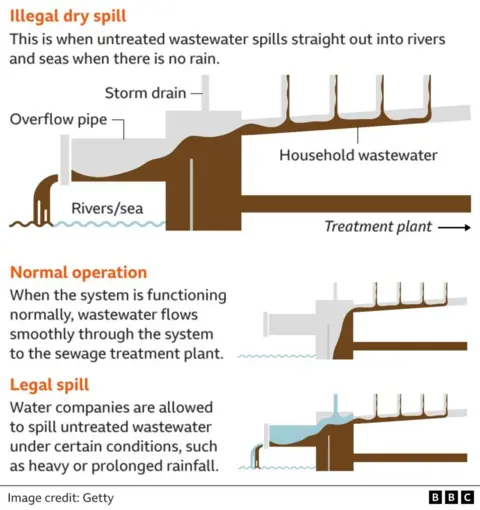
Most of the United Kingdom has a combined sewer system, which means that rainwater and wastewater – toilets, bathrooms and kitchens – are transported in the same pipes.
Wastewater is generally sent to wastewater treatment.
But the capacity can sometimes be exceeded during strong precipitation, especially if the dry soil cannot quickly absorb large amounts of water.
This could lead to a flood of sewer work and potential floods of houses, roads and open spaces.
The system is therefore designed to overflow from time to time and discharges excess wastewater in the sea and the rivers of combined sewers (CSO).
What is a dry spill and when do they happen?
According to the regulator of the OFWAT industry, certain water companies have “systematically released wastewater” outside of high showers, in violation of their permits – known as the dry spill. He said this is the result of companies that do not manage their wastewater treatment plants leading to wastewater overflowing in rivers and lakes before being treated.
Last year, the BBC discovered 6,000 potential dry spills by aquatic companies in England in 2022.
Even if it rains, the water company permits also force them to treat a minimum quantity of wastewater before freeing it.
What do we do to fight against wastewater releases?
The aging infrastructure has been identified by industry, the government and activists as one of the main reasons for wastewater spills.
At the end of last year, Ofwat agreed that water companies in England and Wales would spend a total of 104 billion pounds sterling over the next five years to make improvements as well as secure water supply – 20 billion pounds sterling would specifically go against wastewater waters.
Water UK, the industry organization, said it would be the “most ambitious modernization of the sewers since the Victorian era”.
But there have been criticisms from environmental activists according to which customers’ bills had to increase considerably to help pay a share of these changes, while water companies continue to pay dividends to shareholders.
Since the Labor Party entered the government in the summer of 2024, he also announced a number of new policies:
- Restrict the bonuses of the water company
- Launch of an independent water commission chaired by the former deputy governor of the Bank of England Sir Jon Cunliffe
- Prohibit wet wipes containing plastic – to reduce blockages
What are the risks for health to swim in polluted water?
 Getty images
How can I check if the sea near me is clean?
Each week between May and September, the Environment Agency measures the quality of the water to swimming sites across England, and in certain places, it issues daily forecasts for risk of pollution. It also offers to extend the bathroom season which would provide tests all year round.
You can search for your website by location. There are similar websites where you can discover the beaches and bathing water in Scotland, Wales or Northern Ireland.
And at the end of last year, Water UK – the Industry organization – launched the National Storm Overflow Hub where almost real -time discharges can be seen through all the overflow points in England. But this does not contain data on the volume of wastewater flow or the presence of organisms bearing a fecal-oral disease in water.
To what extent are British waters overall?
Wastewater spills are only regularly monitored for a few years, so it is difficult to say exactly how they have changed over time.
However, the overall quality of water has been monitored for decades. This also explains other sources of pollution, such as agriculture.
In May 2023, the Environment Agency said that 16% of the surface water evaluated in England had obtained a “good” ecological status, in particular:
- 14% of rivers and lakes
- 19% of estuaries
- 45% of coastal waters
- 93% of the designated bathing water
The quality of the water is generally higher in other parts of the United Kingdom.
In Scotland, around two thirds of surface water are classified as having a “good” ecological status.
In Wales, the figure is 40% and in Northern Ireland, 31%.


