How to begin your amateur astronomy journey

When you purchase through links on our articles, Future and its syndication partners may earn a commission.

Learn some key skygazing tips from experts. . | Credit: Alan Dyer/VWPics/Universal Images Group via Getty Images
There’s no better time than now to embrace the majesty of the night sky and begin a lifelong journey with amateur astronomy that will have you exploring everything from the twinkling stars and constellations with wandering, distant planets galaxies and countless other astronomical wonders.
However, there’s no denying that getting started with stargazing – and the myriad of tools used to explore the night sky – can be a daunting experience for newcomers. Well, we have what you need! Read on for a collection of tips and tricks from expert stargazers that will ensure your first steps into the world of amateur astronomy are as smooth and enjoyable as possible.
Check out our daily guide to the night sky to stay informed of the main stargazing events. You can also see our picks for best telescopes And best stargazing binoculars if you are looking to upgrade your equipment. You may also want to check out our roundup of best astronomy apps to navigate the stars!
Expert Tips for New Astronomers
Ed Bloomer, senior curator at the Royal Observatory, Greenwich
Space.com: What is your best advice for amateur astronomers?
Bloomer: It’s best to start with a little naked-eye astronomy: see if you can choose only something at the beginning, and build from there, over time. Try to identify one or two constellations in relation to each other and try to spot them over the course of a few nights to start building a little mental map of the sky.
Try to find a particular transient thing, like a planet, and note how it changes position relative to the stars – or to another planet, or to the planet. moon – over a few nights. Start small and build up speed, rather than trying to do everything at once.
Follow your interests. It’s much easier to pursue what interests you than to try to develop encyclopedic knowledge before taking the plunge. There are many online and other resources [who are] interested in the same thing. Chatting with someone else who started their journey before you is always good!
Coping with cold and darkness
This usually involves you being outside, in the dark, perhaps for quite a while and possibly in the cold, so treat it like any outdoor activity. Hat, gloves, torch [flashlight]comfortable shoes and a thermos of hot tea are among a stargazer’s most valuable equipment. Maybe even a small folding camping chair?
Also, patience. And a desire to end your day without getting discouraged when the clouds spoil your view!
Space.com: What’s a common mistake astronomers make when they’re starting out?
Bloomer: I think the most common mistake is not taking the time to adapt to the darkness – or adapting, then ruining it by looking at your phone. It takes 20 to 30 minutes for the eyes to become fully sensitive to darkness, so a quick glance at the night sky won’t reveal much. Movies tend to present the night sky as this beautifully balanced bright display of light with the illuminated figures in the foreground, but the sky is darkand you have to give yourself the time and concentration to really let it reveal itself.

The Milky Way’s bright ribbon crosses the sky to meet the dish of a radio telescope in Madrid. | Credit: Photo by Marcos del Mazo/LightRocket via Getty Images
Gianluca Masi, founder of The Virtual Telescope project
Space.com: What is your favorite memory from your early days of stargazing?
Masi: I have so many fond memories of when my interest in astronomy began, in the late 70s. I fondly remember the sudden discovery of the starry night panorama. At some point I saw it and fell in love with its wonders, so much so that I decided to become a professional astrophysicist, working intensively on both research and science communication, eventually creating the Virtual Telescope Project in 2006.
I’m always very happy when I see people starting out with the same passion, and I like to share some advice with them, after almost half a century of stargazing.
The importance of patience
Space.com: What are your best tips for amateur astronomers?
Masi: For me, the most important keyword here is patience. Explore the night sky [and] knowing its many routes takes time. Yes, today we have many amazing tools that support and even enrich the experience, but there are no shortcuts.
Take your time to familiarize yourself with some seemingly easy, but important points, like orientation and star recognition, perhaps using a classic paper star map, as this makes you more confident with what’s going on behind the scene. Take the time to observe the slow apparent movement of the stars as our planet rotates around its axis, [and] enjoy the subtle but stunning details, like the different colors and brightness among the stars.
“Always find time to observe with your own eyes”
The time you spend will be rewarded with experience and confidence with the night sky.
Space.com: How can astronomers maintain their passion over the long term?
Masi: Of course, at some point you’ll want an astronomical telescope, and you’ll even want to take photos of these cosmic treasures. This is fantastic, but only take these steps once you [are] familiar with the night sky. This way you can point [at] this and that, knowing where to go to see them. You would buy a car after learning to drive and discovering the places worth visiting; the same, for me, is true with the night sky. This will also help keep that passion alive.
And when you master observing and imaging with advanced telescopes, always find time to observe with your own eyes. This will foster your interest in astronomy, supporting the emotional side of this adventure which is very important, decade after decade.

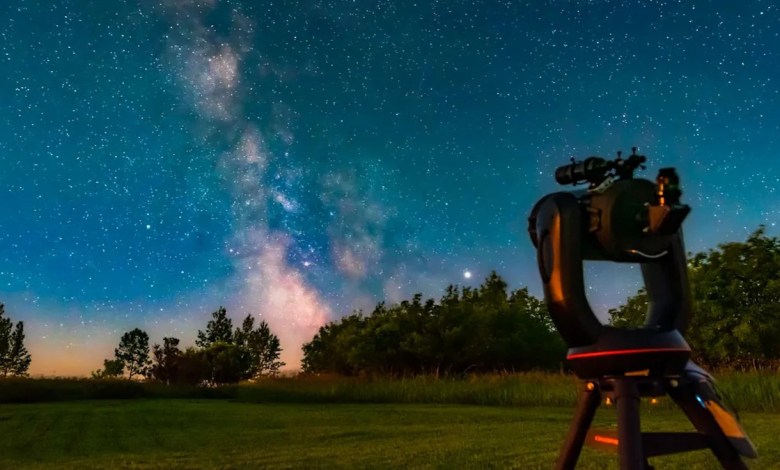
A telescope is ready to explore the wonders of the universe as the Milky Way shines above us. | Credit: Alan Dyer/VWPics/Universal Images Group via Getty Images
Robert Lunsford, Fireball Report Coordinator, Newsletter Editor, and Treasurer of the American Meteor Society
Space.com: What equipment do beginning astronomers need?
Lunsford: For anyone interested in the night sky, I suggest learning the constellations First of all. The only thing you would need is a reference book displaying the constellations. If [you find yourself] wanting to go beyond naked eye observations, then a inexpensive pair of binoculars will reveal the colors of the stars, the brighter the brighter star cluster. Binoculars provide a wide field of view so it’s easy to find objects listed in each constellation.
The trick with telescopes
Space.com: What should amateur astronomers know about beginner telescopes?
Lunsford: There are objects too small or too faint to see with binoculars that a telescope can reveal. The only problem with using a telescope is the small field of view compared to binoculars. Therefore, a riflescope with reticle is of great help in finding objects in a telescope. Most cheap telescopes come with low-quality telescopes that are virtually worthless. The lens of a rifle scope should be at least 1 inch [2.5 centimeters] in diameter to be useful.
I would advise people to buy refractors as their first scope. These telescopes are ready to use right out of the box, and there is no need to collimate a mirror, which is often misaligned in the reflectors. Avoid using high-power eyepieces at first, as their field of view is tiny and images are not as sharp as with low-power eyepieces. Any eyepiece with a focal length greater than 20mm is suitable for low power sights.
Finally, a robust to go up is a must for a successful observation. Cheap mounts will wobble in the slightest breeze, making observation impossible.

The auroras shine over Lake Ellesmere in New Zealand. | Credit: SANKA VIDANAGAMA/AFP via Getty Images
Josh Dury, award-winning astrophotographer
Space.com: What’s your best advice for skywatchers just starting out?
Dury: When taking your first views of the distant universe, I advise you not to opt for the most expensive equipment first. The experience involves learning the basics of telescopes, as well as camerasto become familiar with the terminology and operation of additional features and accessories. Once you start learning how they work and seeing your first celestial objects, look to upgrade your equipment.
I would also advise you to join your local astronomical society. Not only do you meet groups of like-minded people, but they are great meetings to exchange and share your knowledge. A fundamental value where we learn to share the night sky. Space is for everyone.
The weather is of course a challenge. I will always vouch for more than one weather forecast when looking for your next clear sky. Look at several models to see if the sky is sometimes clear, and [you] you may have to watch at the last minute when the clouds part.
“Go to your local booksellers and look for physical guides”
When learning about the night sky, don’t rely solely on online resources. Visit your local bookstores and look for physical guides. They contain precise and succinct information to help you in your astronomical project. Not only can you take them with you on the go; they are also designed for use with red torches [flashlights] to preserve night vision.
When you go out with your camera or telescope, use a red torch. This wavelength of light preserves your night vision. So, even when you operate a red light, you will be able to see many stars, unlike white light, where it will take your eyes 20 minutes to see them. [adapt to the] dark.
Editor’s note: If you would like to share your astrophotography with Space.com readers, please send your photo(s), comments, name and location to spacephotos@space.com.


