Wildfire smoke lofted miles high could have an unexpected effect on Earth’s climate

When you purchase through links on our articles, Future and its syndication partners may earn a commission.

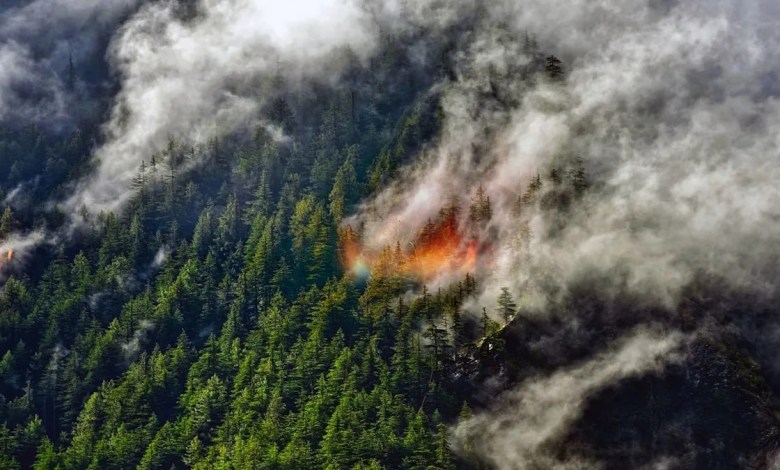
Climate models may need to be updated to include new types of particles from smoke from old wildfires. | Credit: anand purohit/Getty Images
Wildfires don’t just burn landscapes. Some are so intense that they create their own weather systems, like pyrocumulonimbus thunderstorms that throw smoke up to 10 miles (16 kilometers) into the sky. atmosphere. Although it has long been known that these high-altitude smoke can persist in the atmosphere for weeks or months, their effect on the climate remains difficult to measure, due to the difficulties of collecting samples. That is, until now.
Atmospheric scientists at the Harvard John A. Paulson School of Engineering and Applied Sciences report the first direct measurements of smoke from a five-day-old wildfire in the upper troposphere, about 9 miles (14.5 kilometers) above the Earth’s surface. They discovered large smoke particles that are not represented in current climate models, and these particles actually appear to cool the atmosphere.
To directly capture the fresh smoke, the team flew a high-altitude NASA ER-2 aircraft into a plume created by a New Mexico wildfire in June 2022, just five days after the fire broke out. The onboard instruments measured particle size, concentration and chemical composition.
Inside the smoke cloud, the researchers detected aerosols about 500 nanometers wide, about twice the size of typical aerosols from a low-altitude wildfire. The team suggests that the large size may be attributed to efficient clotting.
“Particles can coagulate anywhere in the atmosphere,” Yaowei Li, the lead author of a study on the research, said in a statement. statement. “But in this specific region, the air mixes very slowly. This allows wildfire smoke particles to stay concentrated and collide more often, making coagulation much more efficient.”
These aerosols play a role in changing the amount of radiation reaching the Earth surfacewhether by absorbing sunlight or reflecting it back into space. In this study, the larger particles had a striking effect: They increased outgoing radiation by 30% to 36% compared to low-altitude particles, producing a measurable cooling effect that current climate models do not account for.
Further research is needed to determine the additional effects of this high-altitude wildfire smoke on weather and climate. Study co-author and project scientist John Dykema suggests that large coagulated smoke particles could affect atmospheric circulation through local heating, potentially displacing jet streams. “I think all of these things are possible, and we don’t have enough information right now to say which direction they might go,” he said.
The study was published December 10 in the journal Scientific advances.
Join our space forums to continue talking about the latest missions, the night sky and more! And if you have a tip, correction or comment, let us know at: community@space.com.


