How Trump can make his immigration pause survive courts and deliver real reform


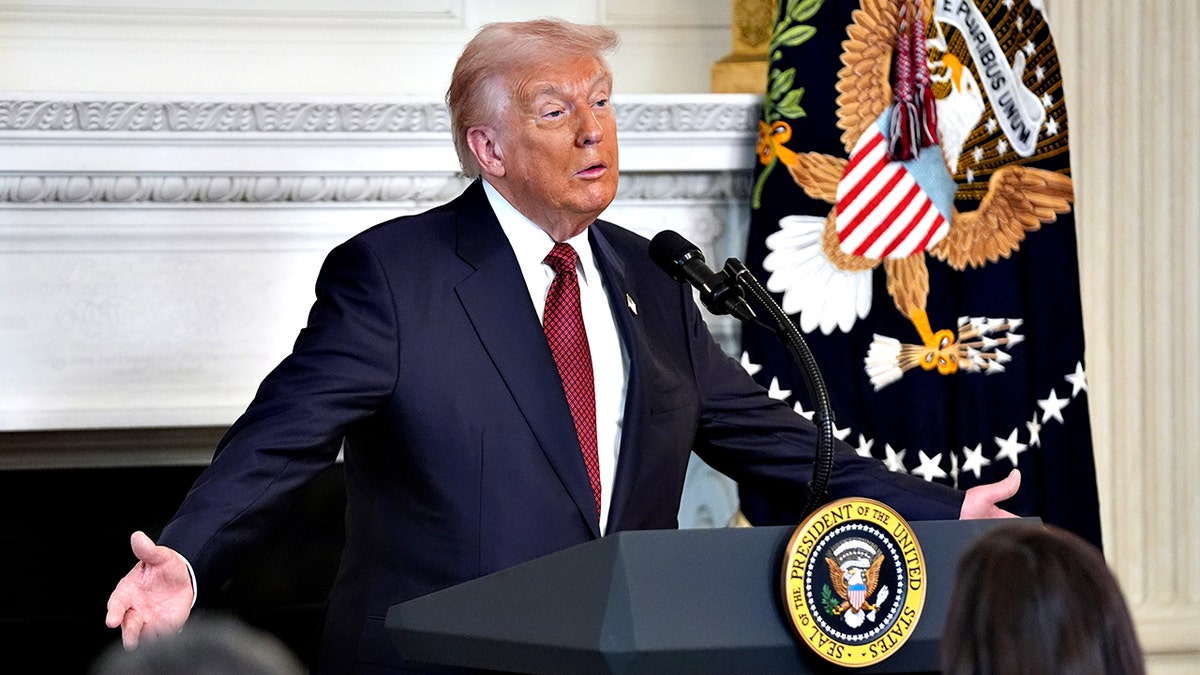
Trump strengthens US immigration after shooting in Washington
Fox News’ Danamarie McNicholl and law professor John Yoo join “Fox News Live” to break down the Trump administration’s tougher immigration guidelines after two National Guard members were shot and former President Joe Biden used the autopen.
NEWYou can now listen to Fox News articles!
President Donald Trump has promised to halt third-world immigration. Here’s how to resist the inevitable legal challenges.
First, the President should use his authority under 8 USC 1182(f), but with a twist. This law authorizes the president to suspend the entry of “all aliens or any class of aliens” whenever he determines that their entry would be “prejudicial to the interests of the United States.” The plain language is broad and encompasses economic and social interests, not just national security. Every president since Ronald Reagan has invoked it. The Supreme Court upheld this in 2018, noting that the law “exudes deference to the president.”
However, targeting specific countries brings unnecessary challenges: discrimination based on national origin, statistical justification requirements, detailed examination of how the target list was developed. Courts can make endless distinctions on a country-by-country basis.
Trump has secured the border again – but now the hard part begins
A universal pause avoids all of this and there is a compelling rationale.
It is “detrimental” to America’s interests to admit more immigrants when our mechanisms for screening welfare applications and asylum fraud are so failing. Maybe it wouldn’t be so bad if we could fix mistakes quickly, but now it takes forever to kick someone out.
Quote asylum. A DHS study found that 70 percent of asylum applications involve fraud or suspected fraud. It was so shocking that the Obama administration refused to release it until a whistleblower testified before Congress. Even the New York Times acknowledges that this is a problem. More than a million asylum applications were filed in 2023 alone, or around 700,000 fraudulent applications.
Then there is the public office disaster. Since 1882, immigration law has explicitly prohibited the admission of any person “likely at any time to become a public charge.” The logic is simple. It makes no sense to import welfare cases. Yet 54% of households headed by immigrants receive at least one form of public assistance. The reason is that bureaucrats subvert Congress’s intent by interpreting the ban as applying only if the alien is “primarily dependent” on the benefit and it is paid in cash, meaning that receipt of Medicaid, public housing, or food stamps does not count. Efforts to restore the original meaning are blocked in court by activists. Today, more than 11 percent of welfare benefits are claimed by immigrants who were admitted on the explicit premise that they would never qualify for welfare. This costs taxpayers $109 billion a year.
And that doesn’t even include outright fraud. Federal prosecutors in Minnesota recently charged members of the Somali community with massive fraud schemes totaling hundreds of millions of dollars in child nutrition programs, housing services and autism treatment. Police sources confirm that millions of stolen funds were sent back to Somalia, where some “probably ended up in the hands of Al-Shabaab”, a terrorist group.
When the enforcement mechanism cannot prevent welfare dependency despite explicit legal prohibitions and cannot detect fraud on an industrial scale, continued mass admission is clearly detrimental to the national interest.
The administration’s second line of defense consists of injunctive obligations. Federal law requires plaintiffs seeking pretrial injunctions to post bond. The bond must be in an amount “appropriate to pay the costs and damages suffered” by any wrongfully ordered defendant. Given the social spending involved, the appropriate obligations are expected to be in the tens of millions. Circuit courts have characterized adequate bonds as a “suspensive condition” to the issuance of an injunction and the lack of them a “reversible error.” The Department should insist on adequate bonds in all cases challenging these immigration restrictions and take steps to invalidate any no-bond injunctions.
CLICK HERE FOR MORE FOX NEWS REVIEWS
Third, while legal battles play out in the courts, a powerful defensive strategy should be implemented behind the scenes: Homeland Security Secretary Kristi Noem should rescind delegations of immigration approval authority. Congress personally entrusted the Secretary of Homeland Security with the authority to grant green cards, work authorizations and other benefits. 8 USC 1255 states that an alien’s status “may be changed by the [DHS Secretary]at her discretion” to the permanent resident. Even cases processed at consulates begin with DHS. In practice, the Secretary has delegated this authority to immigration officers scattered throughout USCIS field offices. If she revokes these delegations, applications for green cards and other select benefits would require her personal signature, slowing processing to a crawl. This is not a workaround; it is the Secretary exercising the exact authority that Congress gave her given.
CLICK HERE TO DOWNLOAD THE FOX NEWS APP
Smaller solutions have failed for decades. It is time to end the immigration debate with decisive action.
The president’s recent message calling for stricter immigration measures is a welcome development, but we’ve heard this kind of rhetoric before. The MAGA base has lost confidence in the presidential team’s ability to follow through on its statements. They must think creatively and act with a sense of urgency in order to turn the president’s truths into reality.


