How Trump secured a Gaza breakthrough which eluded Biden


Anthony ZürcherNorth America Correspondent And
Tom BatmanState Department Correspondent

 Getty Images
At the time, Israel’s airstrike against the Hamas negotiating team in Qatar appeared to be yet another escalation that pushed the prospect of peace even further away.
The September 9 attack violated the sovereignty of a US ally and risks expanding the conflict into a regional war.
Diplomacy seemed in ruins.
Instead, it proved to be a key moment that led to a deal, announced by President Donald Trump, to free all remaining hostages.
It’s a goal he and President Joe Biden before him have sought for nearly two years.
This is only the first step toward a more lasting peace, and the details of Hamas’ disarmament, Gaza’s governance, and Israel’s full withdrawal remain to be negotiated.
But if this agreement is fulfilled, it could be Trump’s signature achievement of his second term – one that has eluded Biden and his diplomatic team.
Trump’s unique style and crucial relationships with Israel and the Arab world appear to have contributed to this breakthrough.
But, as with most diplomatic achievements, there were factors at play that were beyond either man’s control.
A close relationship that Biden never had
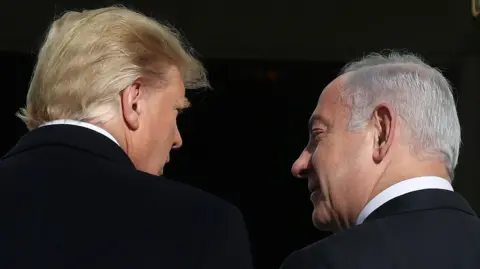
In public, Trump and Israeli Prime Minister Benjamin Netanyahu are all smiles.
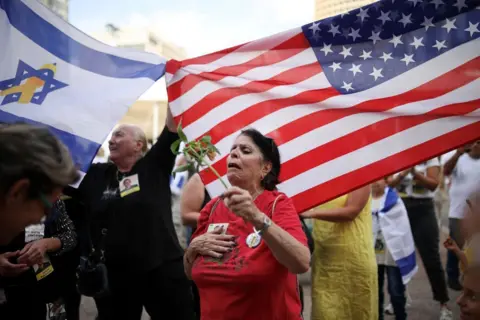
Trump likes to say that Israel has no best friend, and Netanyahu has described Trump as Israel’s “greatest ally in the White House.” And these warm words were accompanied by actions.
During his first presidential term, Trump moved the US embassy in Israel from Tel Aviv to Jerusalem and abandoned the long-standing US position that Israeli settlements in the Palestinian West Bank are illegal, a position consistent with international law.
When Israel began airstrikes against Iran in June, Trump ordered U.S. bombers to target the country’s nuclear enrichment facilities with their most powerful conventional bombs.
 Reuters
These public displays of support may have given Trump the opportunity to exert more pressure on Israel behind the scenes. According to reports, Trump negotiator Steve Witkoff intimidated Netanyahu in late 2024 into agreeing to a temporary ceasefire in exchange for the release of some hostages.
When Israel launched strikes against Syrian forces in July, including bombing a Christian church, Trump pressured Netanyahu to change course.
Trump has exerted a degree of will and pressure on an Israeli prime minister that is virtually unprecedented, says Aaron David Miller of the Carnegie Endowment for International Peace. “There is no example of an American president literally telling an Israeli prime minister that you are going to have to comply or else.”
Biden’s relationship with Netanyahu’s government has always been more tenuous.
His administration’s “bear hug” strategy called for the United States to support Israel publicly in order to allow it to moderate the conduct of the war in private.
Underlying all this was Biden’s nearly half-century of support for Israel, as well as sharp divisions within his Democratic coalition over the war in Gaza. Every move Biden took risked shattering his own domestic support, while Trump’s strong Republican base gave him more room to maneuver.
In the end, domestic politics or personal relationships may have mattered less than the simple fact that, under President Biden, Israel was not ready to make peace.
Eight months into Trump’s second term, with Iran chastised, Hezbollah to the immediate north greatly diminished, and Gaza in ruins, all of his major strategic objectives had been achieved.
Business history helped secure Gulf’s support
The Israeli missile attack in Doha, which killed a Qatari citizen but no Hamas officials, prompted Trump to issue an ultimatum to Netanyahu. The war had to end.
Trump had given Israel a relatively free hand in Gaza. He lent American military power to the Israeli campaign in Iran. But an attack on Qatari soil was an entirely different matter, bringing it closer to the Arab position on how best to end the war.
Several Trump officials told the BBC’s US partner CBS that it was a turning point that prompted the president to apply maximum pressure to reach a peace deal.
 Reuters
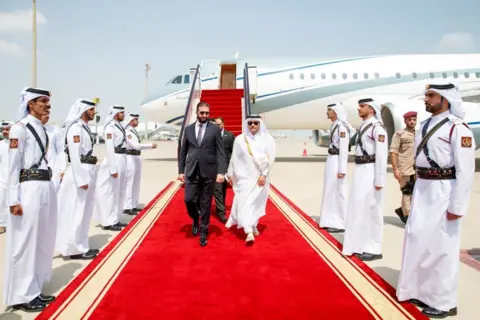
This American president’s close ties with the Gulf States are well known. It maintains commercial relations with Qatar and the United Arab Emirates. He began his two presidential terms with state visits to Saudi Arabia. This year he also stopped in Doha and Abu Dhabi.
His Abraham Accords, which normalized relations between Israel and several Muslim states, including the United Arab Emirates, were the greatest diplomatic achievement of his first term.
The time he spent in capitals across the Arabian Peninsula earlier this year helped change his thinking, says Ed Husain of the Council on Foreign Relations. The US president did not visit Israel on this Middle East trip, but visited the United Arab Emirates, Saudi Arabia and Qatar, where he heard repeated calls to end the war.
Less than a month after that Israeli strike on Doha, Trump sat nearby as Netanyahu personally telephoned Qatar to apologize. And later in the day, the Israeli leader endorsed Trump’s 20-point peace plan for Gaza — a plan that also had the support of the region’s major Muslim nations.
If Trump’s relationship with Netanyahu gave him the ability to pressure Israel into a deal, his history with Muslim leaders may have gained their support and helped them convince Hamas to commit to the deal.
“One of the things that has clearly happened is that President Trump has developed influence over the Israelis and indirectly over Hamas,” says Jon Alterman of the Center for Strategic and International Studies (CSIS).
“It made a difference. His ability to do that at the right time, and not succumb to the desires of the fighters, has been a problem that many previous presidents have struggled with, and he seems to be doing it relatively well.”
The fact that Trump is much more popular in Israel than Netanyahu himself is a lever he has used to his advantage, he adds.
Israel has now committed to freeing more than 1,000 Palestinians held in Israeli prisons and agreed to a partial withdrawal from Gaza.
Hamas will release all remaining hostages, living and dead, captured during the first Hamas attack on October 7, which resulted in the deaths of more than 1,200 Israelis.
The end of the war, which led to the devastation of Gaza and the deaths of more than 67,000 Palestinians, is now imaginable.
Europeans exert their influence
Global condemnation of Israel for its actions in Gaza also weighed on Trump’s thinking.
The conditions on the ground are unprecedented in terms of destruction and humanitarian catastrophe for Palestinians. In recent months, the Netanyahu government has become increasingly isolated on the international stage.
As Israel took military control of the Palestinian food supply and then announced a planned assault on Gaza City, several major European countries, led by French President Emmanuel Macron, decided they could not remain aligned with Washington’s stance of unequivocal support for Israel.
 Reuters
A historic rift has occurred between the Americans and their European allies over key elements of diplomacy and the future of the Israeli-Palestinian conflict.
The Trump administration lambasted France when it announced it would recognize a Palestinian state, a move followed by the United Kingdom. They were trying to keep the idea of a two-state solution on life support, but more fundamentally to marginalize the extremes on both sides and revive a diplomatic path toward a shared Israeli-Palestinian future.
But Macron was astute in getting the Saudis to buy into his peace plan.
Ultimately, Trump found himself pitted against a Euro-Arab alliance against Israeli nationalists and the far right when it came to visions for Gaza’s long-term future. He chose his friends from the Gulf.
As part of a French-Saudi peace plan, Arab countries also unprecedentedly condemned Hamas’s Oct. 7 attacks and called on the group to end its rule over Gaza and hand over its weapons to the Palestinian Authority as part of an independent state.
It was a diplomatic victory for the Arabs and Europeans. Trump’s 20-point plan borrows from the French-Saudi plan in key areas, including a reference to a possible Palestinian “state,” although this was vague and highly conditional.
Trump, while asking Turkey, Qatar and Egypt to keep up the pressure on Hamas, framed Netanyahu, putting unprecedented pressure on him to end the war.
No one could be on the side of saying no to Trump.
Trump’s unique style broke the deadlock
Trump’s unorthodox ways still have the power to shock. It begins with bluster or grandiloquence, but then develops into something more conventional.
During his first term, his “little rocket man” insults and “fire and fury” warnings seemed to bring the United States to the brink of war with North Korea. Instead, he engaged in direct talks.
Trump launched his second term with a striking suggestion that Palestinians should be forced to leave Gaza, as Gaza is transformed into an international resort.
Muslim leaders were furious. Senior Middle East diplomats were dismayed.
Trump’s 20-point peace plan, however, is not that different from the type of deal Biden reportedly made and that America’s allies have long supported. This was not a project for a Gaza Riviera.
Trump took a very unconventional route to achieve a conventional outcome. It was complicated. Maybe that’s not how they teach diplomacy at Ivy League universities. But, at least in this case and at present, it has proven effective.
Tomorrow, the Nobel Committee will announce the winner of this year’s Peace Prize. And while Trump is unlikely to be on the receiving end, the prospect doesn’t seem as unlikely as it did just a few weeks ago.
Additional reporting by Kayla Epstein