Hubble Sees Dusty Spiral Galaxy: NGC 7496


NGC 7496 is a barred spiral galaxy located approximately 24 million light years away in the constellation Grus.
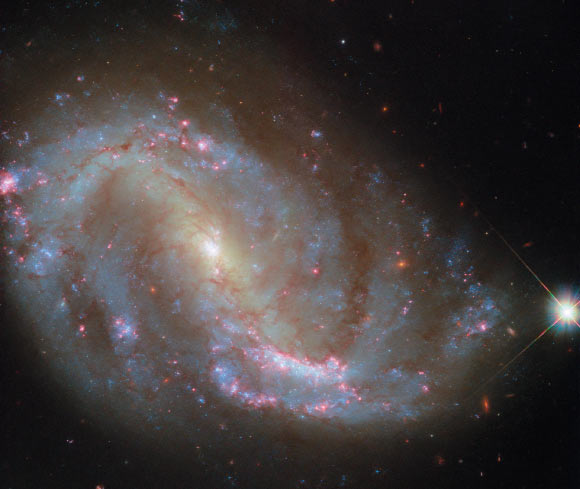
This Hubble image shows NGC 7496, a barred spiral galaxy located about 24 million light-years away in the constellation Grus. Image credit: NASA / ESA / Hubble / R. Chandar / J. Lee / PHANGS-HST team.
NGC 7496 was discovered on September 5, 1834 by the English astronomer John Herschel.
Otherwise known as ESO 291-1, LEDA 70588, and IRAS 23069-4341, this galaxy is approximately 70,000 light years across.
NGC 7496 is part of the NGC 7582 group, a grouping of nearly ten large galaxies.
The galaxy is also classified as a Seyfert type II galaxy with a high star formation rate.
At the center of NGC 7496 is an active galactic core, a supermassive black hole that feasts on gas.
“Hubble first observed NGC 7496 as part of the Physics at High Angular Resolution in Nearby Galaxies (PHANGS) program,” Hubble astronomers said in a statement.
“This program drew on the capabilities of several powerful astronomical observatories, including the Atacama Large Millimeter/Submillimeter Array, the ESO Very Large Telescope, and the NASA/ESA/CSA James Webb Space Telescope, in addition to the NASA/ESA Hubble Space Telescope.”
“NGC 7496 was the first PHANGS sample galaxy observed by Webb.”
“Each of these observatories offers a different perspective on this well-studied galaxy.”
“Thanks to its unique ultraviolet capabilities and fine resolution, Hubble’s view reveals young star clusters brimming with high-energy radiation.”
“Hubble’s observations of NGC 7496 help reveal the age and mass of these young stars, as well as the extent to which their starlight is blocked by dust.”
“A previous Hubble image of NGC 7496 was released in 2022,” they added.
“Today’s image incorporates new data that highlights the galaxy’s star clusters, which are surrounded by bright red clouds of hydrogen gas.”


