Unusual Bonebed in Arizona Reveals North America’s Earliest-Known Pterosaur


Paleontologists have found the fossilized jaw of a new species of pterosaur with hundreds of other fossils – including one of the oldest turtles in the world – in a distant daring bos in the national forest park petrified in Arizona, in the United States.
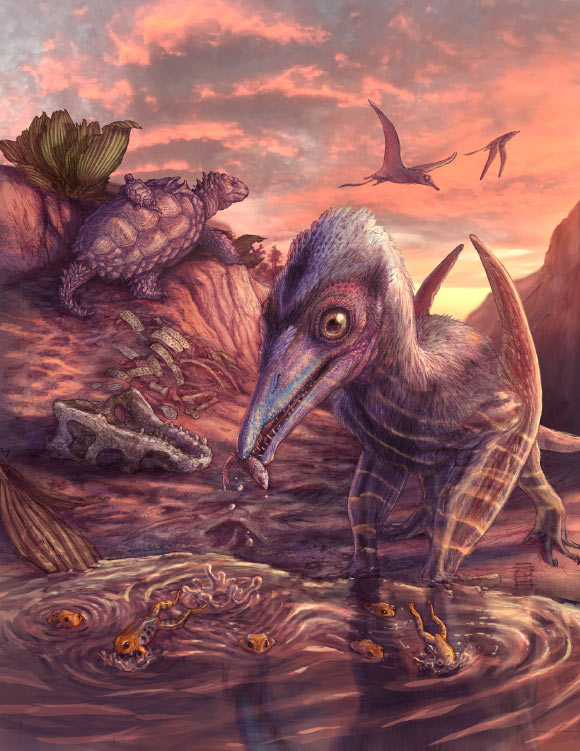
The reconstruction of an artist of Eotephradactylus mcintiaeOther animals and plants found preserved in a bone bed distant in the national park of the petrified forest in Arizona, in the United States. Image credit: Brian Engh.
Newly identified species of pterosaurs, Eotephradactylus mcintiaelived in what is now Arizona at the end of the time of the Triassic, about 209 million years ago.
“The winged reptile would have been small enough to perch comfortably on a person’s shoulder,” said Dr. Ben Kligman of the National Museum of Natural History of the Smithsonian Institution and his colleagues.
“What was exciting to discover this specimen is that the teeth were always in the bone, so I knew that the animal would be much easier to identify,” added Suzanne Mcintire, a preparer who volunteered in the Fossilab of the National Museum of Natural History for 18 years.
“The jaw sewn with teeth revealed crucial clues to the way the first pterosaurs lived.”
“Because the tips of the teeth were worn out, we concluded that the pterosaurus was likely to feed on the fish of the site, many of which were locked up at scales in the shape of armor.”
Eotephradactylus mcintiae Co-existing with giant amphibians, parents of armored crocodiles, frogs and turtles.
In addition to the flying reptile, paleontologists have discovered more than 1,200 individual fossils, including bones, teeth, fish scales and coprolites.
“This assembly contains 16 different groups of vertebrate animals that once lived in a various ecosystem,” they said.
“The braided rivers of the region were filled with fish, such as freshwater sharks and coelacanths, as well as old amphibians, some of which increased up to 1.8 m (6 feet) long.”
“The surrounding environment housed formidable reptiles which evolved earlier in the Triassic, including armored herbivores and tooth predators that looked like giant crocodiles.”
The newly discovered bone bed is part of the training of the upper Chinle in the Petrified Forest National Park.
“This part of the northeast of Arizona was positioned in the middle of the Supercontinent pangea and sat down just above the equator 209 million years ago,” the researchers said.
“The semi-arid environment of the region was crisscrossed by small river channels and probably subject to seasonal floods. These floods have washed sediment and volcanic ash in the canals. ”
“One of these floods has probably buried the creatures kept in the bone bed. The site is so rich in small fossils that all for them are impossible.”
According to the team, the new site helps to fill a gap in the fossil file which prior to the extinction of the final trias (summer).
“About 201.5 million years ago, volcanic eruptions associated with the breakdown of the Supercontinent Pangea have considerably changed world climates and annihilated about 75% of species on earth,” said scientists.
“This has paved the way for new groups, such as dinosaurs, to diversify and dominate ecosystems in the world.”
“The direct evidence of this transition to earth are difficult to find due to a lack of terrestrial fossil outcrops just before summer.”
“The site captures the transition to communities of more modern terrestrial vertebrates where we are starting to see groups which later prosper in the mesozoic living alongside these older animals which do not exceed the Triassic.”
“Fossil beds like this allow us to establish that all these animals lived together.”
The team’s article was published in the Proceedings of the National Academy of Sciences.
_____
Ben T. Kligman and al. 2025. The unusual bone bed reveals a community of vertebrates with pterosaurs and turtles in the equatorial pange before the extinction of the final triasic. PNA 122 (29): E2505513122; Doi: 10.1073 / PNAS. 255513122


