
By comparing new Hubble observations with images first taken in 1999, astronomers traced the continuing expansion of one of the sky’s most studied supernova remnants, energized by a rapidly spinning pulsar at its core.
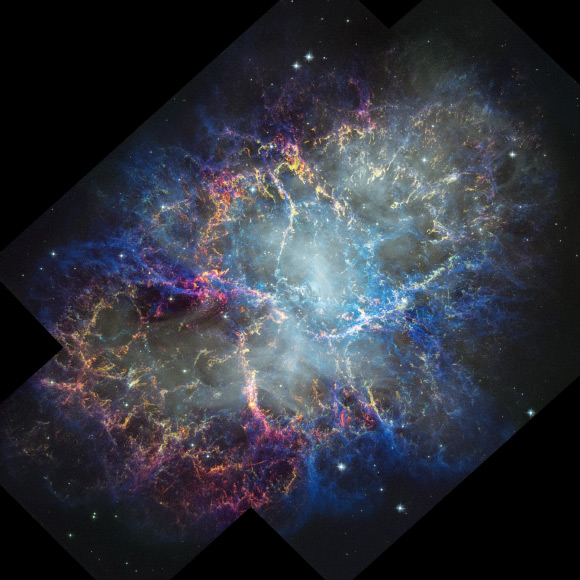
This image, captured with the NASA/ESA Hubble Space Telescope in 2024, shows the Crab Nebula. Image credit: NASA / ESA / STScI / William Blair, JHU / Joseph DePasquale, STScI.
In 1054, Chinese astronomers were startled by the appearance of a new star, so bright that it was the brightest object in the night sky, second only to the Moon, and was visible in broad daylight for 23 days. The supernova was also recorded by Japanese, Arabic, and Native American stargazers.
Today, the Crab Nebula, also known as Messier 1, M1, NGC 1952 or Taurus A, is visible at the site of that bright star.
The nebula, bright enough to be visible in amateur telescopes, lies approximately 6,500 light-years away in the constellation of Taurus.
The object was first identified in 1731 by the English doctor, electrical researcher and astronomer John Bevis and was rediscovered in 1758 by the French astronomer Charles Messier.
The Crab Nebula derived its name from its appearance in a drawing made by Irish astronomer Lord Rosse in 1844.
In its very center lies what remains of the innermost core of the original star: the Crab Pulsar, also known as PSR B0531+21.
“We tend to think of the sky as being unchanging, immutable,” said Dr. William Blair, an astronomer at Johns Hopkins University.
“However, with the longevity of the NASA/ESA Hubble Space Telescope, even an object like the Crab Nebula is revealed to be in motion, still expanding from the explosion nearly a millennium ago.”
In the new image, Hubble captured the nebula’s intricate filamentary structure, as well as the considerable outward movement of those filaments over 25 years, at a pace of 5.6 million km per hour (3.4 million miles per hour).
“Hubble is the only telescope with the combination of longevity and resolution capable of capturing these detailed changes,” the astronomers said.
“For better comparison with the new image, Hubble’s 1999 image of the Crab Nebula was re-processed.”
“The variation of colors in both of the Hubble images shows a combination of changes in local temperature and density of the gas as well as its chemical composition.”
“Even though I’ve worked with Hubble quite a bit, I was still struck by the amount of detailed structure we can see and the increased resolution with Hubble’s Wide Field Camera 3 (WFC3), as compared to 25 years ago,” Dr. Blair said.
“WFC3 was installed in 2009, the last time Hubble instruments were updated by astronauts.”
“Filaments around the periphery of the nebula appear to have moved more compared to those in the center, and that rather than stretching out over time, they appear to have simply moved outward.”
“This is due to the nature of the Crab as a pulsar wind nebula powered by synchrotron radiation, which is created by the interaction between the pulsar’s magnetic field and the nebula’s material.”
“In other well-known supernova remnants, the expansion is instead driven by shockwaves from the initial explosion, eroding surrounding shells of gas that the dying star previously cast off.”
“The new, higher-resolution Hubble observations are also providing additional insights into the 3D structure of the Crab Nebula, which can be difficult to determine from a 2D image.”
“Shadows of some of the filaments can be seen cast onto the haze of synchrotron radiation in the nebula’s interior.”
“Counterintuitively, some of the brighter filaments in the latest Hubble images show no shadows, indicating they must be located on the far side of the nebula.”
“The real value of Hubble’s Crab Nebula observations is still to come.”
“The Hubble data can be paired with recent data from other telescopes that are observing the Crab in different wavelengths of light.”
“The NASA/ESA/CSA James Webb Space Telescope released its infrared-light observations of the Crab Nebula in 2024.”
“Comparison of the Hubble image with other contemporary multiwavelength observations will help scientists put together a more complete picture of the supernova’s continuing aftermath, centuries after astronomers first wondered at a new little star twinkling in the sky.”
The findings were published in January 2026 in the Astrophysical Journal.
_____
William P. Blair et al. 2026. The Crab Nebula Revisited Using HST/WFC3. ApJ 997, 81; doi: 10.3847/1538-4357/ae2adc


