Hubble Space Telescope Spies Beautiful Lenticular Galaxy: NGC 7722


Astronomers using the NASA/ESA Hubble Space Telescope have captured a new photo of the lenticular galaxy NGC 7722.
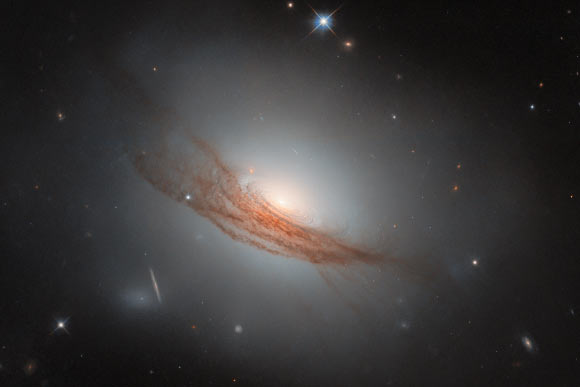
This Hubble image shows NGC 7722, a lenticular galaxy located about 187 million light years away in the constellation Pegasus. Image credit: NASA / ESA / Hubble / RJ Foley, UC Santa Cruz / Dark Energy Survey / DOE / FNAL / DECam / CTIO / NOIRLab / NSF / AURA / Mehmet Yüksek.
NGC 7722 is approximately 187 million light years from Earth, in the constellation Pegasus.
Also known as IRAS 23361+1540, LEDA 71993 and UGC 12718, this lenticular galaxy was first discovered by German astronomer Heinrich Louis d’Arrest on August 12, 1864.
NGC 7722 is part of the NGC 7711 group, a grouping of seven large galaxies.
“A lenticular (lens-shaped) galaxy is a type that lies between the more familiar spiral galaxies and elliptical galaxies,” Hubble astronomers said in a statement.
“It’s also less common than these, in part because when a galaxy has an ambiguous appearance, it can be difficult to determine whether it’s actually a spiral galaxy, an elliptical galaxy, or something in between.”
“Many known lenticular galaxies exhibit characteristics of spiral and elliptical galaxies. »
“In this case, NGC 7722 lacks the defined arms of a spiral galaxy, while it does have an extended, bright halo and a bright bulge at the center similar to an elliptical galaxy,” they explained.
“Unlike elliptical galaxies, it has a visible disk: concentric rings swirl around its bright core.”
“However, its most prominent feature is undoubtedly the long bands of dark red dust that wrap around the outer disk and halo.”
The new image of NGC 7722 taken by Hubble’s Wide Field Camera 3 (WFC3) instrument highlights the galaxy’s impressive dust lanes.
“Dust lanes like this are not uncommon in lenticular galaxies, and they stand out from the broad, smooth halo of light that typically surrounds lenticular galaxies,” the astronomers said.
“NGC 7722’s distinctive dust bands are thought to result from a merger with another galaxy in the past, similar to other lenticular galaxies.”
“It is not yet completely understood how lenticular galaxies form, but mergers and other gravitational interactions are thought to play an important role, reshaping galaxies and depleting their gas reserves while bringing in new dust.”


