Human rights breaches precede mass atrocities


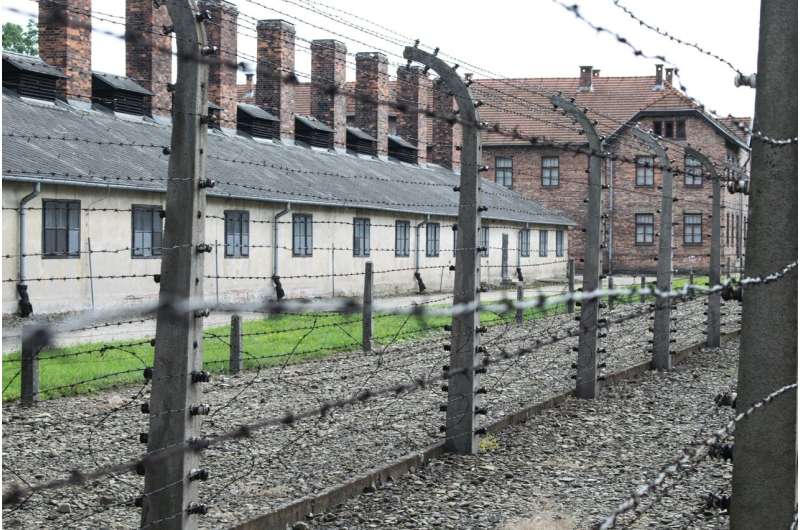
Credit: Pixabay/CC0 Public domain
The path to genocide does not begin with bullets and mass graves, but with more subtle violations.
The decline of workers’ rights or compromises on fair trial rights may come first. The brutality of law enforcement and prison guards has become widespread. The judiciary loses its independence from the executive power.
Then more serious signs follow: freedom of speech is restricted for a specific group of people, and then their right to assemble in public places. Members of this group could find themselves increasingly imprisoned for their beliefs and lose the ability to vote or run for office. Every violation should flash red, demanding we pay attention.
“There has never been a genocide without multiple other human rights violations occurring,” observed David Cingranelli, a professor of political science at Binghamton University, co-director of the university’s Human Rights Institute, and co-founder of the CIRIGHTS data project, a collaboration between Binghamton and the University of Rhode Island (URI). “The Holocaust is a famous example.”
In a recent article from Journal of Comparative Policy AnalysisURI Associate Professor of Political Science Skip Mark, Ph.D. ’18, and Cingranelli argue that human rights violations are escalating in predictable patterns, which can potentially result in atrocities.
In “The Sequential Theory of Human Rights Atrocities: A Comparative Analysis,” researchers use data from the U.S. State Department’s annual human rights reports. Few people have read these detailed State Department reports except members of Congress, Cingranelli said.
“I always ask my students to read reports from countries that we are friendly with, but which are known to have poor human rights records, to see if we are being honest about it,” he added. “I think the reporting is consistent.”
Their data shows that state atrocities have occurred in more than 30 countries every year for the past seven years; There have been 47 atrocities alone in 2022, the highest number ever recorded.
State violence inevitably targets specific groups; Human rights are primarily focused on the rights of minorities, Cingranelli explained. In the United States, these are almost exclusively racial minorities; in India, on the other hand, it is the Muslim religious minority.
A mass atrocity is at play when extrajudicial killings are widespread and accompanied by other human rights violations. Genocide, on the other hand, requires a government’s intention to exterminate a group in whole or in part, in accordance with international law. Setting that intention can be difficult, Cingranelli said. Ultimately, the United Nations decides whether a mass atrocity can be considered genocide and that too is a political process.
“Our research doesn’t look at politics. We just read what the report says about how many people the government killed without due process in a given year,” Cingranelli explained. “If they were citizens of your country, this constitutes an extrajudicial execution of your own people.”
The sequence
The raw information in the State Department report is provided by U.S. embassies around the world. Embassies of any size typically have — or had, anyway — at least one designated human rights official who collects this data, which is then sent to the State Department in Washington, DC.
“Multiply that by 194 countries in the world, that’s a ton of money and a ton of effort,” Cingranelli said. “When I visited human rights officials in these countries, they took me to the prisons to talk with the wardens about their policies and that sort of thing.”
The first report was published in 1974, but did not provide reliable data until 1981, during the Carter administration. Cingranelli has used these reports to rank countries’ human rights performances since the early 1980s. Political science professor Mikhail Filippov, one of the co-directors of CIRIGHTS, also plays an important role in collecting data that he uses in his own research.
Using this data, researchers developed a brutality-based atrocity indicator to predict the possibility of genocide, triggered by an escalation of human rights violations. The right to a fair trial is one of the first to be compromised, followed by torture, defined as the intentional suffering inflicted by state agents on targeted individuals.
Next comes the loss of collective bargaining, an independent judiciary and the right to organize, followed by restrictions on freedom of expression and freedom of association. Then come political imprisonment, loss of electoral self-determination and finally extrajudicial executions, a hallmark of mass atrocities.
Surprisingly, restrictions on freedom of movement are not among the warning signs; this type of ban generally comes into force when extrajudicial killings become widespread. Nor is the loss of women’s social and economic rights, which may be due to cultural factors surrounding the role of women in traditional societies.
“I see things in this sequence that don’t make sense to me. We’re going to re-examine it to see how we could refine it to include more rights in the sequence and take more into account how women are treated in society,” Cingranelli said. “It’s a work in progress.”
How long is the sequence? Cingranelli and Mark are currently researching the answer to this question. In Myanmar, for example, escalating human rights violations lasted more than a decade before culminating in genocide against the Rohingya ethnic minority. The researchers’ brutality-based indicator is believed to have been triggered at least two years before six of the seven genocides that occurred after 1990, with the conflict in Serbia and Montenegro being the only exception.
The future
Currently, researchers are in the process of scoring countries for 2023. This is where the project will end in its current form; the State Department report released in 2025, which looks back at the previous year, is not comparable to previous human rights reports and does not appear accurate, Cingranelli said.
“It’s not that our idea stops, but using these reports to rate countries probably won’t go beyond 2023,” he said. “Until Trump, there were consistent reports from the U.S. State Department and very professional people writing those reports. The process was not politicized and America’s friends were not treated kindly.”
However, they have 40 years of reports to draw on, which is more than enough to generate a sequence. Amnesty International also provides actionable data.
As an academic, Cingranelli admits he has no particular understanding of the reasons behind the increase in atrocities.
“I think something serious is happening in the world,” he admitted. “People are ready for a more violent government. That’s not just happening in the United States; it’s also happening in Western Europe, in many countries that we once considered very respectful of human rights.”
Fear of immigrants is probably part of the equation; European countries, for example, militarize their borders in a manner similar to that of the United States. Increased political polarization and the willingness to use violence to pursue majority-approved goals are also factors.
Individual freedom and social order exist in tension, but it is a necessary tension; Individual freedoms require a certain social order to exist. The system becomes unbalanced when the majority becomes increasingly willing to trample the rights of minorities to achieve their goals, preferring to maintain social order rather than maximizing individual freedom.
“When people think that the level of social order in their society has passed a certain threshold, they are willing to allow the government to do all kinds of horrible things,” Cingranelli observed.
Mark and Cingranelli will work on a book about the project, with Cornell University postdoctoral fellow Deanne Roark.
“We’re going to put all of this together in a way that it’s useful to those who are trying to stop the atrocities,” Cingranelli said. “If you are an activist in a country and you see human rights violations of a particular type, it warns you that the next step could very well be large-scale massacres.”
More information:
Skip Mark et al, The Sequential Theory of Human Rights Atrocities: A Comparative Analysis, Journal of Comparative Policy Analysis: Research and Practice (2025). DOI: 10.1080/13876988.2025.2551039
Provided by Binghamton University
Quote: Human rights violations precede mass atrocities (November 3, 2025) retrieved November 3, 2025 from https://phys.org/news/2025-11-human-rights-breaches-mass-atrocities.html
This document is subject to copyright. Except for fair use for private study or research purposes, no part may be reproduced without written permission. The content is provided for informational purposes only.